5/28/2026

The Decline of FM Radio Stations vs Online Stations


In the ever-evolving landscape of audio entertainment, the decline of traditional FM radio stations signals a significant shift in how listeners consume music.

The rise of online stations has not only transformed accessibility but has also redefined the listening experience.

Among these online platforms is DMT-FM, a stirring force in the psytrance genre, offering 24/7 access to an electrifying selection of tracks.

This article delves into the reasons behind the dwindling numbers of FM radio stations and examines the burgeoning popularity of online alternatives, illustrating a fascinating transition in audio culture.

The Golden Days of FM Radio

For decades, FM radio was the heart of music discovery and entertainment. With its rich sound quality and broad accessibility, it became a staple in households and cars alike.

Stations catered to local audiences with tailored content, featuring everything from news to local events, while also playing an integral role in breaking new artists and tracks.

DJs developed personalities that resonated with listeners, creating a sense of community centered around shared musical tastes.

However, as technology advanced and listener habits changed, the dominance of FM radio began to wane.

The emergence of the internet marked the first fissures in the once-unassailable fortress of traditional broadcasting.

As listeners increasingly sought content aligned with their specific interests, the limitations of FM radio—most notably, its fixed programming and geographic constraints—became apparent.

The Rise of Online Stations

The advent of online stations has dramatically disrupted the audio landscape.

Platforms like DMT-FM have led the charge in showcasing niche genres, including the vibrant psytrance community.

Unlike traditional FM stations, online broadcasters are not limited by geographic boundaries or rigid programming schedules.

They can cater to global audiences, offering curated playlists that celebrate underground and emerging artists alongside established names.

One of the critical advantages of online stations is their ability to provide a continuous stream of music tailored to specific interests.

DMT-FM’s 24/7 psytrance radio stream exemplifies this flexibility, allowing listeners to dive deep into a world of pulsating beats and transcendent melodies at any hour.

This kind of on-demand accessibility has become a hallmark of contemporary music consumption, appealing especially to a younger demographic that values immediacy and personalization.

Why FM Radio is Losing Ground

Several factors contribute to the decline of FM radio stations.

First and foremost is competition from online platforms.

With the proliferation of streaming services like Spotify, Apple Music, and dedicated online radio stations like DMT-FM, listeners have a plethora of choices that allow them to curate their listening experiences.

The convenience of accessing vast libraries of music from smartphones and computers means fewer people turn to FM stations for their audio entertainment.

Moreover, FM radio’s advertising model has become less appealing.

Advertisers are increasingly targeting online platforms with more precise analytics, enabling them to reach their desired audience more effectively.

This shift has led to reduced funding for traditional radio stations, forcing many to cut costs, sometimes at the expense of programming quality.

As the variety of shows and music dwindles, so too does listener engagement.

Another factor is the generational divide; younger audiences often gravitate toward digital platforms that align with their fluid lifestyles.

This demographic is more inclined to discover music through social media and streaming services rather than traditional FM broadcasts.

For many, FM radio feels outdated, lacking the immediacy and interactivity that online platforms provide.

The Future of Audio Entertainment: A Hybrid Model

While FM radio may be in decline, it’s essential to recognize that it still holds a place in the broader audio entertainment landscape.

Many listeners appreciate the nostalgia and familiarity of traditional radio, particularly for local news or community events.

However, the future appears to lean towards a hybrid model where both FM and online stations coexist.

Online stations like DMT-FM offer an exciting glimpse into this future.

By incorporating interactive elements such as live chats, social media integration, and listener-requested playlists, they create a dynamic community-oriented experience that FM radio struggles to replicate.

Psytrance fans, for instance, can connect with like-minded individuals around the world, sharing their passion for a genre often overlooked by mainstream platforms.

Ultimately, the decline of FM radio does not signify the end of radio itself but rather an evolution.

As technology progresses and listener preferences continue to shift, the audio landscape will likely continue to diversify.

Online stations will thrive in this new environment, driven by their personalized approach and ability to cater to niche audiences.

Conclusion: Embracing Change in the Audio Landscape

As we navigate this transition, it’s clear that both FM radio and online stations have unique strengths and weaknesses.

While FM boasts the charm of local presence and established credibility, online stations like DMT-FM represent the future of music consumption, characterized by diversity, accessibility, and community engagement.

Listeners today are fortunate to have access to an unprecedented range of audio options.

The decline of FM radio may evoke nostalgia, but it also heralds an exciting era for music lovers, where genres like psytrance flourish on platforms that celebrate every beat and every note.

Whether you tune in to FM or stream your favorite tracks online, there’s no denying that music continues to evolve, bringing people together in new and vibrant ways.

Embrace the change, explore the sounds, and immerse yourself in the rhythm of today’s audio landscape.

The Decline of FM Radio Stations vs. Online Stations

In a rapidly evolving media landscape, the way we consume audio content has transformed significantly over the past few decades.

Once the cornerstone of radio broadcasting, FM stations are witnessing a steep decline in listenership, propelled by technological advancements and shifting consumer habits.

Conversely, online stations are surging in popularity, offering unparalleled variety and convenience.

In this article, we will explore the reasons behind the decline of FM radio stations and the rise of their online counterparts, ultimately shedding light on the future of audio broadcasting.

The Changing Landscape of Audio Consumption

To understand the current state of FM radio versus online broadcasting, it’s essential to grasp how audio consumption has changed dramatically.

In the age of smartphones and high-speed internet, listeners have access to a vast array of options at their fingertips. Gone are the days when people relied solely on FM radio, which offers a limited selection of channels and programming.

Nowadays, platforms like Spotify, Apple Music, and countless niche streaming services allow users to curate their listening experience based on personal preferences.

Moreover, the rise of podcasts has shifted attention away from traditional FM stations.

Podcasts provide listeners with specialized content that can be consumed on demand, catering to diverse interests and lifestyles.

This shift has led to a scenario where audiences prioritize convenience and personalization, often at the expense of traditional radio formats.

Reasons Behind the Decline of FM Radio Stations

Several factors contribute to the decline of FM radio stations. First and foremost, the impact of technology cannot be overstated.

Smartphones and smart speakers have revolutionized how we interact with audio content.

With voice commands and seamless integration with various apps, listeners find it much easier to access their preferred music or shows rather than tuning into an FM station.

Additionally, FM radio faces fierce competition from online platforms that offer a more engaging user experience.

Streaming services often provide curated playlists, personalized recommendations, and the ability to skip songs—all features that FM radio simply cannot match.

The interactivity afforded by these platforms allows users to feel more in control of their listening experience, leading to a significant decline in FM radio listenership.

Another crucial aspect is the presence of targeted advertising. Online stations and streaming services leverage data analytics to serve personalized ads to listeners, creating a more relevant advertising experience.

In contrast, FM stations often rely on generic commercials that may not resonate with their audience, leading to listener disengagement.

The Rise of Online Stations: Opportunities and Innovations

While FM radio experiences a downturn, online stations are flourishing.

They offer numerous advantages that resonate with today’s audiences.

One of the most significant benefits is the diversity of content available.

Online stations can explore niche genres, catering to specific demographics and interests that might be underserved by traditional radio.

For instance, listeners can now discover indie music, global sounds, or even specialized talk shows focused on obscure topics—options that FM stations rarely provide.

This not only enriches the listening experience but also creates communities around shared interests.

Moreover, online stations thrive on innovation.

Many incorporate interactive elements—such as live chats, social media integrations, and audience participation—which engage listeners far beyond what traditional FM formats can achieve.

This creates a sense of belonging for listeners, making them more likely to tune in regularly.

In addition, many online stations broadcast live shows featuring guest interviews, listener call-ins, and real-time interactions, further enhancing the listening experience.

The Future of Audio Broadcasting: A Hybrid Approach?

As we look to the future, the audio broadcasting landscape is poised for continued evolution.

While FM radio stations are unlikely to disappear entirely, their role will likely diminish as online stations gain prominence.

However, there’s potential for a hybrid approach that combines the strengths of both mediums.

For instance, some FM stations are beginning to embrace online streaming, launching their own apps and podcasts to reach broader audiences.

This integrative strategy could allow them to retain loyal listeners while attracting new ones who prefer digital formats. Additionally, leveraging social media and digital marketing strategies can rejuvenate FM brands and create innovative collaborations with online platforms.

In summary, while the decline of FM radio stations is undeniable, the growth of online stations presents exciting opportunities.

As technology continues to advance, it reshapes our consumption patterns and expectations.

The future may not be about the outright replacement of FM radio but rather a symbiotic relationship between traditional and digital platforms, catering to diverse audiences and evolving listening habits.

Conclusion

The decline of FM radio stations, juxtaposed with the rise of online stations, reflects broader trends in media consumption and technology. As audiences flock to platforms that offer convenience, personalization, and diverse content, traditional radio must adapt to survive.

By embracing innovation and exploring hybrid solutions, FM radio can carve out a niche in this dynamic landscape, ensuring that audio content remains accessible and engaging for all.

Whether one prefers the nostalgia of FM radio or the convenience of online stations, the evolution of audio broadcasting continues to be a fascinating journey worth following.

Share On Social Media
Source: https://dmt-fm.com/the-decline-of-fm-radio-stations-vs-online-stations/


Digital killed the radio stars? The long decline of FM radio


I just read how Norway has become the first country in Europe to turn off FM radio.

For most people, this news will confirm the rise of ‘narrowcasting’ and digital audio, which made me question: is this the death of FM, or for that matter the death of radio?

I’m first to admit that I’m a believer in digital radio. Having moved into an apartment block two years ago, I couldn’t get a noise-free AM radio signal because of the huge amount of structural steel in the building and, I suspect, changes in the underlying interference models in modern construction.

AM radio is pretty much Marconi’s law with more volts: it’s all about ‘amplitude’ or how strong the signal is. The frequency is the meaningful bit, much as sound pitch is about the frequency of the wave (they just translate the wave from sound waves into radio waves). So, if you have a huge source of noise (think of all of those devices you have plugged in, including the fridge and air conditioner) and a lot of steel radiating that noise (think concrete reinforcement) it’s not going to work out well.

My plans for a symbolic TV hanger were voted down by my partner pretty quickly.

Although AM radio reception has been a hassle in my new place, the same can not be said about our digital TV signal – we live within eye-sight of the television transmission masts for Brisbane. The beauty of digital TV is that we don’t need to plug our TV into an antenna — I did consider hanging a symbolic coat hanger antenna above the TV for laughs.

Anyway back to my radio situation. After a quick Google to figure out a cost-effective solution, I headed off to the electronics store and bought a DAB+ radio decoder. This plugs into my hi-fi and picks up the digital radio signal which is coming from the TV distribution masts. Problem solved. Except… not quite.

First, some signals now broadcast directly from Sydney—almost 1,000 kilometres away—because the digital stream is sent over the Internet (I bet you wondered when this would become an Internet story). Because only certain states and territories in Australia recognise daylight saving time, this means there are five time zones. In our situation, this means I get the 8am news at 7am local time.

Secondly, digital breaks down badly. That’s to say, it doesn’t break down at all, and then falls off a cliff. AM radio, analogue radio even on FM, tends to degrade more gracefully because the encoding is not complex, and your loss is either marginal elements of the frequency spectrum or brief. In digital, when you lose packets, you suddenly enter the room of error correcting codes: what delay is the signal sent on? How much forward error correcting is encoded? How much loss is tolerated before you lose the channel? How long before it re-establishes signal and decodes? The answer is… a lot more audible than you’d like. Oh well, now my life consists of fiddling with the antenna.

But… hold on a minute. When TV went digital, we didn’t just stop using the old FM and VHF radio frequencies that the old analogue TV was sent on. Those frequencies are incredibly valuable because they reach inside concrete and steel buildings. So, these frequencies have been re-purposed, to feed digital signals into our lives — not just digital radio but the Internet too. Sometimes it’s slower than the higher frequency cellular 4G and 5G signals, but it is a really useful, economically important radio spectrum that we can re-use more densely because of what digital encoding lets us do.

So, here’s my New Year’s thought for you all: if FM radio is dying, and we’ve got frequencies coming up for re-use which reach deep inside our homes, as well as investment in transmission technologies on hills and building tops to distribute it, then what do we want to do with all that bandwidth?

The views expressed by the authors of this blog are their own and do not necessarily reflect the views of APNIC. Please note a Code of Conduct applies to this blog. 

Source: https://blog.apnic.net/2017/12/20/digital-killed-radio-stars-long-decline-fm-radio/


What will happen to AM and FM broadcasts in the future? It's a tech question that needs to be answered.

AM radio has been around since the beginning of broadcasting. FM was invented in the 1930s and surpassed AM as the band of choice in the 1980s. Both bands have had an excellent run. But how much longer will we be using them?

I am NOT talking about the death of terrestrial radio. It will survive just fine. But the distribution channels will change.

Here in North America, we have AM, FM, satellite radio, streaming, and HD-Radio. Let’s go through them.

AM faces the biggest challenge, not only because of its inferior audio quality but because signals cannot penetrate the electromagnetic fields generated by electric vehicles. If you can’t be heard in the car, you’re dead. A new survey says that 73% of people listen to radio in the car. Some AM stations are moving to FM, but government regulations and dearth of open spots on the dial are big roadblocks.

FM continues to do well despite pressure from other audio options like smartphones and streaming. Its biggest disadvantage is that it’s not interactive, something that younger generations demand.

Satellite radio serves a listening niche, although there’s just one provider in North America. While it offers a huge variety of programming, it’s not free. That’s a big barrier to a lot of people.

Online audio streaming of radio continues to grow. That same survey says that 70% of Americans stream AM/FM radio and audio content weekly.

HD Radio (the brand name of In-Band On-Channel or iBOC) is based on tech developed in the 1990s. It has never taken off in a big way even though many, many markets have stations that broadcast in HD Radio. And if your car is less than seven years old, chances are it can receive HD Radio broadcasts, although most infotainment systems don’t make it easy.

Nothing stands still, how will radio be distributed in the future?

Things are evolving in other parts of the world. Norway, Switzerland, and a few other countries are in the process of shutting down the legacy bands (i.e. AM and FM) in favour of digital radio (DAB). That’s never going to happen here.

We in North America had a chance to get on board with DAB more than 20 years ago, but the US kiboshed the whole thing for a couple of reasons. First, the broadcast frequencies required by DAB were apparently too close to those used by the US military. Second, the US is just too big and no one wanted to spend the necessary money to build transmitters and repeaters. HD Radio was seen as a compromise, but no one seems to care.

And third, Canada actually adopted DAB more than two decades ago but ran into technical issues. At the time, though, VHF frequencies were being used for over-the-air analogue TV (not a problem anymore). The other issue was that because DAB used microwave frequencies around 1200 MHz, lots and lots of transmitters would be required to have extensive and smooth signals. Like the US, we’re just too big (although Australia and Russia seem to be interested in solving this problem.)

Okay, so where do we go from here? There are big predictions about the connectivity possible with 5G and 6G networks. That, however, requires a LOT of technical infrastructure upgrades. It’ll also take a long time for the majority of the population to transition from whatever type of network they’re using now. This will also require changes to infotainment systems in cars, something that won’t happen quickly.

Broadcasters will have to figure out how to adapt, too, but are very, very wary of moving too quickly in this direction. We in radio remember the early 2000s when we went all-in with online offerings. But by the time we were able to roll out the new platforms, the tech had moved on and we were stuck with an outdated and buggy online presence. Radio now tends to use off-the-shelf products (e.g. building websites on WordPress platforms instead of creating something from scratch). At this point, there are no off-the-shelf solutions for 5G and 6G connectivity.

We will move on eventually. But what will happen to that spectrum now occupied by AM and FM? Will they be repurposed? Unknown.

Old-school VHF radios once used by taxis and other fleet vehicles have pretty much disappeared in favour of apps on a smartphone. Is that the direction of AM and FM? Possibly. Will these frequencies eventually empty out? Could they be used for low-power very specialized micro-broadcasting? Maybe.

To be clear, “radio” is not going away. It will be with us forever. It just needs to be redefined away from sounds that come out of box that you tune to a specific frequency. “Radio” will become something that can be enjoyed digitally both in real time and on-demand. How we receive those broadcasts is still very much TBA.

To get a little more into the weeds, go here.

Source: https://www.ajournalofmusicalthings.com/what-will-happen-to-am-and-fm-broadcasts-in-the-future-its-a-tech-question-that-needs-to-be-answered/


Below are some vintage high quality FM tuners that are sought after by audiophiles:


The Kenwood KT-815 Tuner- below


Inside the Kenwood KT-815 Tuner - below


3/14/2026

Internet Radio Applications for Linux - 7

I have become a big fan of streaming Internet Radio and Podcasts lately. It avoids all the static, signal strength, and local geographic limitations of terrestrial radio, and you are not tied into using your home audio receiver. It opens up the world to your computer/laptop. And of course many Linux applications have been written to fill this need. Below are several recommendations (Gemini, MakeUseOf, and my own):

Linux has a robust selection of radio applications, ranging from minimalist "set and forget" tools to full-featured media centers. Depending on whether you want a native desktop experience or something that lives in your terminal, here are the top picks for 2026:

1. Shortwave (The Modern Standard)

Shortwave is the successor to the popular Gradio app and is widely considered the best overall internet radio player for Linux today. It is built in Rust and integrates perfectly with the GNOME desktop, though it works beautifully on any environment.
Key Features: Access to over 50,000 stations via the Radio-Browser database, automatic song recognition, and the ability to record streams.
Best For: Users who want a clean, modern UI that just works.
You can find it here: https://flathub.org/en/apps/de.haeckerfelix.Shortwave


2. Tuner: Internet Radio

Make finding and listening to internet radio stations fun again!
Instead of showing all the stations you already know, Tuner presents you a new selection of stations from all over the world every time you hit the Shuffle button.
Tuner uses the community-driven station catalog radio-browser.info.
1-Discover new stations every day
2-Star stations you like and visit their website
3-Control Tuner from your volume indicator
You can find it here: https://flathub.org/en/apps/io.github.tuner_labs.tuner


3. Goodvibes (The Lightweight Choice)


If you prefer something that stays out of your way, Goodvibes is a minimalist player that lives primarily in your system tray or as a simple window.
Key Features: It doesn't use a massive database; instead, you add your own favorite station URLs. It’s extremely light on system resources and focuses on stability.
Best For: Older hardware or users who already have a specific list of stations they love.
You can find it here: https://flathub.org/en/apps/io.gitlab.Goodvibes


4. Advanced Radio Player (KDE Specialized)


For those on the KDE Plasma desktop, this is a powerful "professional-grade" option.
Key Features: It supports HLS, MP3, and Ogg Vorbis streams. It features an intelligent caching mechanism to prevent stuttering on unstable connections and handles metadata (like album art) better than most open-source players.
Best For: Users who want deep integration with the KDE ecosystem and high-quality metadata display. You can find it here: https://store.kde.org/p/1313987/


5. PyRadio (The Terminal Powerhouse)


If you spend most of your time in the command line, PyRadio is the gold standard for TUI (Terminal User Interface) radio.
Key Features: Controlled entirely via keyboard shortcuts. It uses mplayer or vlc as the backend and allows for easy station management through simple text files.
Best For: Terminal junkies and fans of "distro-hopping" who want their radio setup to be portable across any system.
You can find it here: https://opensource.com/article/19/11/pyradio


6. Pithos

Pithos is a simple but featured Pandora radio client. Log into pandora.com and create a free account. An easy to use native Pandora Radio client that is more lightweight than the pandora.com web client and integrates with the desktop.
It supports most functionality of pandora.com such as rating songs, creating/managing stations, quickmix, etc. On top of that it has many features such as last.fm scrobbling
It also has some nice plug-in such as a 10-band equalizer and volume normalization.
You can find it here: https://flathub.org/en/apps/io.github.Pithos


7. Gnome Radio


GNOME Radio is Free Internet Radio Software for the GNU Network Object Model Environment. The 73.0 release features 240 international radio stations including Studentradioen i Bergen (Bergen, Norway), Radio Revolt (Trondheim, Norway), Nea Radio (Stjørdal, Norway), Radio Riks Oslo (Akershus, Norway), Radio Rjukan (Rjukan, Telemark), Radio Stortinget (Stortinget, Oslo, Norway), Radio Latin-Amerika (Oslo, Norway), Radio Havana Cuba (Havana, Cuba), The Current (Minnesota, United States of America), Circuito Adulto Joven (Caracas, Venezuela), Radio Greenland (GodthÃ¥b, Grønland), UCT Radio (South Africa), Radio Warszawa (Poland), BBC (UK), C-SPAN (USA), Hawaii Public Radio (NPR), NPO Radio 1 (Netherlands), Radio Punjab Today (India), University of Washington (USA), Radio Alhara (Betlehem, Palestine), Radio Haifa (Israel), as well as 100+ city map markers around the world. 
Available at: https://gnomeradio.org/


And many more FlatHub applications:


And there are many more available from the FlatHub Store below: https://flathub.org/en or https://flathub.org/en/apps/search?q=radio


Another article for more reading is available here:
The 5 Best Open-Source Internet Radio Apps for Linux
https://www.makeuseof.com/best-online-radio-apps-for-linux/

For those who are nostalgic (like me) for the classic hi-fi audio tuners of the past here is a nice trip back in time.


3/13/2026

Digital Watch: In Search of High Fidelity Internet Radio


After writing last week about how some listeners were upset about changes to the BBC 3 high quality/bitrate stream my curiosity was piqued about higher fidelity internet radio stations. So I set about finding stations that highlight sound quality by offering higher bitrate streams.

First, it’s important to define terms. For the purpose of this post I’ll be using the terms “high fidelity” and “high bitrate” which correlate, but not perfectly. Fidelity, of course, refers to how good the stream sounds, while bitrate refers to how much bandwidth the stream uses. All things being equal, higher bitrate streams deliver better sound quality. That said, if the source material isn’t well recorded or the signal path is not well designed, it’s also quite possible to deliver sub-par sound quality over a high bitrate stream. I listened to a few too many stations like that.

These days most internet radio streams use either MP3 or AAC compression. MP3 should be to familiar to just about anyone who listens to digital audio. AAC is a newer standard that is used by Apple for iTunes music downloads, and is a little more efficient than MP3. That means it delivers better sound quality at the same bitrate.

So, for “high bitrate” MP3 streams I’m using the same standard as BBC 3, 320 Kbps. Because AAC is a little more efficient, I’m using 256 Kbps as the minimum. Now, certainly one can argue that these standards seem arbitrary, and that very good sound can be had at levels below these. However, my experience is that these are the bitrates where the compression is least likely to impact the sound–if the quality is less than optimal it’s probably due to some other link in the chain. With AAC, in particular, I’ve heard some very nice sounding stations using the more advanced AAC+ codec streaming at bitrates as low as 96 Kbps. Nonetheless, the point of this examination is to find stations that push high fidelity, not just good fidelity.

“High fidelity” is a more subjective standard. For me, I consider a station “high fidelity” if it sounds as if I’m listening to purchased digital file from a music store like Amazon or iTunes, or even as good as a CD. For all intents and purposes nothing negative about the sound should call attention to itself. Examples of things I shouldn’t hear include the “underwater” quality associated with poorly encoded and low bitrate MP3s or a shimmery high-end heard on instruments like cymbals. I also shouldn’t get the sense that I’m missing some aspect of the sound, whether it’s high end or very low end content. In practical terms, at the very least I should very easily think I’m listening to a good analog FM broadcast.

As it turns out, there are plenty of stations that stream at 320 Kbps MP3, but not all of them qualify as high fidelity to my ears. In fact, many sounded poorer than stations streaming at 256 or 192 Kbps. My guess is that’s because they were often playing back MP3 files that don’t meet that standard as the source, which were simply being recompressed to 320 at playback. Such recompression–called “stacking codecs”–only further degrades sound quality, and never improves it. I also heard some college and community stations streaming at 320, but where it definitely sounded like there were wiring problems in the connection to the streaming computer, resulting in buzzes, hum or distorted audio.

There are fewer stations streaming in the AAC format to begin with, and even fewer meeting the high bitrate standard. In general these stations were more likely to sound good than the MP3 stations. I figure that’s because choosing AAC likely means that sound quality is more of a specific emphasis.

Finally there are a handful of stations that stream in full CD-quality, without any MP3 or AAC compression. Most use a standard called FLAC which reduces the amount of data needed by half, but without throwing away any data like both MP3 and AAC do. These stations stream at bitrates from about 768 Kbps to 1.44 Mbps (megabits). A decade ago those would have been considered outrageous bandwidth hogs. But given that HD streaming video requires 3+ Mbps, today that doesn’t seem so bad.

Now I will share some of my finds. These stations were selected because they both stream at a high bitrate and sound very good. For each station I’ve given direct links to the stream that will play in most audio apps like iTunes, Quicktime, WinAmp, Windows Media Player or VLC. I provide these links because often these stations’ web players only provide lower bitrate streams.

By no means is this a comprehensive list of high bitrate streaming audio sources. I welcome suggestions of other good stations in the comments.

High Fidelity Internet Radio Streaming in AAC (256+ Kbps)

Audiophile Stream Network – Greece
Multiple genres, all in 320 Kbps AAC
Baroque classical: http://50.7.173.162:2199/tunein/baroque.pls
Classical: http://50.7.173.162:2199/tunein/classical.pls
Jazz: http://50.7.173.162:2199/tunein/jazz.pls
Live: http://50.7.173.162:2199/tunein/live.pls
Rock and blues: http://50.7.173.162:2199/tunein/enieopyy.pls

Radio Jackie – UK – “The Sound of South West London"
Local pop radio: http://www.radiojackie.com:5873

High Fidelity Internet Radio Streaming in MP3 (320Kbps)

Amys FM – Belgium
Soul, R&B: http://ns336770.ip–5–39–71.eu:2199/tunein/amysfm.pls

Hi OnLine Radio – Netherlands
Multiple genres, only some at 320kbps.
Classical: http://mediaserv30.live-streams.nl:2199/tunein/hionlineclassic.pls
Latin: http://mediaserv33.live-streams.nl:2199/tunein/hionlinelatin.pls
Lounge: http://mediaserv33.live-streams.nl:2199/tunein/hionlinelounge.pls
Pop: http://mediaserv30.live-streams.nl:2199/tunein/hionline.pls

KRUI – University of Iowa
College radio: http://krui.student-services.uiowa.edu:8000/listen.m3u

Linn Radio – UK
Plays music from the record label of this high-end audio manufacturer.
Eclectic: http://radio.linnrecords.com/cast/tunein.php/linnradio/playlist.pls
Classical: http://radio.linnrecords.com/cast/tunein.php/linnclassical/playlist.pls
Jazz: http://radio.linnrecords.com/cast/tunein.php/linnjazz/playlist.pls

Monster FM – Germany
Five different genre streams.
Top hits: http://stream.radiomonster.fm/tophits/listen.pls
“Evergreens”: http://stream.radiomonster.fm/evergreens/listen.m3u
Dance: http://stream.radiomonster.fm/dance/listen.m3u
German hits: http://stream.radiomonster.fm/schlager/listen.pls
Techno/House: http://stream.radiomonster.fm/techhouse/listen.pls

The Organ Experience
Classical organ music: http://www.organlive.com/organlive_320.m3u

Radio Satellite 2 – France
Oldies: http://radiart.eu:2199/tunein/satellite.pls

SceneStat Radio – Sweden
Electronic, video game music: http://scenesat.com/listen/normal/max.m3u

Somehow Jazz
Funk and jazz fusion: http://www.somehowjazz.com/live/mp3–320.pls

WIUX – Indiana University
College radio: http://hannibal.ucs.indiana.edu:8080/wiuxultra.m3u

Uncompressed Internet Radio

All of these stations require the VLC player or another app that can play back FLAC streams. iTunes will not work.

Europaradio Jazz: Live SmoothJazz HD – Italy
FLAC Lossless 1 Mbps: http://www.europaradiojazz.org/stream.flac.m3u

Czech Radio D-dur
FLAC uncompressed classical music: http://radio.cesnet.cz:8000/cro-d-dur.flac

Absolute Radio streams five different rock and pop stations in uncompressed FLAC, but is only available in the UK.

Source: https://www.radiosurvivor.com/2015/03/digital-watch-in-search-of-high-fidelity-internet-radio/

3/10/2026

How to find online radio stations run by real human DJs


Break free from the constraints of the music-streaming algorithm.

I listened to a lot of sad music during the pandemic, which taught Spotify’s algorithm that I like sad music. The result: a never-ending stream of depressing indie songs. I was stuck in an algorithmic rut. That changed when I started searching for online radio stations DJed by actual human people.

Algorithms are smart but they’re also kind of stupid. They don’t know who you want to be, or who you might become—they only know who you were. They see your past behavior as indicative of your future preferences. Human DJs don’t do that. The good ones just play whatever they feel like, which exposes you to artists and songs no automated system would even consider. 

Don’t get me wrong—I love melancholy indie songs. But there’s more to me. I contain multitudes. That’s why I try to get out of my algorithmic bubble and listen to something new. 

Why online radio is the answer to an algorithmic rut

Algorithmic playlists aren’t all bad—we’ve talked about finding the best Spotify playlists, for example, and the results can be great. But there’s something about a good radio station that even the best automated playlist can’t give you. A few things stand out: 

  • Discovering music algorithms won’t show you. This is the key point for me. Radio stations play stuff I wouldn’t choose, and that Spotify wouldn’t choose for me. It’s refreshing. 
  • The little human touches. The best DJs talk between segments, introducing an artist and giving you background. They’ll also just talk about… whatever. I work from home, alone, and it’s nice when a little bit of spontaneous conversation breaks up a killer playlist.
  • A better connection to your local community. If you find a local radio station you’ll learn about up-and-coming artists in your area and possibly hear them talk about their music. You’ll also hear about upcoming concerts. 
  • Learning more about other places. I’ve taken road trips abroad multiple times, and a small pleasure is scanning the local radio stations. I learned about The Great British Bake Off because rock DJs on three different stations were talking about cakes while I was driving from Liverpool to Glasgow—I was confused at the time, but I wouldn’t trade this memory for the world. Listening to radio stations from other places can bring this small part of travel to your life, even when you’re sitting at home. 

Once you find a station, you can stream it in your browser or, if you prefer, ask your smart speaker to stream it for you. Some stations offer apps you can install on your phone—I tend to prefer just using the browser.

How to find great online stations

By now, you’re probably wondering how to even find radio stations online. There are all kinds of services for this, but I can recommend five that worked for me.

  • TuneIn has a handy local station feature that lists a bunch of radio stations near you—try out any that sound interesting. Make sure you scroll to the bottom to find any online-only stations you might miss. The TuneIn app (free for Android and iOS) is a pretty good way to listen to such stations on your phone, too.
  • The website Public Radio Fan is basically a massive database of public radio stations all over the world, including community stations that play music. You can filter by location or the kind of music you want to hear. The site provides links to the station’s website and, in most cases, direct streaming links.
  • InternetRadio.com is another site that makes finding online radio stations easy. Browse by genre or try a search. 
  • NPR Music offers quick access to hundreds of local stations from all over the US—just scroll down to the Listen Live section. 
  • Apple Music stands out from Spotify and Pandora by offering a bunch of radio stations with actual human DJs, a few of which you can listen to without a subscription. It also offers a directory of local radio stations, if you’re subscribed, which is an underappreciated reason to consider Apple Music over Spotify. 

There are other sites you could use as starting points, but these are my favorites. While I’m here, though, there are a few specific stations I want to highlight: 

  • Poolsuite.net is so weird and wonderful that I couldn’t not mention it. The website mimics the look and feel of a ‘90s Mac, and the music is a constant stream of serotonin-inducing summer sounds (basically the opposite of my sad indie Spotify situation).
  • Radio Paradise is an internet legend—it’s been around since the early 2000s. Everyone should check it out once. 
  • Soma.fm is another service that’s been around forever, and it offers dozens of commercial-free stations covering all kinds of genres from pop punk to “secret agent.”

You’re not here for my radio station recommendations, though—the point is to find your own. But I do hope the tips and resources I’ve provided have given you a solid starting point and that you find a few stations that pull you out of whatever algorithmic rut you might find yourself in.

Source: https://www.popsci.com/diy/find-radio-stations-online/


Internet Radio on the Mac, After iTunes

After assessing the state and likely demise of the iTunes internet radio tuner, I started to consider what this means for listening to internet radio with a computer, rather than mobile device, smart speaker or appliance. Then we received an email from a reader who reported they still use iTunes for internet radio, in part because it allows them to curate a playlist of their favorite stations for easy access. The reader noted that using station websites doesn’t quite work the same way, and that those sites vary widely in design and how simple they make it to start a stream.

I’ll admit that iTunes does excel at that kind of radio preset-style tuning. It’s something I’d forgotten since I do most of my internet radio listening using my Sonos, where I keep my favorite stations bookmarked in the system’s favorites.

I started to poke around to see what kind of desktop radio apps are left out there. I started with macOS because that’s what I primarily use. I found that there are damn few.

Go searching in the macOS App Store and you’ll encounter about a dozen or so true internet radio apps. But the majority of them seem not to have been updated in the last three to five years. In fact, I found only one that is worth trying.

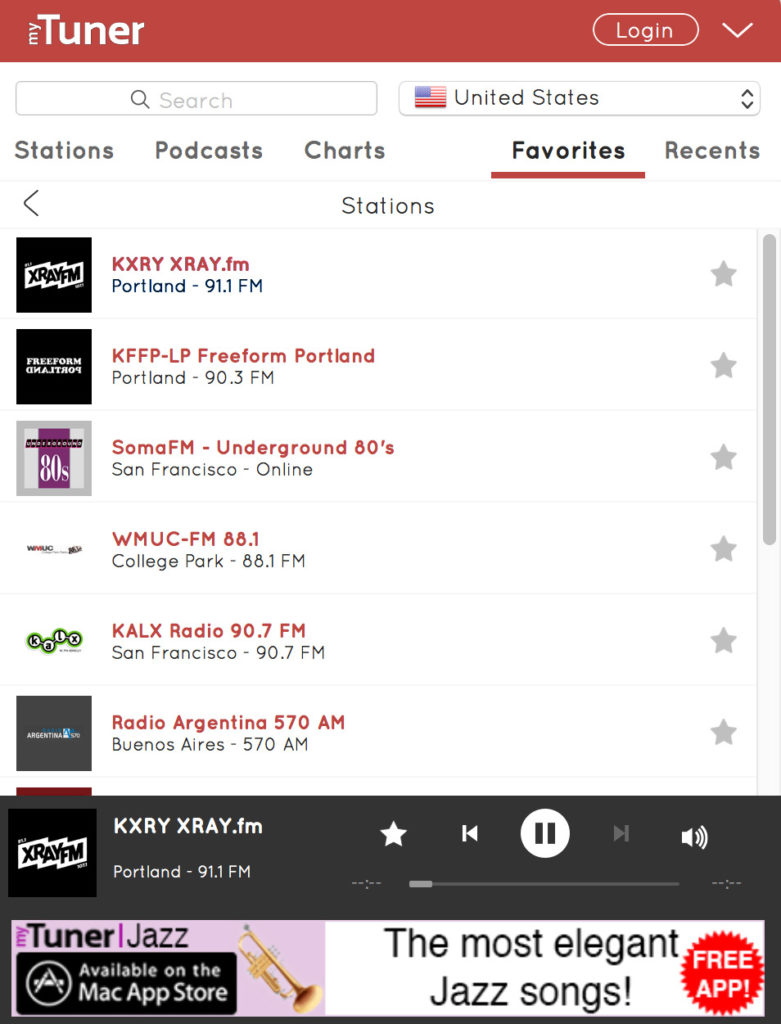
myTuner Radio

myTuner Radio is free in the App Store and very simple. It has a reasonably comprehensive directory of a purported 50,000 stations organized by country. Besides that, they aren’t otherwise categorized. The search is decent, provided you know the call letters or name. If you’re searching by genre or format, you’d better hope that it’s in the name.

Stations owned by iHeart are pretty much entirely absent, though I could find plenty of Entercom and CBS stations, along with those owned by smaller groups. myTuner Radio has banner ads, but mercifully no audio ads. A paid version gets rid of all ads.

myTuner

You can favorite stations for quicker recall, but there’s no provision to organize them, nor is there a provision to add a station’s stream URL like in iTunes. While using myTuner Radio is easier than bookmarking station webpages, you may not find all the stations you want, you can’t categorize the ones you bookmark and you can’t add additional ones not in the directory.

TuneIn Radio

TuneIn Radio has a desktop Mac OS app that replicates the web or mobile app, more or less. To that end, it’s about as good as those. The directory is enormous, and organized by format, genre, location and language. But as I observed earlier, iHeart and Entercom stations have been removed by their owners.

There’s more flexibility in organizing your favorite stations, by putting them into folders. Yet, TuneIn still has no provision to add a station that’s not in the directory. If you like TuneIn on other platforms, you’ll like the desktop app, but it’s not quite a full iTunes replacement.

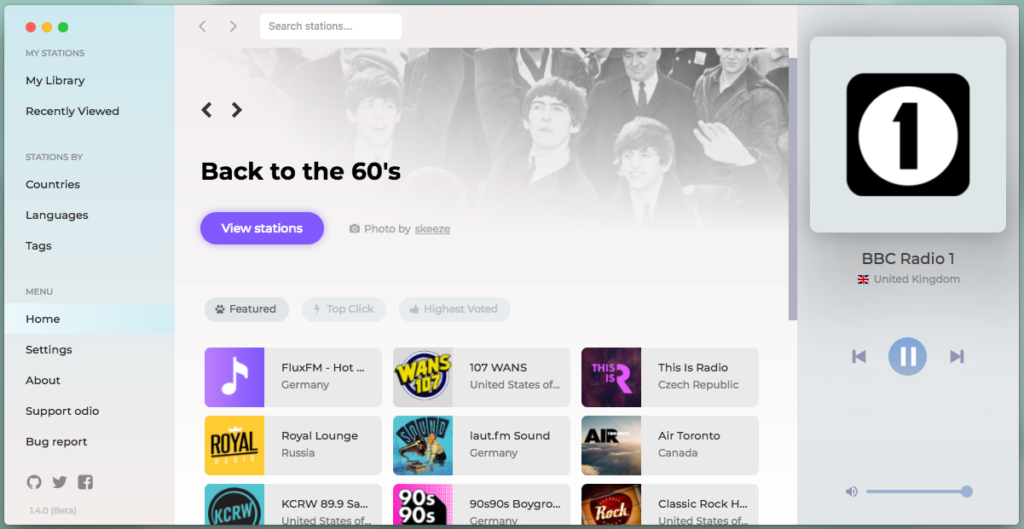
Odio

Odio (not Odeo) is a free open source app that visually resembles iTunes more than the other apps. It’s directory is more idiosyncratic than either TuneIn or myTuner. I could find some iHeart stations, like New York City’s Z100, but not others, like Portland’s The Brew. I had similar hit-and-miss results with Entercom stations.

Odio

Stations are organized by country, language and tag. It took me a bit to figure out how the tags get added, since I saw no feature for doing so in the app. It turns out that Odio uses a directory called Community Radio Browser, where anyone can submit a station. That probably accounts for the idiosyncrasies, since you don’t need to affiliated with a station to submit it. Right now Community Radio Browser lists 24,582 stations, and the project’s webpage has an intriguing list of apps and platforms that use its directory, along with code libraries for folks who might build their own app.

You can maintain a “library” of favorite stations, but there’s no way to organize them.

VLC

VLC is a cross-platform multimedia player app. In that way it’s the closest we have to a free, open source iTunes alternative – one that’s also continuously updated.

The app uses the Icecast Radio Directory. Icecast is an open source streaming audio platform, and stations using it can opt in to be listed. As a result the selection is very eclectic, though you may be hard pressed to find a lot of US broadcast stations. What you may find are live police scanners or Chicago Public Radio WBEZ’s all Christmas music stream. There is no organization – search is your only friend here.

Because it’s a perennially well-supported project, there are ways to add other directories, like TuneIn’s. However, plug-and-play they’re not. You’ll need to know your way around your Mac’s file system. It’s not crazy difficult, but it’s not as simple as installing most apps.

I would call VLC’s interface utilitarian. It’s built more for a power user than a novice, though there’s plenty of help to be found with a quick web search. Its two most iTunes-like features are the ability to add any station’s stream and to organize stations in playlists.

Other Options, Caveat Emptor

Researching this topic I encountered at least a half-dozen other free and open source iTunes alternatives offering at least some kind of internet radio feature. However, they all seem to have little to no development for at least three years. They may still work fine for your, but an OS upgrade could easily foul up the works.

Source: https://www.radiosurvivor.com/2019/06/internet-radio-on-the-mac-after-itunes/

2/13/2026

Internet Radio Directories for Listeners (Google Gemini)

 Top Directories for Listeners- These platforms offer the best user experiences for discovering and streaming global content. 


  • Radio Garden: The most immersive way to find radio. It features a 3D interactive globe where you can rotate the earth and tune into live broadcasts from thousands of cities. It is excellent for finding niche community and independent stations.  

    TuneIn: The industry heavyweight. It has the largest collection (100,000+) of AM/FM and internet-only stations, including major sports networks and news outlets like CNN and BBC

    Radio.net: A clean, straightforward directory with over 60,000 stations. It’s particularly strong for European stations but has a massive global reach and excellent mobile apps.

    Online Radio Box: A favorite for listeners who want to know what’s playing now. It provides live playlists and historical logs of tracks played on each station.

    Streema: Highly organized by city and genre. 1 It is one of the most stable directories for finding local AM/FM stations that have moved to a web stream.

    Source: Google Gemini


    Niche & Specialized Directories

    If you are looking for something specific, like indie music, high-quality audio, or accessibility, try these:

  • SomaFM: A listener-supported, commercial-free directory of over 30 channels of underground/alternative music (chill, lofi, indie, electronic).

  • Filtermusic: A directory specifically focused on electronic and dance music radio stations, updated daily.

  • Radio-Locator: A highly technical search engine for U.S. and international stations. It provides detailed info on signal range and transmitter locations.

  • BlindRadio: Designed specifically to be accessible for the visually impaired, focusing on ease of navigation.

  • NTS Radio: A global platform for artist-run radio, perfect for discovering experimental or avant-garde music.


Internet Radio Station Directories (chatgpt)

If you're looking for directories that list Internet radio stations, there are a few reliable websites and services where you can explore different stations by genre, location, or popularity. Here are some popular ones:


1. TuneIn

  • Description: One of the most well-known platforms for streaming live radio from around the world. TuneIn offers both music and talk stations, and you can search by genre, location, or specific station.

  • Features: Has a mobile app, podcasts, and news alongside radio streams.

2. Radio.com (now Audacy)

  • Description: A comprehensive directory of live radio stations, offering everything from news to music, sports, and talk shows. The website's directory allows users to search by city, genre, or station.

  • Features: Popular in the U.S. with a vast collection of stations.

3. Radio Garden

  • Description: A unique and interactive radio directory that lets you explore live radio stations worldwide using an interactive globe. You can zoom into cities around the world to listen to local stations.

  • Features: Geolocation-based, interactive interface.

4. Shoutcast

  • Description: A popular platform for streaming and hosting internet radio stations. Shoutcast allows you to search for stations by genre, location, and other filters.

  • Features: Provides a free directory of live stations.

5. Live365

  • Website: https://live365.com/

  • Description: A service offering thousands of live internet radio stations across many genres. It's a platform where many independent creators and broadcasters host their stations.

  • Features: Broad genre diversity, from niche hobbies to mainstream music.

6. Radionomy

  • Description: This platform lets users create their own internet radio stations, and it also offers a large directory of community-driven radio stations. You can search by genre and language.

  • Features: Allows station creation, streaming, and discovery.

7. Internet Radio (dir)

  • Website: https://www.internet-radio.com/

  • Description: A simple, no-frills directory that categorizes stations by genre, country, and popularity. It’s easy to navigate and offers quick access to a wide range of stations.

  • Features: Straightforward, easy-to-use interface.

8. iHeartRadio

  • Website: https://www.iheart.com/

  • Description: Offers a wide selection of live radio stations, podcasts, and on-demand content. You can discover radio stations by genre, city, and station.

  • Features: Includes popular stations and exclusive podcasts.

9. Radio.co

  • Website: https://www.radio.net/

  • Description: While primarily a platform for hosting internet radio stations, Radio.co has a public directory where you can find a variety of stations that are broadcasting live.

  • Features: Allows for station management and offers a directory of radio stations.

10. FMRadioFree

  • Website: https://www.fmradiofree.com/

  • Description: A directory of free FM radio stations, including both traditional FM and internet radio. It categorizes stations by genre and location.

  • Features: Free streaming with easy access to stations.

These directories should give you plenty of options to explore a wide range of internet radio stations, whether you’re into specific genres or just curious about discovering stations from around the world.

Source: chatgpt


2/11/2026

Streaming Radio Station Locator

Lately I have been rediscovering local FM radio stations for news and music. FM, AM, SW, and Ham radio broadcasting stations have been moving to online Internet streaming for years. But the selection of FM radio is sometimes hard to find in your area. For those unable to locate a local AM/FM station to stream, the Radio Locator search tool link (below) is available to locate stations that broadcast on the Internet.

There are even more Internet radio only stations around the world. Many people today also stream Internet and FM radio from their cell phones in their cars from iHeart radio (128 kbs), Pandora music radio (64 kbs), Amazon Music (320 kbs), and SiriusXM satellite radio (256 kbs) formats. Enjoy.


https://radio-locator.com/


This is how I used to listen to FM radio. Old memories from the past.