5/09/2025

CD Quality Internet Radio

Back in the day, no self-respecting hi-fi enthusiast would have been without an FM tuner to receive quality stereo broadcasts. When internet radio was introduced traditional radio stations were quick to make their broadcasts available although the initial quality was often poor.

These days there can hardly be a broadcast radio station of any note in the world that does not have a high quality internet presence opening up an almost unimaginable wealth of news, talk shows, drama and music.

Internet only radio channels have expanded the choice available to listeners often with specialist content not found in the mainstream broadcasting world. Low cost and free internet radio broadcasting software has empowered individuals and small organisations to have an internet radio presence adding to the diversity of material available.

Internet Radio Quality

In the early days of internet radio, when dial-up access was all that was commonly available, broadcasts were of limited bandwidth with lossy file formats. But as broadband and 4G for mobile have become the norm, broadcasters are raising their game with MP3 and AAC streams of 256-320 kbps becoming commonly available. This compares favourably to the Standard Quality streaming of Spotify and significantly better than YouTube Music.

In 2017, the British Broadcasting Corporation (BBC) experimented with broadcasting the BBC Proms on its classical music channel, Radio 3, in lossless FLAC but there are currently no publicly available plans to introduce this on a regular basis. The 2017 Proms season also featured a number of broadcasts in binaural format which provided an immersive experience for headphone listeners. The BBC currently streams Radio 3 via its iPlayer software in AAC at 320kbps.

Lossless FLAC Internet Radio

Unlike MP3 and AAC streams which are almost universally supported by radio apps and browsers there are some restrictions if you want to listen to the small but growing list of lossless FLAC stations that have started broadcasting. The requirements are a browser that supports FLAC, such as Chrome or an audio player such as VLC or foobar both of which are free to download.

2019 saw the loss of Bauer Media’s brave experiment in broadcasting its Magic and Absolute Radio families of stations in CD Quality but we had some newcomers such as pop music hits A-1 Mix Radio which has morphed into Magic 108 and Radio BluesFlac featuring the ‘Best Sound 4 the Best Blues’ amongst others. 2021 has brought two new HiRes internet radio offerings – SuperStereo 1 and Paradise Radio broadcasting additional MQA HiRes streams for those with BluOS enabled devices. 2022 started well with two additional HiRes channels from SuperStereo Radio Chile and two more channels from Mother Earth Radio.

There are now just over 50 channels of CD Quality Internet Radio offering a range of music to cover most tastes from Classical, Pop and Rock of all types to Jazz and Blues.

HiRes Radio Stations


Three stations have started broadcasting a HiRes lossless FLAC stream – Mother Earth Radio, SuperStereo 1 and Radio Paradise. Mother Earth Radio is using mainly vinyl sources and SuperStereo 1, SuperStereo 3 and SuperStereo 4 are using a mixture of vinyl and SACD. Radio Paradise has partnered with MQA and where MQA encoded originals are available they are broadcast in MQA HiRes format. You will need BluOS enabled hardware to take advantage of the HiRes streams.

To get further information on HiRes Internet Radio go here.

CD Quality Internet Radio Stations

If you are an internet broadcaster offering CD Quality Internet Radio or you know of a radio station that broadcasts in CD Quality please let us know and we will add the station to our list. Add a new CD Quality Internet Radio Station here.
Stations having dedicated apps

Radio Paradise is a listener supported station with an eclectic ad-free mix of songs where ‘you’ll hear modern and classic rock, world music, electronica, even a bit of classical and jazz.’ The station streams in a range of qualities from 24kbps to 320kbps AAC, 32kbps to 320kbps MP3 and 32kbps to 192kbps Ogg Vorbis. The station also has 32kbps, 128kbps and 192kbps RealPlayer links.

The jewel in the crown is that they also stream CD Quality lossless FLAC using their dedicated iOS and Android apps which are free to download. Fans of Logitech Squeezebox devices and software can also get a plugin to access the station.

In addition to its apps, Radio Paradise now streams its original mix of music, a Mellow Mix, Rock Mix and a World/Eclectic Mix as FLAC streams which can be listened to using an audio player. The four CD Quality Lossless FLAC streams are:

Main Mix FLAC (http://stream.radioparadise.com/flac)
Mellow Mix FLAC (http://stream.radioparadise.com/mellow-flac)
Rock Mix FLAC (http://stream.radioparadise.com/rock-flac)
World/Eclectic Mix FLAC (http://stream.radioparadise.com/eclectic-flac)
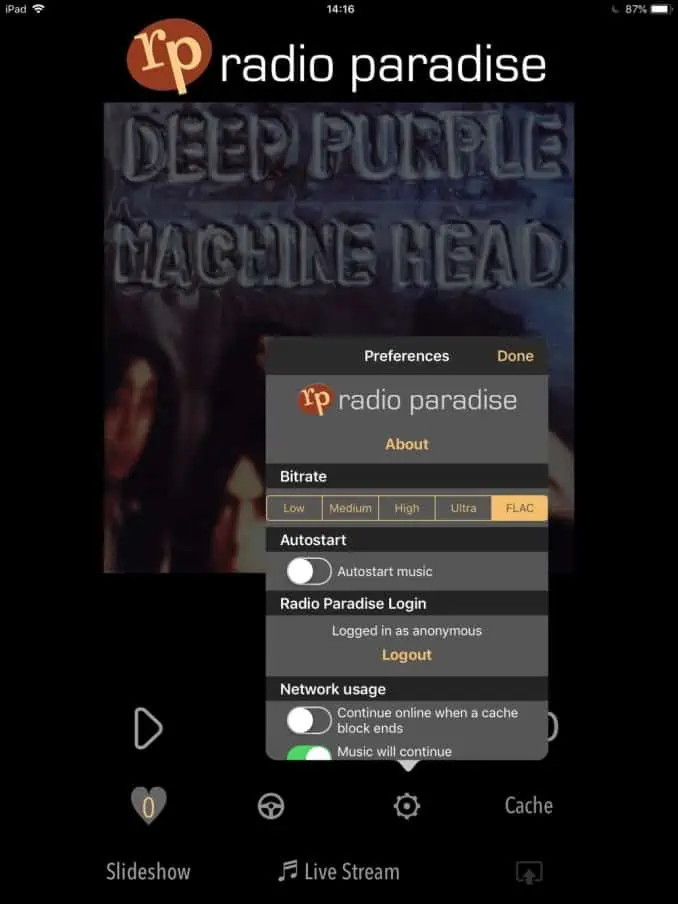


Radio Paradise iOS app screenshot showing FLAC streaming option
Stations that can be listened to by a web browser or audio player

To listen to these stations click on the Streaming URL link or paste it into your browser address bar or audio player ‘Add Location’ menu.

To get further information on:How to listen to lossless FLAC internet radio with free media players go here.
How to listen to lossless FLAC internet radio with your browser go here.

Radio Paradise has now rolled out its FLAC enabled web player which can be accessed here.

(Every effort is made to ensure that the streams are live but many links are to experimental or ‘hobby’ radio stations. Audio Quality stream quality is as measured using foobar.)

‡ These stations contain experimental streams which may not be broadcasting 24×7

§ These stations broadcast an HLS stream which may require special players
StationGenreGeographic AvailabilityAudio QualityWebsite URLStreaming URL
60North RadioLocal Radio/Indie MusicWorldwideFLAC, ~1200kbps/48kHzhttps://60north.radio/http://r5.zetcast.net/flac
95bFMAlternative Music & NewsWorldwideFLAC, ~1000kbps/48kHzhttp://95bfm.com/https://streams.95bfm.com/stream112
Agape’s JPop/Anisong RadioJPop/AnisongWorldwideFLAC, ~2000kbps/48kHzhttp://nas.agapec.fun:81/public/agapes_anisong_radiohttp://nas.agapec.fun:38000/flac
AIDA RadioHoliday RadioWorldwideFLAC, ~2000kbps/48kHzhttps://aidaradio.de/https://cdn05.radio.cloud:8128/AIDA-OMNIA-GAI
Antena Zadar – 97.2 FMCroatian Local RadioWorldwideFLAC, ~1300kbps/48kHzhttps://www.antenazadar.hr/http://hifi.antenazadar.hr:8000/hifi
AURAL RadioEclecticWorldwideFLAC, ~1000kbps/44.1kHzhttps://auralradiokerala.com/http://radio.auralradiokerala.com:1320/stream
Bailrigg 95.3FM Lancaster University Student RadioWorldwideFLAC, ~1200kbps/48kHzhttps://bailriggradio.lancastersu.co.uk/https://bfm-stream.lancs.ac.uk/flac
BDPST Rock RadioRockWorldwideFLAC, ~1200kbps/44.1kHzhttps://bdpstrock.hu/https://s2.audiostream.hu/bdpstrock_FLAC
BesideFMRock and ChilloutWorldwideFLAC, ~1300kbps/48kHz–http://5.128.138.8:8000/stream
BluesWave RadioBlues and RockWorldwideFLAC, ~2000kbps/48kHzhttps://blueswave.radio/http://blueswave.radio:8050/FlacBlues
C9 RadioHit music and newsWorldwideFLAC, ~1100kbps/44.1kHzhttps://www.c9.fr/enhttps://stream.c9.fr/c9radio-flac.ogg.m3u
Calamar RradioEclecticWorldwideFLAC, ~1000kbps/48kHzhttps://www.calamarrradio.org/http://www.calamarrradio.org:8000/stream
City Radio
 
Smooth & JazzWorldwideFLAC, ~1800kbps/48kHzhttp://www.cityradiochile.com/http://cityradio.ddns.net:8000/cityradio48flac
 PopWorldwide FLAC, ~1800kbps/48kHzhttp://www.cityradiochile.com/http://cityradio.ddns.net:8000/citypop
ChiruAnime, Japanese J-PopWorldwideFLAC, ~1000kbps/44.1kHzhttps://chiru.no/https://chiru.no/stream.flac
Classical 90.5 FM §ClassicalWorldwideHLS encoded FLAC/44.1kHzhttps://radio.azpm.org/classical/https://hls.azpm.org/t-fmp4/FLAC/KUAT_FLAC.m3u8?StreamS-MSE-1.0_uuid=46b1af39-6fdf-4824-9acd-8b2924c29996?StreamS-MSE-1.0_uuid=46b1af39-6fdf-4824-9acd-8b2924c29996
Classics RadioClassic Pop and RockWorldwide FLAC, ~1300kbps/48kHzhttps://www.classicsradio.org/http://vriezenet.nl:11051/flac
Club Retro Hits Radio80s,90s HitsWorldwideFLAC, ~1000kbps/48kHzhttps://clubretrohits.cl/http://v4.tustreaming.cl:18156/stream
Czech Radio ÄŒRo VltavaCultureWorldwideFLAC, ~1000kbps/48kHzhttps://vltava.rozhlas.cz/http://amp.cesnet.cz:8000/cro3.flac
Czech Radio ÄŒRo D-durClassical MusicWorldwideFLAC, ~1000kbps/48kHzhttps://d-dur.rozhlas.cz/http://amp.cesnet.cz:8000/cro-d-dur.flac
Czech Radio ÄŒRo JazzJazzWorldwideFLAC, ~1000kbps/48kHzhttps://jazz.rozhlas.cz/o-stanici-5674994http://amp.cesnet.cz:8000/cro-jazz.flac
Czech Radio ÄŒRo Radio WaveYoung listenersWorldwideFLAC, ~1000kbps/48kHzhttps://wave.rozhlas.cz/http://amp.cesnet.cz:8000/cro-radio-wave.flac
Dance Classics RadioClassic DanceWorldwideFLAC, ~2000kbps/48kHzhttps://www.classicsradio.org/http://vriezenet.nl:11051/dcflac
Dance WaveDance, ElectronicWorldwideFLAC, ~1000kbps/44.1kHzhttps://dancewave.online/http://dancewave.online/dance.flac.ogg
Dance Wave Retro!Dance – 90’s, Eurodance, Retro and OldiesWorldwideFLAC, ~1000kbps/44.1kHzhttps://dancewave.online/http://retro.dancewave.online/retrodance.flac.ogg
Danubius Radio80’s, 90’s, 2000’s HitsWorldwideFLAC, ~1200kbps/44.1kHzhttps://danubiusradio.hu/https://danubiusradio.hu/live_HiFi.mp3
DHECTAR RadioTechno/ElectroWorldwideFLAC, 1100kbps/44.1kHzhttps://www.dhectar.fr/http://manager.dhectar.fr:1300/stream
DHECTAR HitsTechno/ElectroWorldwideFLAC, 1100kbps/44.1kHzhttps://www.dhectar.fr/http://manager.dhectar.fr:1110/stream
Djam RadioEclectic Popular MusicWorldwideFLAC, 1200kbps/44.1kHzhttps://www.djam.radio/https://stream10.xdevel.com/audio15s976748-2280/stream/icecast.audio
EasyRadioEasy listening pop/rockWorldwideFLAC, 1000kbps/44.1kHzhttps://easyradio.bg/http://live.easyradio.bg/flac
Eirewave RadioPop/rockWorldwideFLAC, 1200kbps/48kHzhttps://www.eirewave.co.uk/https://audio-edge-5bkfj.fra.h.radiomast.io/157d47f4-e348-4892-bcf6-5bc417683055
Electric CircusDance, ElectronicWorldwideFLAC, 2000kbps/48kHzhttps://radio.eduneu.ar/public/radio1https://radio.eduneu.ar/listen/radio1/radio1_aire
Flacall Radio – Radio AnnushkaDanceWorldwideFLAC, 1200kbps/44.1kHzhttps://annushka.flacall.ru/http://flacradio.ru:1090/stream
Flacall Radio – Hit RadioPop HitsWorldwideFLAC, 1200kbps/44.1kHzhttps://newhits.flacall.ru/http://flacradio.ru:1070/stream
Flacall Radio – International Women’s Radio March 8Women’s RadioWorldwideFLAC, 1200kbps/44.1kHzhttps://8marta.flacall.ru/http://flacradio.ru:1140/stream
Flacall Radio – Radio SummerLatino, HipHop, RapWorldwideFLAC, 1200kbps/44.1kHzhttps://leto.flacall.ru/http://flacradio.ru:1110/stream
Flow RadioUrban LatinWorldwideFLAC, 1600kbps/48kHzhttps://flowradio.es/http://st1.urbanrevolution.es:8000/flowhd
Free Music RadioTop 40 HitsWorldwideFLAC, 2000kbps, 48kHzhttps://freemusicradio.nl/http://stream.freemusicradio.nl:8100/stream.oga
ForEver La Radio – ArcachonLocal Radio, Gironde, FranceWorldwideFLAC, 1200kbps/44.1kHzhttps://www.foreverlaradio.fr/http://stream.sweetfm.fr:8000/flac-forever-arc
ForEver La Radio – BordeauxLocal Radio, Gironde, FranceWorldwideFLAC, 1200kbps/44.1kHzhttps://www.foreverlaradio.fr/http://stream.sweetfm.fr:8000/flac-forever-bdx
Fréquence 3French local radioWorldwideFLAC, 1200kbps/44.1kHzhttp://www.frequence3.fr/https://frequence3.net-radio.fr/frequence3.flac
Fréquence 3 – TouraineFrench local radioWorldwideFLAC, 1200kbps/44.1kHzhttp://www.frequence3.fr/https://frequence3.net-radio.fr/frequence3-fm37.flac
Fréquence 3 – Loir-et-CherFrench local radioWorldwideFLAC, 1200kbps/44.1kHzhttp://www.frequence3.fr/https://frequence3.net-radio.fr/frequence3-fm41.flac
Fréquence 3 DanceHouse and DanceWorldwide
FLAC, 1200kbps/44.1kHzhttp://www.frequence3.fr/https://frequence3.net-radio.fr/frequence3dance.flac
Fréquence 3 Gold80s and 90s hitsWorldwideFLAC, 1200kbps/44.1kHzhttp://www.frequence3.fr/https://frequence3.net-radio.fr/frequence3gold.flac
Fréquence 3 UrbanHip Hop, Rap and R’n’BWorldwideFLAC, 1200kbps/44.1kHzhttp://www.frequence3.fr/https://frequence3.net-radio.fr/frequence3urban.flac
Fréquence 3 WorldWorld MusicWorldwide
FLAC, 1200kbps/44.1kHzhttp://www.frequence3.fr/https://frequence3.net-radio.fr/frequence3world.flac
Futura.FM80’sWorldwideFLAC, ~1200kbps/44.1kHzhttps://futura.fm/https://futura.fm/stream.ogg?ts=1699656027.325
GGRN ‡ExperimentalWorldwideFLAC, 24-bit/96kHzhttps://ggrn.de/wordpress/http://ggrn.de:8040/ggrn.flac
H2OLocal news, info and musicWorldwideFLAC, 1150kbps/48kHzhttp://www.h2oradio.fr/index.phphttp://ice2.ikoula.net-radio.fr/h2oradio.flac
Haarlem Shuffle RadioClassic HitsWorldwideFLAC, 1150kbps/48kHzhttps://www.haarlem105shuffle.nl/https://stream.tbmp.nl:8000/haarlemshuffle.flac
High Fi Dream RadioPop/Rock/DanceWorldwideFLAC, 1600kbps/48kHzhttps://highfidream.com/https://cdn06-us-east.radio.cloud/80ba63862a97bd69c593cc7a2ccaab1c_hq
Hi On Line RadioPopWorldwideFLAC, ~1000kbps/44.1kHzhttps://www.hionline.eu/http://mscp2.live-streams.nl:8100/flac.flac

Incondicionalmente Retro

80s, 90s and moreWorldwideFLAC, 900kbps/48kHzhttps://www.incondicionalmenteretro.cl/http://v4.tustreaming.cl:18128/stream
Insanity RadioCommunity RadioWorldwideFLAC, ~1000kbps/44.1kHzhttps://insanityradio.com/https://stream.cor.insanityradio.com/insanity.flac
Intense RadioElectronic Dance MusicWorldwideFLAC, 1411kbps/44.1kHzhttps://www.intenseradio.net/http://secure.live-streams.nl/flac.flac

https://secure.live-streams.nl/flac.flac

ISEKOI RadioElectronicWorldwideFLAC, ~1800kbps, 48kHzhttps://isekoi-radio.com/public/isekoihttps://isekoi-radio.com/listen/isekoi/radio.flac
ISEKOI AmbientAmbientWorldwide FLAC, ~1600kbps, 48kHzhttps://isekoi-radio.com/public/isekoihttps://isekoi-radio.com/listen/ambient/ambientradio.flac
ISEKOI Chill ZoneElectronic ChillWorldwideFLAC, ~1800kbps, 48kHzhttps://isekoi-radio.com/public/isekoihttps://isekoi-radio.com/listen/chill/radio.flac
Jammin Vibez Radio – Reggae Classic Hits RadioDancehall, Reggae & RootsWorldwideFLAC, ~2000kbps, 48kHzhttps://www.jamminvibezradio.com/https://azuracast.jammimvibez.com/listen/reggae/live.flac
Jammin Vibez Radio – Caribbean Variety RadioCaribbean MusicWorldwideFLAC, ~2000kbps, 48kHzhttps://www.jamminvibezradio.com/https://azuracast.jammimvibez.com/listen/caribbean/live.flac
Jammin Vibez Radio – Caribbean Christmas RadioCaribbean Christmas MusicWorldwideFLAC, ~2000kbps, 48kHzhttps://www.jamminvibezradio.com/https://azuracast.jammimvibez.com/listen/christmas/live.flac
JB Radio-2Rock and BluesWorldwideFLAC, ~1200kbps, 44.1kHz (with metadata)
https://jb-radio.net/https://mediacp.jb-radio.net:8001/flac
Joy HitsPop and Dance HitsWorldwideFLAC, ~1100kbps/44.1kHzhttps://joyhits.online/http://joyhits.online/joyhits.flac.ogg
K-FreeChristian, ContemporaryWorldwideHLS encoded FLAC/48kHzhttps://kfre.us/https://kfre.s3.amazonaws.com/truehd/FLAC/program.m3u8
LapFox RadioElectronicWorldwideFLAC, 24-bit/48kHz ~2000kbpshttps://lapfoxradio.com/https://radio.lapfoxradio.com/radio/8000/stream-flac.flac
La Pop’ulairePopWorldwideFLAC, 24-bit/48kHz ~1600kbpshttps://lapopulai.re/http://hyperion.lapopulai.re:8000/radio.flac
La SuperSonicaLatino, PopWorldwideFLAC, ~1100kbps/44.1kHzhttps://www.facebook.com/SuperSonicaMxhttp://c11.radioboss.fm:8093/stream
La Urban RadioDance, ElectronicWorldwideFLAC, ~1200kbps/48kHzhttps://www.urbanrevolution.es/http://st1.urbanrevolution.es:8000/zonaelectronica
Le Bon MixPopular MusicWorldwideFLAC, ~1100kbps/44.1kHzhttps://www.lebonmix.radio/https://stream10.xdevel.com/audio17s976748-2218/stream/icecast.audio
Le Son ParisienElectronic, Indie, Alternative and LoungeWorldwideFLAC, ~1200kbps/44.1kHzhttps://www.lesonparisien.com/en/http://stream.lesonparisien.com/live.flac
Magic RadioOldies HitsWorldwideFLAC, ~1000kbps/44.1kHzhttps://magic-radio.net/http://mp3.magic-radio.net/flac
MaXXimaElectronicWorldwideFLAC, ~1000kbps, 48kHzhttps://www.maxxima.org/http://maxxima.mine.nu:8000/maxx.ogg
Mother Earth RadioEclecticWorldwideFLAC, ~2700kbps/96kHzhttps://motherearthradio.de/https://motherearth.streamserver24.com/listen/motherearth/motherearth
Mother Earth InstrumentalInstrumentalWorldwideFLAC, -2800kbps/96kHzhttps://motherearthradio.de/http://motherearth.streamserver24.com:18920/motherearth.instrumental
Mother Earth JazzJazzWorldwideFLAC, -2800kbps/96kHzhttps://motherearthradio.de/https://motherearth.streamserver24.com/listen/motherearth_jazz/motherearth.jazz
Mother Earth KlassikClassicalWorldwideFLAC, -2800kbps/96kHzhttps://motherearthradio.de/http://server9.streamserver24.com:18910/motherearth.klassik

Music inspired by EON³ | Audæon

EclecticWorldwideFLAC, ~1600kbps/48kHzhttps://c16.radioboss.fm/u/379https://azuraserv3.live-streams.nl/listen/audaeon/radio
MybobbaFMPopWorldwideFLAC, ~2000kbps/48kHz https://radio.mybobba.org/public/mybobbafmhttps://radio.edith.gg/listen/mybobbafm/radio_flac.flac
Naim ClassicalClassicalWorldwideFLAC, ~1000kbps/44.1kHzhttps://www.naimaudio.com/http://mscp3.live-streams.nl:8250/class-flac.flac, https://mscp3.live-streams.nl:8252/class-flac.flac
Naim JazzJazzWorldwideFLAC, ~1000kbps/44.1kHzhttps://www.naimaudio.com/http://mscp3.live-streams.nl:8340/jazz-flac.flac, https://mscp3.live-streams.nl:8342/jazz-flac.flac
Naim RadioVariousWorldwideFLAC, ~1000kbps/44.1kHzhttps://www.naimaudio.com/http://mscp3.live-streams.nl:8360/flac.flac https://mscp3.live-streams.nl:8362/flac.flac
openbroadcastSwiss Community RadioWorldwideFLAC, ~1100kbps/44.1kHzhttps://www.openbroadcast.ch/http://stream.openbroadcast.ch/16bit.flac
OpenSky RadioPop, Dance, Electro US Rap HitsWorldwideFLAC, ~1200kbps/44.1kHzhttps://opensky.radio/https://audio.opensky.radio:8082/flac?_res_tag_=audio
Periscope RadioEclecticWorldwideFLAC, ~1100kbps/44.1kHzhttp://periszkopradio.hu/http://mumia.periszkopradio.hu:8050/periszkop.ogg
Pi ano
Piano music
Worldwide
FLAC, ~1000kbps/44.1kHz (no metadata)https://p-node.org/piano/
http://stream.p-node.org/piano.flac
FLAC, ~1000kbps/44.1kHz (with metadata)http://stream.p-node.org/piano
PiratenKanon.FMPopWorldwideFLAC, ~1900kbps/48kHzhttps://piratenkanon.fm/https://radio.piratenkanon.fm:10600/flac

Progressieve Rock

Progressive Rock/Prog RockWorldwideFLAC, ~1100kbps/44.1kHz https://progressieverock.nl/https://progressieverock.nl/flac

Punkrockers Radio


Punk RockWorldwideFLAC, ~1100kbps/44.1kHzhttps://www.punkrockers-radio.de/https://stream.punkrockers-radio.de:8443/prr.flac
PureClassix Radio60’s, 70’s, 80’s and OldiesWorldwideFLAC, ~1200kbps/44.1kHzhttps://www.pureclassix.com/http://mscp4.live-streams.nl:8140/flac.ogg
Pure Lounge RadioLounge MusicWorldwideFLAC, ~1200kbps/44.1kHzhttps://www.pureloungeradio.com/https://mscp4.live-streams.nl:8142/lounge.ogg
Pure Radio Holland – The Underground ChannelElectronic MusicWorldwideFLAC, ~1700kbps/48kHzhttps://pureradio.eu/https://streamserver.pure-isp.eu/radio/8000/flac
Pure Radio Holland – Trance-Electro ChannelElectronic MusicWorldwideFLAC, ~1700kbps/48kHzhttps://pureradio.eu/https://streamserver.pure-isp.eu/radio/8020/flac
Pure Radio Holland – Hardcore ChannelElectronic MusicWorldwideFLAC, ~1700kbps/48kHzhttps://pureradio.eu/https://streamserver.pure-isp.eu/radio/8010/flac
Pure Radio Holland – DownTempo ChannelElectronic MusicWorldwideFLAC, ~1700kbps/48kHzhttps://pureradio.eu/https://streamserver.pure-isp.eu/radio/8040/flac
Pure Radio Channel – Live Party ChannelElectronic MusicWorldwideFLAC, ~1700kbps/48kHzhttps://pureradio.eu/https://streamserver.pure-isp.eu/radio/8060/flac
Pure Radio Channel – Dance ChannelElectronic MusicWorldwideFLAC, ~1700kbps/48kHzhttps://pureradio.eu/https://streamserver.pure-isp.eu/radio/8030/flac
Pure Radio Channel – DJ R.I.P.’s PodcastElectronic MusicWorldwideFLAC, ~1700kbps/48kHzhttps://pureradio.eu/https://streamserver.pure-isp.eu/radio/8050/flac
Pure Radio Channel – Various Channel Electronic MusicWorldwideFLAC, ~1700kbps/48kHzhttps://pureradio.eu/https://streamserver.pure-isp.eu/radio/8070/flac
Pure Radio Channel – Rap & HIP-HOP ChannelElectronic MusicWorldwideFLAC, ~1700kbps/48kHzhttps://pureradio.eu/https://streamserver.pure-isp.eu/radio/8100/flac
Qabayan FMFilipinoWorldwideFLAC, ~1800kbps/44.1kHz https://www.qabayanfm.com/https://c2.radioboss.fm:8478/live
Radio 80FM ValenciaDance, TechnoWorldwideFLAC, ~1700kbps/48kHzhttps://www.radio90.fm/http://stream.radio90.fm:2000/stream
Radio AudiomasteringDance/ElectronicWorldwideFLAC, ~1000kbps/44.1kHzhttp://radio.audiomastering.lt/https://transliacija.audiomastering.lt/pure
Radio Bias70’s-2000’s, Pop, Rock, New Wave, Euro, Italo Disco musicWorldwideFLAC, ~1418kbps/48kHzhttps://biasradio.comhttps://admin.biasradio.com/radio/8000/flac
Radio BluesFlacBluesWorldwideOgg FLAC, 1500kbps/44.1kHzhttp://bluesflac.com/https://streams.radiomast.io/radioblues-flac
Radio Calico Rock, PopWorldwideFLAC, ∼1800kbps/48kHzhttps://radio-calico.com/http://radio3.radio-calico.com:8080/calico
Radio Calico (Roon stream) Rock, PopWorldwideFLAC, ∼1800kbps/48kHzhttps://radio-calico.com/http://roon.radio-calico.com:8000/roon
Radio Club 80

ClassicWorldwideFLAC, 2000kbps/192kHz (?)https://www.radioclub80.cl/https://stream.radioclub80.cl:8002/clasicos80.flac
DanceWorldwide?https://www.radioclub80.cl/
TranceWorldwideFLAC, 1100kbps/48kHzhttps://www.radioclub80.cl/https://stream.radioclub80.cl:8052/trance80.flac
RetroWorldwideFLAC, 1800kbps/96kHzhttps://www.radioclub80.cl/https://stream.radioclub80.cl:8022/retro80.flac
EuroWorldwideFLAC, 1800kbps/96kHzhttps://www.radioclub80.cl/https://stream.radioclub80.cl:8032/stream.euro80flac
LatinoWorldwideFLAC, 1800kbps/96kHzhttps://www.radioclub80.cl/https://stream.radioclub80.cl:8012/espanol80.flac
BalladsWorldwideFLAC, 1100kbps/48kHzhttps://www.radioclub80.cl/https://stream.radioclub80.cl:8042/
Movie SoundWorldwideFLAC, 1100kbps/48kHzhttps://www.radioclub80.cl/https://stream.radioclub80.cl:8072/peliculas80.flac
Classic Rock BestWorldwideFLAC, 4400kbps/192kHzhttps://www.radioclub80.cl/http://stream.radioclub80.cl:9040/live.flac
Radio G!Community RadioWorldwideFLAC, 600kbps/48kHzhttps://www.radio-g.fr/internet/index.phphttp://46.105.110.80:8000/fluxradiogHD
Radio HaugalandLocal RadioWorldwideFLAC, 1800kbps/48kHzhttps://radioh.no/http://radioip.no:443/flac
Radio Jeunes RheimsLocal RadioWorldwideFLAC, 1100kbps/48kHzhttps://www.rjrradio.fr/http://stream.rjrradio.fr:8000/rjr-dab.flac
Radio JuventusChillout PopWorldwideFLAC, 1200kbps/44.1kHzhttps://radiojuventus.hu/http://s2.audiostream.hu:8090/juventus_FLAC
Radio Kemonia80s and 90s HitsWorldwideFLAC, 1200kbps/44.1kHzhttps://radiokemonia.it/http://kemoniastreaming2.net:8060/stream
Radio KrovEclecticWorldwideFLAC, 1100kbps/48kHzhttps://radiotalas.dckrov.rs/public/dckrovhttps://radiotalas.dckrov.rs/listen/dckrov/flac?_res_tag_=audio
Radio Paradise Main MixEclecticWorldwideFLAC, ~1000kbps/44.1kHzhttps://radioparadise.com/homehttp://stream.radioparadise.com/flac
Radio Paradise Mellow MixMellow RockWorldwideFLAC, ~1000kbps/44.1kHzhttps://radioparadise.com/homehttp://stream.radioparadise.com/mellow-flac
Radio Paradise Rock MixRockWorldwideFLAC, 1000kbps/44.1kHz>https://radioparadise.com/homehttp://stream.radioparadise.com/rock-flac
Radio Paradise Global MixGlobalWorldwideFLAC, 1000kbps/44.1kHzhttps://radioparadise.com/homehttp://stream.radioparadise.com/global-flac
Radio Remusica80s, 90s and today’s HitsWorldwideFLAC, 900kbps/44.1kHzhttps://remusica.cl/http://v4.tustreaming.cl:18144/stream
Radio RandomEclecticWorldwideFLAC, 1300kbps/48kHzhttps://radiorandom.org/http://radiorandom.org:8000/WBJM-FLAC
Radio SputnikUnderground HouseWorldwideFLAC, 1200kbps/44.1kHzhttp://www.radiosputnik.nl/https://radiosputnik.nl:8443/flac
Radio SummerLocal RadioWorldwideFLAC, 1100kbps/44.1kHzhttps://radioletofm.ru/onlinehttp://flacradio.ru:1110/stream
Radio XLocal Radio – Basel, SwitzerlandWorldwideFLAC, 2000kbps/48kHzhttps://radiox.ch/https://mp3.radiox.ch/standard.ogg
RIO – Rádio Internacional Odemira
Community RadioWorldwideFLAC, 1600kbps/44.1kHzhttps://radiodemira.pt/http://c30.radioboss.fm:8510/autodj
Riverside RadioPop/RockWorldwideFLAC, 2000kbps/48kHzhttps://www.riversideradio.nl/https://stream.and-stuff.nl:8443/riverside
Rlocale RadioCommunity RadioWorldwideFLAC, 1800kbps/48kHzhttps://rlocale.fr/https://rlocale.org/listen/rlocale/rlocale-flac.ogg
Rondo KlasuClassical Full WorksWorldwideFLAC, 1000kbps/44.1kHzhttps://rondo.fi/https://iradio.fi/klasu.flac
Rondo Klasu ProClassical Full WorksWorldwideFLAC, 1000kbps/44.1kHzhttps://rondo.fi/https://iradio.fi/klasupro.flac
Roxy RadioToday’s MusicWorldwideFLAC, 1200kbps/48kHzhttps://roxyradio.hu/https://s2.audiostream.hu/roxy_FLAC
Sanctuary Radio – Dark Electro ChannelElectroWorldwideFLAC, 1300kbps/44.1kHzhttps://www.sanctuaryradio.com/http://66.94.113.88:8000/ultra_hq
Sanctuary Radio – 80’s Alternative Channel80’s AlternativeWorldwideFLAC, 1300kbps/44.1kHzhttps://www.sanctuaryradio.com/http://66.94.113.88:8000/retro_ultra_hq
Sanctuary Radio – Club Mix ChannelClub MixWorldwideFLAC, 1300kbps/44.1kHzhttps://www.sanctuaryradio.com/http://66.94.113.88:8000/clubmix_ultra_hq
SECTOR ClassicalClassicalWorldwideOgg FLAC, ~1000kbps/44.1kHzhttps://sectorradio.ru/nota/http://89.223.45.5:8000/nota-flac
SECTOR ProgressiveProgressive/ElectronicWorldwideOgg FLAC, ~1000kbps/44.1kHzhttp://sectorradio.com/http://89.223.45.5:8000/progressive-flac
SECTOR SpaceElectronicWorldwideOgg FLAC, ~1000kbps/44.1kHzhttp://sectorradio.com/spacehttp://89.223.45.5:8000/space-flac
SECTOR 80s80sWorldwideOgg FLAC, ~1000kbps/44.1kHzhttps://sectorradio.ru/geny/http://89.223.45.5:8000/geny-flac
SECTOR 90s90sWorldwideOgg FLAC, ~1000kbps/44.1kHzhttp://sectorradio.com/90/http://89.223.45.5:8000/next-flac
SECTOR 10s10sWorldwideOgg FLAC, ~1000kbps/44.1kHzhttp://sectorradio.ru/zed/http://89.223.45.5:8000/zed-flac
SECTOR 00s00sWorldwideOgg FLAC, ~1000kbps/44.1kHz–http://89.223.45.5:8000/indigo-flac
SECTOR JazzJazzWorldwideOgg FLAC, ?? 24-bit, 3100kbps/9kHz
–http://89.223.45.5:8000/jazz-flac
Sing SingEclecticWorldwideFLAC, ~700kbps/44.1kHzhttp://www.sing-sing-bis.org/results.php?kbps=Infinityhttp://stream.sing-sing-bis.org:8000/singsingFlac, http://stream.sing-sing-bis.org:8000/singsingFlacSansMetadata
Skylegend Radio80’s, 90’s, Pop and RockWorldwideHLS encoded FLAC, ~1300kbps/48kHzhttps://www.skylegend2024.fr/http://173.212.250.212:8200/flac
SomaFM ‡§Downtempo and chillout electronicaWorldwideHLS encoded FLAC, ~1100kbps/48kHzhttps://somafm.com/groovesalad/index.htmlhttps://hls.somafm.com/hls/groovesalad/FLAC/program.m3u8
Special Sound RadioPopWorldwideFLAC, ~1100kbps/4.1kHzhttps://special-sound-radio.com/start.phphttp://c01.lexycast.de:3420/stream
Starter FMDanceWorldwideFLAC, 2400kbps/48kHzhttps://starterfm.com.au/http://10321.cloudrad.io:9054/hd
Stereo AnimeAnimeWorldwideFLAC, 1800kbps/48kHzhttps://www.stereoanime.net/http://radio.stereoanime.net:8000/flac
SUNLocal radioWorldwideFLAC, 1200kbps/48kHzhttp://www.lesonunique.com/http://diffusion.lafrap.fr:8000/sun.flac
 

SuperStereo 1

Yacht Rock

Worldwide

FLAC, 24-bit/96kHz ~1300kbpshttp://www.superstereohires.com/http://icecast.centaury.cl:7570/SuperStereoHiRes1
SuperStereo 1+Disco,Soul &Funk

Worldwide

FLAC, 24-bit/96kHz ~1300kbpshttp://www.superstereohires.com/http://icecast.centaury.cl:7570/SuperStereoHiRes1Plus
SuperStereo 250’s, 60’s and 70’sWorldwideFLAC, 24-bit/96kHz ~1300kbpshttp://www.superstereohires.com/http://icecast.centaury.cl:7570/SuperStereoHiRes2
SuperStereo 3
Pop & Dance 80’s,90’sWorldwideFLAC, 24-bit/96kHz ~1300kbpshttp://www.superstereohires.com/http://icecast.centaury.cl:7570/SuperStereoHiRes3
SuperStereo 3+New Wave,New Romantic, Synth-PopWorldwideFLAC, 24-bit/96kHz ~1300kbpshttp://www.superstereohires.com/http://icecast.centaury.cl:7570/SuperStereoHiRes3Plus
SuperStereo 4Ballads, 80’s, 90’s, 00’sWorldwideFLAC, 24-bit/96kHz ~1300kbpshttp://www.superstereohires.com/http://icecast.centaury.cl:7570/SuperStereoHiRes4
SuperStereo 4 +Ballads & Latin Pop 80’s,90’s,00’sWorldwideFLAC, 24-bit/96kHz ~1300kbpshttp://www.superstereohires.com/http://icecast.centaury.cl:7570/SuperStereoHiRes4Plus
SuperStereo 5RockWorldwideFLAC, 24-bit/96kHz ~1300kbpshttp://www.superstereohires.com/http://icecast.centaury.cl:7570/SuperStereoHiRes5
SuperStereo 6Instrumental MusicWorldwideFLAC, 24-bit/96kHz ~1300kbpshttp://www.superstereohires.com/http://icecast.centaury.cl:7570/SuperStereoHiRes6
SuperStereo 7JazzWorldwideFLAC, 24-bit/96kHz ~1300kbpshttp://www.superstereohires.com/http://icecast.centaury.cl:7570/SuperStereoHires7
Sveriges RadioClassical MusicWorldwideFLAC, ~1100kbps/48kHz https://sverigesradio.se/https://live1.sr.se/p2-flac
Sweet FMLe Mans, France – Local RadioWorldwideFLAC, ~1100kbps/48kHzhttps://www.sweetfm.fr/http://stream.sweetfm.fr:8000/dab-forever-lms
TEKnival RadioRave MusicWorldwideFLAC, 1900kbps/48kHzhttps://www.teknivalradio.co.uk/https://listen.teknivalradio.com/listen/teknivalradio/radio.flac
The Cheese80’s, 90’s, 00’s HitsWorldwideFLAC, 1500kbps/48kHzhttp://thecheese.co.nz/https://station.thecheese.co.nz/listen/the_cheese/flac
TrancePulseTranceWorldwideFLAC, ~1400kbps/44.1kHzhttps://trancepulsefm.ie/http://stream.trance.ie:8000/tpmixes
Violent Forces RadioThrashWorldwideFLAC, 1900kbps/48kHzhttps://violentforcesradio.weebly.com/https://tuneintoradio1.com:8000/stream.flac
Violent Forces Radio80’s ThrashWorldwideFLAC, 1900kbps/48kHzhttps://violentforcesradio.weebly.com/https://tuneintoradio1.com:8010/stream.flac
WBOR (91.1FM)CommunityWorldwideFLAC, 1600kbps/48kHzhttps://wbor.org/https://azura.wbor.org/listen/wbor/flac
Zap! FMOldies, PopWorldwideFLAC, ~1100kbps/48kHzhttps://www.zap.fm/enhttps://zapstream.nl:8443/1
Zappa Stream RadioFrank ZappaWorldwideFLAC, ~900kbps/44.1kHzhttps://www.norbert.de/index.php?id=10https://streams.norbert.de/zappa.flac
Source: https://www.hiresaudio.online/cd-quality-internet-radio/

CD types & sonic quality (UHQCD, SHMCD, BSCD2, Crystal Disc, MQA-CD etc.)


5/08/2025

What is FLAC? The high-def MP3 explained


flac440.pngFLAC is an open-source file format which offers true-CD quality rips at half the sizeXiph.org Foundation

In the late 1990s, one of the original portable music file formats -- the MP3 -- was causing quite a bit of bother mainly due to user's illegal sharing over Napster. While MP3 eventually prevailed, there is an even better choice for high-quality music downloads, and it's playable on your favorite device. It's even in your music streams.

FLAC (Free Lossless Audio Codec) is a musical file format that offers bit-perfect copies of CDs but at half the size. It is compatible with many phones (including the iPhone -- with an app), portable music players (PMP) including the PonoPlayer and hi-fi components. FLAC files are available for roughly the same price as the equivalent MP3 in online stores and sound much better.

To see where FLAC has come from and where it is headed, you only need to look at the history of its "lossy" predecessor. Though MP3.com was one of the first sites to sell MP3s in 1999, dedicated players like the Rio PMP300 were subject to legal action by record companies. Yet when the iPod was released in 2001, it helped to legitimize the format, and today MP3s are now sold by most online music stores. (Disclosure: MP3.com no longer sells MP3s and is now owned by CBS Interactive, parent company of CNET.)

FLAC, ahh-ahhh, it'll save every one of us*

roon-1.jpg

One of the best FLAC players available is Roon, a high-end music player for PC and Mac.Screenshot by Ty Pendlebury/CNET

Until recently, the music format FLAC (Free Lossless Audio Codec) enjoyed a similar "pirates-only" reputation to MP3 because of its lack of Digital Rights Management (DRM), but FLAC has the potential to reach a larger audience than just audiophiles and tech enthusiasts. Currently, almost every record label is on board with the format, and consumers can buy lossless music from both major and indie acts for the same price as the iTunes Store.

FLAC first emerged in 2001 as an open-source alternative to other lossless formats emerging at the time. These included Apple Lossless (ALAC), Microsoft's WAV (Waveform Audio Format) and WMA Lossless. But these competitive formats do have their disadvantages. While ALAC has a loyal following among iPod and iPhone users, it hasn't seen much uptake outside of Apple products. The WAV format is also popular, and it's compatible with iOS devices, but its biggest problems are that file sizes are very large, and it can't retain "tag" data -- artist, album name, lyrics, and so on -- in the way the other formats can. FLAC, on the other hand, not only supports tags but is also compatible with most music players. Apple is the only real holdout here, for while there was talk in 2017 of hardware support in both the iPhone 8 and X nothing has materialized. However, there are simple workarounds for iOS and Mac users.

*With apologies to Queen

What's the difference between MP3 and FLAC?


MP3 is a lossy format, which means parts of the music are shaved off to reduce the file size to a more compact level. It is supposed to use "psychoacoustics" to delete overlapping sounds, but it isn't always successful. Typically, cymbals, reverb and guitars are the sounds most affected by MP3 compression and can sound really distorted or "crunchy" when too much compression is applied.

Like MP3 before it, FLAC has been embraced by the music industry as a cost-effective way to distribute CD-or-better-quality music, and it doesn't have the auditory problems of MP3s. FLAC is lossless and more like a ZIP file -- it comes out sounding the same when it is unzipped. Previously the only way to get "lossless" files was via the uncompressed CD formats CDA or WAV, but neither is as space-efficient as FLAC.
naim-muso-01.jpg

The Naim mu-so is a high-end wireless speaker that supports FLAC.

Sarah Tew/CNET

While FLAC files are up to six times larger than an MP3, they are half the size of a CD, and can have the same boost in audio quality. Furthermore, FLAC is not just restricted to 16-bit (CD quality), and you can buy files up to 24-bit/192kHz for another potential boost in performance. While the effects of better-than-CD quality are highly debated, companies like Neil Young's Pono staked their reputations on its benefits.

But regardless of whether you are using 16- or 24-bit quality files, FLAC is here to stay. Experts such as Malcolm Hawksford, professor of psychoacoustics at Essex University, say that despite competition from proprietary formats like MQA and DSD the humble FLAC is still competitive.

"FLAC has a place in the future for high-quality audio. It is good for transporting files on the internet as it typically halves download time. It is unlikely that for lossless compression there will be significant improvements," Hawksford wrote on Bowers & Wilkins' Society of Sound blog.

While physical discs are still popular, their usefulness will eventually be eclipsed by the convenience of purely digital files: whether that means streaming or software files stored on your network or in the cloud. As a format FLAC will probably never be as popular a format as CD and DVD were in their heydays, but it's quickly become the format of choice for people who care about sound quality.


FLAC versus streaming

FLAC downloads have one major competitor: streaming. While audiophiles are mostly concerned with music bought from music stores like Bandcamp and HD Tracks, it's not the only option available to people interested in high quality music. At the lower end of the scale, Pandora and Rhapsody have been streaming for years at bit-rates between 128kbps and 192kbps but they're no match for lossless FLAC in the audio department.

However there are several major streaming services that offer very high sound quality -- Spotify, Tidal and soon Qobuz -- and depending on the record, they can be indistinguishable from the CD. While Spotify content is ripped in 320Kbps Ogg Vorbis, it's Tidal that offers the biggest alternative to personal collections as it's also based on FLAC. The company is also able to offer hi-res music by adding Meridian's MQA technology for compatible devices. By contrast, Qobuz offers hi-res FLAC streaming without the use of a proprietary wrapper, but the trade-off is much larger file sizes not suitable for the train. In the meantime, both Spotify and Tidal let you download tracks for offline listening (with a paid subscription), and both catalogs are quite impressive.

But it's not just Tidal and Qobuz that offer lossless streaming: there are othe up-and-comers as well. While CD-ripping service Murfie was one of the first sites to offer true-quality streaming, it's currently only for customers who pay an additional $99 fee (roughly converting to £80 and AU$140), and only for the CDs they currently own. Meanwhile, Deezer Elite is another service that offers lossless streaming but currently only to users of Sonos.
gettyimages-468173718.jpg

Stars including Rihanna, Nicki Minaj, Madonna, Deadmau5 and Kanye West called for a fairer deal at the launch of Jay Z's Tidal streaming service.

Kevin Mazur/Getty
While the world is swiftly moving toward streaming, FLAC does offers several advantages over the Spotifys and Tidals of this world. Firstly, you only need to pay once for a FLAC album. With a streaming service, you'd need to pony up for a subscription fee for the rest of your life or lose access to your carefully curated music collection.

Secondly, you don't need an internet connection to listen to your music, and while the Offline modes of both Tidal and Spotify enable you to use it on the subway, it still needs to be connected to the 'net at some point to get the files. What if your music player doesn't have apps or network capability? For inexpensive music players like the Sony A17, a set of FLAC files make the most sense.


Where can I get FLAC files?

hdtracks_1.jpg

If you want to support the artist, there are several sites that let you purchase FLAC files.

HDTracks.com
There are two main ways to get your FLAC files legally: ripping from CD or purchasing from a digital store. Ripping is easy to do but you will need the right software for your computer. However, there are some devices that enable you to rip and store FLAC files on a networked hard drive without having to ever touch a PC; the Bluesound Vault is one of these.

If you'd rather pay someone else to do that for you, we cover our favorite sites for buying FLAC files here. If you want to find music and don't know which site the music is on, do a Google search for the name of the artist/album and "digital."


How do I play FLAC files?

flac_player.jpg

FLAC Player is one of the many apps for iOS that enables FLAC playback.

FLAC Player

iOS: There is still one hurdle preventing FLAC's full-scale adoption: the Apple iPhone and other iOS devices don't support within iTunes. With every major edition of iOS and iTunes, we secretly hope for FLAC support, but we may never get it. While Apple announced its Mastered for iTunes program (24-bit/44.1kHz) several years ago, the company has moved on to more profitable and immediate concerns such as Apple Music.

However, there are several apps available in the iTunes Store that do support the FLAC format and even let you stream them between devices on your network via AirPlay and DLNA. Apps available from the App Store include FLAC Player, MediaConnect and Capriccio.

Android: Users of Google's phone OS don't need to worry as much about FLAC support; from Android 3.1 (Honeycomb) onward the OS supports the file format natively. Even if you have an older Android phone, manufacturers like HTC and Samsung have added FLAC support to their software media players. Nonetheless, good apps to try from Google Play are Rocket Music Player, Player Pro -- which also supports high-res -- and Bubble UPnP (which includes DLNA support and also Tidal integration).

Windows and Mac: If you're a Windows 10 user, you can play FLAC files natively in the operating system. For older Windows versions, there is a Windows Media Player plug-in, but the players most recommended by audiophiles are Roon, Media Monkey and JRiver. Meanwhile Mac users can download Roon, Fluke for basic support for FLAC in iTunes or Songbird (also on PC).
Neil Young's Pono dreams soon to come true, Ep. 151

The PonoPlayer was one of the most high-profile FLAC devices but it was discontinued in 2017.

Sarah Tew/CNET

Portable: While Android MP3 players have dwindled in popularity, they have been replaced by high-res portable players like Sony's Walkman NW-WM1 and the now-discontinued PonoPlayer designed to support FLAC natively, up to 24-bit/192kHz. Meanwhile, traditional players by Sony, iRiver and FiiO can typically play back FLAC.

Getting quality that's measurably better than your phone will cost you though, with models from Astell & Kern costing into the thousands. However, players such as the Sony A30 Walkman A Series promise 45 hours of battery life and start at about $220 (roughly £170 and AU$310). See CNET's best players that support FLAC here.
fl-google-home-max-10

The Google Home Max supports both streaming and downloaded FLAC files via Chromecast.

CNET


Hi-fi: Of course, the biggest advantage to FLAC files is that they are ideally suited to listening on a hi-fi device. In the last few years, a wealth of streaming audio players have appeared with lossless FLAC playback one of their many benefits. The least expensive of these is the $35, £30 or AU$59 Chromecast Audio but these multiroom music systems also support the format.

If you own a Network Attached Storage (NAS) device, PC or even a phone you can serve FLAC files to any number of DLNA for media streamers--what does it all mean? in your AV system including TVs, Roku boxes, receivers and more. If the device connects to the internet, it's most likely to also support DLNA, and though FLAC isn't officially part of the DLNA specification, it usually comes along for the ride anyway.


Conclusion

Though streaming services may come and go, and even the long-term prospects of Spotify are not assured, a FLAC file is like a CD: once you buy it or rip it, it's yours forever (barring storage catastrophes). FLAC may never actually supplant MP3, but if you care about sound quality, then FLAC is undoubtedly your best option -- both now and into the foreseeable future.

Editors' note, October 28, 2018: This article was originally published in October 2012 and has been updated with new information.

Source: https://www.cnet.com/news/what-is-flac-the-high-def-mp3-explained/


3/04/2025

Everyone Says CDs Are Dead or Dying, But Here’s the Real Story


Everyone Says CDs Are Dead or Dying, But Here’s the Real Story https://www.headphonesty.com/2024/10/cd-not-dead-evolving/

We independently review all our recommendations. Purchases made via our links may earn us a commission. Learn more ❯

CDs may be ‘retro’ but they’re not irrelevant.

With in-car CD players vanishing and digital platforms thriving, you might think CDs are on their way out.

Yet, against all odds, CD sales tell a different story. They’re still far from being the dominant music format and perhaps they never will be. But, CDs are growing to meet new demands driven by collectors, younger listeners, and exclusive releases.

In other words, CDs aren’t dying off; they’re changing with the times.

Are CD Sales Even Really Declining?

You might have seen Billboard’s reports showing CD sales falling by around 20% in 2024 compared to last year. But before you write off CDs completely, there’s something you should know about how these numbers are tracked.


YoY comparison of album consumption units by format. (From: Billboard)

You see, Luminate, the company that gives Billboard its data, completely changed how they count CD sales (or any music format sales for that matter). They used to make weighted estimates about indie store sales, but now they’re only counting actual reported sales.

Some indie stores didn’t like this change and stopped reporting their sales in protest. This made comparisons with previous years less reliable, which made it look like CD sales dropped more than they really did.

It’s kind of like if half your friends stopped posting their music recommendations. You’d think nobody was listening to new music anymore!

But, when you look past these reports, CDs are actually doing pretty well.

In fact, in the first half of 2024, CD unit sales grew by 3.3%, reaching 16.8 million units.


The differences between Digital Downloads vs Physical sales in the first half of 2024. (From: RIAA)

Even better, CDs made $236.7 million compared to digital albums’ $87.8 million. Meaning, they’re making nearly three times more money than digital albums.

The Loss of In-Car CD Players Doesn’t Mean the End

When Subaru announced they were dropping CD players from their 2024 Forester, it felt like watching the last record store in town close.

With this, all major car manufacturers have now shifted to digital systems like Apple CarPlay and Android Auto. This makes it easy to think that streaming has officially taken CDs to its grave.

However, this announcement really irked a lot of people. Contrary to what the manufacturers thought, not everyone’s thrilled about being forced to stream their road trip playlist.

In exchange to CD players, car manufacturers are now relying on streaming for automotive entertainment. (From: Subaru)

The numbers back this up too.

Kim Bayley, who runs the Digital Entertainment and Retail Association (ERA), found that around 7 million people in the UK (that’s 15% of adults!) still prefer listening to CDs in their cars.

Many respondents also expressed dissatisfaction with the absence of CD players in new models in recent surveys.

It’s clear that while car manufacturers might be ready to move on, millions of music lovers aren’t quite ready to let go of their CD collections just yet.

That’s reassuring for CDs as the pushback means the format is still appreciated in this time and age. And, there are still millions of people actually supporting and using the format.

More People Are Shifting to CDs

CDs are finding fans across all age groups. Younger listeners, nostalgic Gen Xers, and Millennials are all part of the format’s comeback.

In fact, Gen Z, the digital natives born in the late 1990s and early 2000s, are some of the biggest CD fans.

For this group, CDs bring a totally different experience from just tapping a screen. It’s like discovering a cool new technology that happens to be retro (A.K.A. trendy). They’re falling in love with the ritual of opening that plastic case, flipping through the booklet, and actually holding their favorite album in their hands.

The ownership factor is huge too.

Ever had a favorite song disappear from your playlist overnight because of licensing issues? With CDs, once you buy it, it’s yours forever. No internet required, no subscription needed, no surprise disappearing acts.

CDs are cheaper too.

While vinyl records might look cool on Instagram and cost $30-40, most CDs are $10-15 or less. That means you can build a serious music collection without emptying your wallet.


More artists are releasing variants of a single album to increase revenue. (From: Luminate)

Not to mention, major artists like Taylor Swift and Beyoncé are also helping to boost CD sales with special edition releases that appeal to collectors and superfans. Thanks to this, CDs have officially become collectibles with fans buying more than one variant of the same album at a time.

CDs and Streaming Can Coexist

It’s easy to see streaming as the end of CDs, but the two formats can and do coexist.

Streaming works great for exploring new music quickly and making playlists on the go. It’s perfect when you want to jump between different songs or try something new.

However, CDs serve a different purpose. They provide a physical and more permanent connection to your music.

Sometimes you want to sit down with an album, follow the lyrics, and really focus on the music. Or maybe you want to show friends your signed copy of a rare album. These are the moments when having a physical CD feels special.

There’s more to buying CDs than just nostalgia.

It’s not about one replacing the other. It’s about having options for how we experience music.

Plus, the numbers show there’s room for both. While streaming brings in millions of plays, CDs still earn serious income for musicians.

Think of it this way: streaming is like having access to every restaurant in town, while owning CDs is like having your grandmother’s recipe book. Both are valuable, both serve a purpose, and both make our experiences better.

It’s never about choosing one or the other, but more about enjoying the best of both worlds.

1/28/2025

SPARS code AAD: When CDs sounded best


Why Super Audio CD Failed


Super Audio CD (SACD) was introduced in 1999 by Philips and Sony, its co-inventors, as the next generation of consumer audio, featuring six channels of Direct Stream Digital (DSD), the highest resolution then available to home listeners, and backward compatibility to existing CD players through its hybrid CD layer.

AR-logo_sacd copy.jpgMy Sony and Philips colleagues and I demonstrated DSD surround recordings of classical, jazz, and rock music to several hundred leading recording engineers, musicians, and reviewers, using top-quality playback equipment in acoustically treated environments. We received almost unanimous praise for their transparency. Reviewers exulted over its lack of digital harshness, and one well-known engineer told me that while 96/24 PCM sounded good, with DSD he heard the output of his console, not the output of the recorder.

Interestingly, one major artist A/B compared this engineer’s simultaneous 96/24 PCM and DSD recordings of her music in his control room and told him, “We can’t go back.”


Consumers could buy SACDs before they bought surround systems and their purchases wouldn’t be obsolete when they upgraded. The same discs would play in their cars, their portable players, their children’s boom boxes, and the surround systems in their listening rooms.

AR-DVD_audio_logo copy.jpgFurther, DVD-Video was making significant progress in homes, helped by low-cost but low-quality “home theater in a box” surround systems. One might assume that surround audio on a CD-sized disk would be an easy sell.

So why was SACD not a commercial success?

First, there was a format war. The DVD Forum, headed by Toshiba, refused to pay patent royalties to Sony and Philips, and they launched a competing format: DVD-Audio, which couldn’t be played in a CD player. Ironically, the royalty for an SACD was the same as for a CD: $.10 per disc, while the royalty on a DVD-Audio disc was around four times higher.

Record labels chose sides. The Warner group, part of the DVD Forum, went with DVD-Audio, and Universal and Sony chose SACD. Consumers are understandably reluctant to choose one new format over another — they remembered the Beta vs. VHS format war — so neither SACD nor DVD-Audio gained significant traction.

Then came the bombshell. Like Monty Python’s Spanish Inquisition, nobody expected the iPod. While there were MP3 players that preceded the iPod, they were clunky, difficult to use, and thus had limited success. Steve Jobs and his crew put a simple, straightforward user interface in an elegant package that was a huge hit. Never mind that it used MP3 files (although it could also play PCM files).


The mass market fell in love with the iPod. Consumers didn’t care that its supplied earbuds were poor quality and that its MP3 files didn’t sound as good as CDs, let alone high-resolution. Then Apple released its iTunes software, first for the Mac and then for Windows, and they started selling music at $.99/track through the iTunes Music Store. Apple made it easy for the average consumer to buy music and carry it in a convenient package.

The money that consumers would have spent by on high-resolution surround sound instead went to portable music, and the demand needed to establish a viable high-resolution format never materialized.

When we look back, we see that acoustical recordings, which started around the turn of the century, were replaced by electrical recordings in the mid-1920s. The LP and the 45 replaced those in the late 1940s and evolved into stereo records in the late ’50s. The CD took hold in the early 1980s. SACD and DVD-Audio may have been too early, as they were introduced in 1999 and 2000, respectively, but the iPod’s introduction in 2001 sealed their fate.

Source: https://audiophilereview.com/cd-dac-digital/why-super-audio-cd-failed/

Why have premium audio formats such as DVD-Audio and SACD failed?

It was a couple of things, all at once.

Average Consumers Don’t Care

To start with, the average consumer doesn’t have an audio system capable of demonstrating a discernable difference between a higher-spec format and a CD. So immediately, at least on paper, the higher-spec formats were audiophile-only.

Let’s revisit that for just a second, then I’ll go on. In practice, this wasn’t actually the case, but for all the wrong reasons. CDs were typically part of every record company’s mass market operations. It was a very common thing for these divisions to take an artists’ final release and do a pretty lousy job of final mastering for production. This includes engaging in “loudness wars” evils, compressing the pretty wonderful dynamic range of CD down to 12-bit, 10-bits, sometimes 8-bits of actual dynamic range.

The high-spec audio was always sent to the “specialty” division of the record companies, the same guys who dealt with all small production music: classical, jazz, audiophile, vinyl, etc. So they got the artists’ release master and didn’t screw it up. So in reality, if you bought an SACD and listened just to the CD-compatible layer, you probably heard a much better mix than you would with the mass-market CD. But no one really understood that, or even cared that much about it.

Average Consumers Don’t Hear It

As I jumped around from listening to music, playing music, recording and mixing music, I came to understand that there are fundamentally different ways of listening to music.

While it might be surprising, there’s truth to the old “musicians have the worst stereos” cliche, and it’s not just because musicians are chronically underpaid. But rather, when I “listen as a musician”, I have a pretty complete idea of any song I know already in my head. That’s actually pretty necessary when I’m up there at the open mic with just my voice, harmonica, and guitar. But it’s actually how most people who really like music listen. If you’re singing along, you’re probably one of us. Your brain fills in what you know about the music you’re listening to. So you’re pretty ok listening on an iPod, a smartphone, a car radio, etc.

And there are those who basically just put music as a background, They don’t pay much attention at all, so they don’t really care all that much about listening.

Then there’s the way I’ve learned, though both experience and coursework, to listen “critically”. That’s how you figure out how to tweak your 40 channel recording into something that sounds comparable to what you hear on that car radio. It’s listening with that memory part of your brain shut off and the listening part set to 11.

And I believe that audiophiles, whether they know it or not, pretty much listen the same way. This is not music at a gym, and no, they’re not trying to fix the music, though maybe looking to spend another $10,000 on some pointless tweak to their music system. But I’m not suggesting they’re all big fakes — just a little gullible. But they have discovered this same mode of listening. The audiophile goes into a room with an audio system that cost as much as your car, or at least my car. They put on the music, sit down in a nice comfortable chair, maybe wiht a glass of wine or a single malt scotch, and listen, with that memory part on low if not off completely. They experience the same kind of detail I’m listening for when mixing/mastering, only for different reasons.

Those are the folks buying high-spec music, and there just are not all that many around.

The Digital Revolution Continued…

So, while the various forces at Sony and Philips were concocting SACD, and other various folks as the DVD Forum were concocting DVD-Audio, everyone slowly started getting into MP3 downloads and digital audio players. This was a reduction in quality from CD, but of course, as mentioned, the average person was happy with their car’s factory audio system or the all-in-one they have at home. They were not put off by MP3 at 128kb/s, which had after all been designed to be “transparent” for use in radio (the 128kb/s was the speed of a dual-channel ISDN line, which was a common enough thing for radio station audio transfers).

That one player could take 20 albums, then 200, then maybe your whole collection. But here’s the second problem: you couldn’t “rip” a DVD-Audio disc, and you could only rip the CD layer of an SACD, if it had one. So that was just one more reason for folks to not buy these discs.

The Format Wars! And the Winner Is….

So, the other problem was that the tiny market for high-spec audio was split! It was DVD-Audio against SACD, of course. And not only that, but neither format could necessarily play on your existing gear. No CD player could handle a DVD-Audio disc. A standard DVD player could play only the compressed, AC-3 tracks on a DVD-Audio disc, and you probably had to turn on the televsion to enable that. The SACD’s CD layer would play on a conventional CD player or more DVD players, but you needed a special SACD player to play the high spec part. And the CD layer was not a requirement; some discs didn’t have it.

And of course, by then, everyone had already bought numerous CD players, DVD players, etc. So there was a strong pushback against “yet another format”. And so neither thrived. And even its friends didn’t stand behind SACD. I recall when Sony killed that compatibility in my PS3. I could have wrung their collective necks!

And it wasn’t all that long before there were two new high-spec audio formats. The first was the download. While you never got high-spec audio from Apple, Amazon, or other mass market vendors, lossless compressed formats like FLAC and ALAC allowed more specialized online music companies to offer the same content you’d get on SACD or DVD-Audio, but in a copy-protection-free format that would play on at least a more advanced audio player.

And Blu-ray came along. Not only did Blu-ray come along, but the Blu-ray people made their own version of an advanced audio disc with even higher specs than SACD or DVD-Audio. And they even had the uncommonly good sense to make that not a special new kind of disc, but in fact, a disc that could play on any old Blu-ray player. The details of the music-only Blu-ray, dubbed Profile 3.0, is really just the set of rules for discs to play on audio-only players — no screen. They still play just dandy on your bog-standard Blu-ray player.

So those two put the final nails in the SACD/DVD-Audio coffin.

Blu-ray Audio may not be knocking down walls with its mass-market popularity. But it really just amounts to an authoring decision for any company making an audio release. So it’s got its following. Similarly, online high-spec audio downloads have done better than the dedicated formats, because there’s really nothing extra to buy — though of course, your PC/Phone/etc. used as a player might need an app update, and might offer no better audio output than for playing CD-quality downloads.

Source: https://www.quora.com/Why-did-SACD-format-die-considering-its-audio-quality-was-far-superior-to-any-other-standards

12/13/2024

6 Reasons I’m Still Collecting CDs in 2024

CD sales are on the rise again, and for good reason. In fact, there are a lot of good reasons.

It’s 2024 and streaming makes up more than 84 percent of the music industry. But there’s still a lot of love for physical audio formats. Vinyl is in a huge resurgence, of course, with sales growing year after year since 2005. In 2023, more than 41 million LPs were sold in the U.S. alone.

As for CDs, well, you might be surprised that people are still listening to them. In fact, I’m one of them. After being in a steady decline since 2000, CD sales are actually rising. Last year, almost 37 million CDs were sold — up nearly three percent year over year.

Here are all the reasons I collect CDs and think you should, too.

1. CDs sound better than vinyl

One of the great myths in the audio world is that vinyl sounds better than CDs. It’s just not true.

Don’t get me wrong. I love vinyl’s warm analog sound, specifically its crackling and other imperfections. And there’s the visceral experience of actually dropping the needle on a spinning record.

But CDs are simply the best sounding physical audio format. Compared to vinyl, CDs are able to produce a wider dynamic range and more bass. Plus, they’re not going to skip (unless they’re scratched).

2. CDs sound better than streaming files, too

If you’re streaming music from the likes of Spotify, Apple Music or Tidal, you’re listening to a compressed music file. That means that the audio data is being stored in less space, which results in a loss of information and the music isn’t going to sound as vibrant or as complete. MP3, AAC, WMA are all types of compressed music files.
Most songs on streaming services are compressed files, meaning songs don’t sound as vibrant or complete.Photo by Henry Phillips

The best compressed digital music files are referred to as lossless because they don’t lose information, but only a few streaming services are able to play lossless or CD-quality audio — such as Tidal, Amazon Music HD and Apple Music — and those require a subscription and can be pretty expensive.

3. CDs are significantly cheaper than vinyl

If you’re looking for a superior audio format, CDs are the best deal you’re likely to get. To be frank, they’re cheap to buy. Audio shops and retailers are practically giving away used CDs, while new CDs are usually in the $12 to $15 price range.

If you’re looking for vinyl, on the other hand, a new record will likely cost twice as much as that. Also, there’s the resale value of CDs and vinyl. It might not be much, but you can sell your old records and CDs online or to record shops. If you buy a digital song, like an mp3 file, there’s no resale value.

4. CD booklets are underrated

In this streaming age, the album artwork seems to be more of an afterthought (to consumers, at least). Sure, you see a little picture of the album cover when you’re listening to a song, but you’re missing the story of the album.When you stream music, you lose one of the best parts about listening to a new album: diving into the booklet that comes with a CD.Cambridge Audio

The 12×12 album cover of a vinyl record is still the gold standard, but the little booklet that comes with each CD, highlighting some behind the scenes shots or interesting artwork, and showing the lyrics to each song, is a nice middle ground between having to rely on digital images and having to store giant vinyl records.

As a kid, I always enjoyed getting a CD and flipping through the booklet — something I still try to do. I think it makes you feel more connected to the music.

5. Artists still release CDs of their new albums

Yes, you can still buy the latest albums of modern artists as CDs. They are releasing their new albums in CD formats just like they are also releasing them vinyl.

You can buy these new CDs at pretty much any music shop. But if you’re struggling to find a CD of a specific artist, it’s worth going to their official website — a lot of artists and bands these days sell direct-to-consumers these days as well.

6. Audio companies are still releasing new CD players

The portable CD player is mostly a thing of the past, but, believe it or not, big-time audio companies are still releasing CD players for the home. Why? Because audiophiles are still craving them.

In the past few years, companies such as Cambridge Audio, Panasonic, McIntosh, Rotel and Sony have all released new CD players (or integrating them into digital streamers).

These players are a great option for people who have a large CD collection and don’t want to pay for a music server (or spend the time uploading all their entire CD library to it). Also, high-end CD players aren’t terribly expensive.

Source: https://www.gearpatrol.com/audio/reasons-to-buy-cds/

8/31/2024

Why CDs Are Still Worth Buying in 2024 (Yes, Seriously)

Key Takeaways

CDs can offer savings over music subscriptions by providing lifetime ownership at affordable prices.

CD quality surpasses compressed digital formats while avoiding storage issues with lossless formats.

Physical CD collections provide aesthetic appeal, reflect your personality, and are more practical than tape and vinyl.

Old-school music tech is back in a big way—we are witnessing a significant resurgence in vinyl, cassette, and CD sales. As much as I love the convenience of music streaming services, here is why I believe CDs are still worth buying in 2024:


CDs Save You Paying for a Music Subscription Service

I have a music streaming subscription but often find myself listening to the same playlists, which makes me wonder if it's worth the monthly fee. Much of the music I listen to on Spotify already exists in my home music collection, and I'm chiefly paying for the convenience and practicality of music streaming. It begs the question: would the hundreds of dollars I pay yearly for music subscriptions be better spent on physical recordings?

Music streaming has revolutionized the industry, but the impact is not all positive. Artists are paid less, while record companies and streaming services are getting the lion’s share. Algorithms shape our decisions and set trends, while new artists aren't necessarily getting the exposure they deserve. Additionally, streaming services frequently charge a premium for CD-quality sound.


CD Quality Beats Compressed Digital Formats

Music streaming services like Apple Music, Amazon Music Unlimited, and Tidal already provide high-resolution audio. With the imminent release of Spotify HiFi, all major platforms will offer us the option to stream in 16-bit or higher quality that matches or exceeds that of CDs. However, much of this quality is lost on the average listener unless the music is played on high-end equipment or transmitted via premium Bluetooth codecs when connecting wirelessly.


Due to digital music's binary nature, CD quality is theoretically inferior to analog sound reproduction. Still, it beats the quality of compressed digital formats like MP3 by a large margin. The 16-bit 44.1 kHz standard CDs offer can reproduce all frequencies detectable by the human ear, but MP3 and other compressed formats are a significant compromise. If you choose to store your digital music library on a hard drive, storage device, phone, or digital music player (yes, these are also making a comeback), you have to use a lossless format like ALAC, AIFF, WAV, or FLAC to achieve CD-quality sound.


CDs Save You Using Storage Space on Your Devices

The problem with lossless formats is that they have much larger file sizes. Depending on the size of your music collection, this may lead to compromises when using a portable device to listen to your music, and it might dominate space on your computer's hard drive. I use a laptop with a decent amount of storage. However, I have had to relocate my digital music files to an external hard drive to ensure enough space for music creation and video editing.


A CD is a digital storage device in its own right, and if you have the available room, it makes sense to give your music collection a dedicated space distinct from your digital devices. As I prepare to dust off my old CD collection, I am seriously considering buying a modern CD player to get the best possible results and expanding my collection to include new purchases and music converted from my vinyl collection.


CD Players Can Be Compact and Stylish

The world has changed since the CD's heyday, and we tend to favor compact devices over large Hi-Fi separates and boxy floor-standing speakers. Modern entertainment centers seldom have enough room to house much more than a gaming console, a soundbar, and a TV streaming box, but thankfully, CD players have also moved with the times.


While it is still possible to buy 19-inch Hi-Fi separates, many manufacturers are producing scaled-down CD players that produce excellent results. Some exceed thousands of dollars in price, suggesting that the CD format is alive and well in audiophile circles. On the other end of the scale, some of the best new CD players are practical, affordable, and include modern features such as Bluetooth connectivity.


CDs Are Often Cheap to Buy

CDs can be affordable and come with lifetime ownership, unlike subscription services, where even your downloads ultimately expire. New releases on CD usually cost around $15, whereas classic albums and compilations can be found for between $5 and $10 on Amazon. Unsurprisingly, CD prices are lower in used markets, with popular releases selling for as little as $2 to $5 online.

CDs can still be found even cheaper in charity shops and thrift stores, although there's an element of chance involved regarding whether you will find something you like. That said, shopping for records is one of the greatest pleasures of owning physical music. I have spent entire afternoons looking for bargains and hidden gems among the racks of CDs—something that is becoming lost in the age of streaming media.

It Feels Good to Have a Physical Music Collection on CD

Like your taste in clothes or the artwork on your wall, your music collection says a lot about you. Physical music media comes with attractive images and informative liner notes, and a CD collection, like a well-stocked bookshelf, lends aesthetic appeal to a living space. There's much to be said for perusing a shelf full of CDs to consider what to play—something that often can't be said for scrolling through an app where you'll likely be bombarded with suggestions that don't reflect your mood.


As a vinyl collector for over twenty years, I am a fan of physical music media, but CDs are more robust, so I don't get nervous when a friend fumbles through my collection. A well-looked-after CD should last a lifetime, and building a sizable CD library shouldn't take long. You can also easily convert your analog media to CD format as a backup to save it from wear and tear and listen to it on the move.

It's easy to see why CDs declined in popularity. With the proliferation of digital music players, MP3 quickly became the gold standard, damaging the entire music industry as piracy and duplication were rife. To their credit, music streaming services have helped rectify some of these issues, but a new generation is happy to return to basics. As someone who loves their vinyl collection but likes to listen to music on the move, CDs provide the perfect compromise, especially if I decide to take my music entirely offline.

Source: https://www.makeuseof.com/why-cds-are-still-worth-buying/

1/23/2024

XRCD / K2HD / SHM HD Discs by JVC

Extended Resolution Compact Disc (XRCD) is a mastering and manufacture process patented by JVC (Victor Company of Japan, Ltd) for producing Red Book compact discs. It was first introduced in 1995.

An XRCD is priced about twice as high as a regular full-priced CD. JVC attributes this to the higher cost of quality mastering and manufacturing.
 

Technical overview

The XRCD definition refers to the mastering and manufacture process; the resulting CD and the contained data conform to the redbook standard and are encoded at 16 bits, 44.1 kHz. Hence, XRCDs are playable on any compact disc player.

JVC uses advanced dither algorithms (though without noise shaping) in their K2 technology to transfer the analog or digital source to physical disc. The company claims to have studied how inferior CD-remastering techniques degrade the master tape sound and strives to minimize this loss.

Unlike HDCD, the extra four bits cannot be recovered, as this method of mastering only aims to improve dithering to 16-bit, rather than to store extra data.
 

Mastering process

If analog, the source material is first converted to digital via JVC's K2 20-bit or 24-bit analog-to-digital converter.

The musical information is next encoded on a magneto-optical disk for transport to JVC's Yokohama manufacturing plant, where jitter reduction is applied. The musical signal on the disk is down-converted to 16-bit through a K2 "super-coding" process. This 16-bit signal is eight-to-fourteen modulation-encoded (EFM-encoded) before going through a proprietary "Extended Pit Cut" DVD K2 laser technology to produce a glass master. JVC claims this optimizes the linear velocity of the glass master, giving precise pit lengths to eliminate time jitters, controlled by an extremely precise rubidium clock. All CDs are finally stamped directly from this glass master.

XRCD2 and XRCD24 are improved versions of the original XRCD process. XRCD2 is the first to record to a magneto-optical disk via the digital K2 regenerator, while XRCD24 upgrades the original music signal's bit depth signal from 20 to 24 bits. 

Source: https://en.wikipedia.org/wiki/Extended_Resolution_Compact_Disc


K2 HD Mastering

K2 HD Mastering:
This is an epoch-making mastering technology which can pack the original attractive sound quality of master sources in each media with the information of quite wide frequency range up to 100kHz and high resolution of 24bit based upon K2 High Definition coding technology.
In case of CD mastering, it can realize very high sound quality CD which never existed before by packing the information of 192kHz and 24bit in CD master format of 44.1kHz and 16bit.


It depends on the master sources.

*In case of completed master sources such as "Analog Masters" with attractive original sound, it can keep all the information included in the master sources without any change.

*In case of Digital master sources (3/4U-matic, DAT etc.) in which the information or sound quality has already changed compared with the original masters, it can reproduce the sound quite close to the original.

*In case of master sources which need higher sound quality, it can be realized in an active and creative way.

"K2HD MASTERING" requires engineers to have enough skills in handling the equipments knowing well the special character of "K2 High Definition Coding", coping with the various situations such as the status of provided master formats, in judging the sound quality, and the best approach depending on the music genres and contents.

"K2HD MASTERING" can exist only by the engineers' manpower with high judgment for sound quality, and high skills which can match it best to the sound sources to be mastered.


The main purpose of "K2HD MASTERING" is to reproduce the charms packed in the original master sources as much as possible. It is especially effective for the reproduction of rich ambience and sound reality. Particularly it’s recommended for jazz and classical music full of sound reality played by acoustic instruments.


The direction of completed sound depends on the contents of masters but as a whole, it will be with a lot of analog taste full of depth which is soft as well as with high frequency range. Therefore, it's best for mastering of old master sources.


The process of K2HD MASTERING is the same as the one of normal mastering.


There's no special restriction for the format of original master sources or the completed format after mastering. The sound sources can be exchanged through Internet as well.

In case of CD manufacturing, as the master sound quality becomes much better by K2HD MASTERING, it will be possible to manufacture high quality CDs even if the process after mastering is the same as usual.

Of course, it's possible to play such CDs on normal CD players, which can show enough effect of K2HD MASTERING.


Epoch-making new mastering technology which can pack the original attractive sound quality of master sources brought out by mastering engineers' sensitivity and skill in each media with the information of quite wide range up to 100kHz and high resolution of 24bit based upon K2 High Definition coding technology.


The following points are necessary for K2HD MASTERING.
*Mastering engineers with high sensitivity for sounds and enough skill
*Attractive pieces of music
*Master sound sources with enough information


This CD is mastered with superior skill of mastering engineer and revolutionary "K2 High Definition Coding" technology. K2HD MASTERING enhances sound spectrum to a bandwidth of 100 KHz and 24-bit resolution, while retaining all the charm of the original recording. K2HD mastered CDs offer extended nuance, dynamics and musicality and are playable on any CD player.


K2 High Definition Coding:
New technology developed by JVC group (JVC & Victor Entertainment) which can pack the information of wide frequency range up to 100kHz and high resolution of 24bit into lower format. This is a part of "K2 technology" which is JVC's original technology for higher digital sound quality started in 1987.


In CD's case, it is possible to pack the information of 192kHz & 24bit into the format of 44.1kHz & 16bit.


K2 Technology:
In 1987, JVC and Victor Musical Industries started to cooperate with each other to improve the digital sound quality, and developed this "K2 technology" as JVC's original.

To begin with "K2 interface", innovative technology to cancel fundamentally the elements out of signals such as "jitter and ripple" added at the time of transmission of digital signals which affect much the sound quality, this technology has been active in various professional recording and mastering studios as essential technology to stabilize and improve the sound quality by removing various factors which might affect the sound quality in the process of data transmission or change of media.


JVC is proud of this technology including the newest "netK2" and "K2HD coding" toward all over the world which is evolving day by day.

Source: https://hificable.dk/k2-hd-mastering/

Below is a sample XRCD:


SHM CD Discs

Since its first release of 2007, SHM-CD format has gained much popularity and been highly-acclaimed by audiophiles around the world especially who put the importance on the quality of the sound the most. This page will show you all about SHM-CD format for further understanding on it. It would be great if this page helps your next adventure to the pursuing-the-high-fidelity-audio world.

About SHM-CD

SHM-CD (Super High Material CD) is a superior quality CD fully compatible with all CD players. SHM-CD utilizes a polycarbonate material originally developed for LCD screens, and the enhanced transparency of the SHM-CD results in more clarity, depth and definition of sound, bringing the listener ever closer to the music of the original master.
*Results may vary depending on playback environment.

Features of the SHM-CD: Production

The injection molding system developed by JVC KENWOOD enhances the increased fluidity and greater transfer qualities of the polycarbonate, creating a new and improved disc in a compatible CD format.
  • The machine utilizes a precision master metal stamper also developed by JVC KENWOOD.
  • SHM-CD has it’s own production line, exclusively created for manufacturing SHM-CDs.

At JVC KENWOOD, we take pride in this meticulous production process, and prioritize quality over quantity.

Features of the SHM-CD: Quality


  • Every SHM-CD is made from a highly transparent polycarbonate originally designed for LCD screens.
  • Increased fluidity and greater transfer qualities of the polycarbonate allow for finer precision in pit formation.
  • Cleaner audio signals reduce jitter and the effects of birefringence.
Birefringence is the refraction of light in two slightly different directions to form two rays, scattering the radar and leading to poor reading. The superior transparency of this polycarbonate substrate (1.2mm thick) reduces the effects of birefringence resulting in a more accurate reading by the laser (780nm).

Features of the SHM-CD: Hardware


  • Conforms to the Red Book specification and definition of a Compact Disc Digital Audio.
  • Compatible with all CD players.
  • A CD with exceptional qualities across the board.
  • Superior manufacturing process extracts the highest possible sound quality.
 

Features of the SHM-CD: Sound Quality


  • Crystal clear sound.
  • Significantly higher resolution.
  • Excellent balance and stability.
  • Reduction in distortion, and improvement in bass range volume.


Source: https://www.cdjapan.co.jp/feature/shmcd_allabout


12/21/2023

Budget SACD Player: Sony BDP-S6700 or BDP-BX57

The Sony BDP-S6700 is a moderately priced Blu Ray player that will play Blu Ray discs as well as SACD discs, as well as MP3 and FLAC files from the included USB port. This is a current model and also offers video streaming as a bonus. It will also upscale SD video to HD video. Seems to be a tremendous value for audiophiles.


Sony BDP-S6700 Blu Ray Player , Jeff Miller, by Crutchfield's Jeff Miller

Your home theatre system's jack of all trades

I've built a solid Blu-ray collection, so I'm glad to see Sony is still committed to making great disc players. The Sony BDP-S6700 won't play Ultra-HD 4K Blu-ray discs, but it will upconvert standard Blu-ray and DVD discs to near-4K quality for playback on your Ultra HD TV. And this versatile player also offers popular streaming video services and delivers serious picture detail to a 1080p screen.

If you're connecting to a home theatre audio system, the BDP-S6700 supports high-resolution movie sound formats, like Dolby® TrueHD and DTS® HD. It will play CDs, SACDs, and music files from a thumb drive. Plus, it offers a wide variety of streaming audio options.

Dual-band Wi-Fi means smooth video streaming...

Dual-band Wi-Fi gives you a strong, quick connection for streaming services like Netflix. And Sony's noise reduction technology improves the quality of your streamed videos. On top of that, Miracast™ technology lets you “mirror” what you see on your smartphone or tablet on your TV's big screen.

Sony BDP-S6700

Send sound from the Sony BDP-S6700 to a pair of wireless Bluetooth headphones (not included) for late night viewing.

...and music streaming, too

If you're a Spotify® Premium subscriber, Spotify Connect lets you play your albums and playlists through your connected speakers. Or you can download Sony's free SongPAL™ app for iOS® or Android™. It gives you wireless access to the music stored on your phone, Pandora® Internet radio, and even music stored on a DLNA-connected server.

Beam sound wirelessly to headphones via Bluetooth

The BDP-6700's built-in Bluetooth lets you send the sound of your movies, shows, and other media to a pair of Bluetooth headphones. This helps with late night binge-watching. You can catch all the dialogue and hear all the loud, exciting sound effects without waking everyone up.

Product highlights:

Plays 3D and standard Blu-ray discs, DVDs, SACDs, CDs and rewriteable CDs

4K video upscaling for use with Ultra HD TVs

Dual-band Wi-Fi for smooth wireless streaming

Streaming video and music apps for playing TV shows, movies, and music, including Netflix, Amazon Instant Video, YouTube™, and Pandora (subscriptions required for some services)

Bluetooth transmitter sends audio from player to Bluetooth-compatible headphones or speakers

LDAC Hi-Fidelity wireless music streaming to and from compatible sources

Miracast-compatible — screen-mirroring with Miracast-compatible smartphones and tablets

Quick Start/Load mode swiftly queues up a disc from the "off" position

Free downloadable Sony SongPAL app (available from iTunes Store and Google Play) helps connect the player to your wireless network and controls playback, and volume

Also gives you control over other compatible Sony speakers as part of a multi-room music system

Control the player and stream content from compatible smartphones and tablets with Sony's SideView app for Apple® and Android™ devices (requires both devices to be connected to the same wireless home network)

BD-Live and BonusView support for added bonus features with compatible discs (requires external USB storage device)

Remote control

Pays Region A Blu-ray discs and Region 1 DVDs

Technical Specs:

Selectable video resolution up to 1080p

Built-in audio decoding for Dolby® Digital, Dolby TrueHD, DTS®, and DTS-HD Master Audio

Plays AAC, AIFF, ALAC, FLAC, MP3, WMA, and WAV audio file formats

Sony BDP-S6700 file format support:
Media: Bluray Disc (ROM/R/RE) DVD (+/-R/RW/R-DL/8cm) SACD, CD (R/RW) USB (FAT32/NTFS), External HDD (read)

Video: MPEG-1 (mpg, mpeg, mkv), MPEG-2 (mpg, mpeg, m2ts, mts, mkv), MPEG-4/AVC (mkv, mp4, m4v, m2ts, mts, mov, 3gp, 3g2, 3pgg, 3gpp2)

Audio: LPCM (mka), MP3, AAC (.m4a, aac, mka), FLAC (.flac, .fla), wma, wav, ac3

Sound formats: LPCM, Dolby Digital True HD, DTS HD Master Audio, DTS Neo:6, AV Sync, DRC, DSD

Photo: JPEG (jpg, jpeg), gif, png, mpo (not DLNA)

Front-panel USB port to play music, movies, and images from external hard drives and thumb drives

HDMI output

Coaxial digital audio output

Ethernet port for Internet connectivity

10-1/16"W x 1-1/2"H x 8"D 


SONY BDP-BX57 Blu Ray Player

Another even lower-cost option is to get the older Sony BDP-BX57 Blu Ray player. It is readily available on eBay for around $50. It also has the traditional older RCA line output jacks. It will play Blu Ray discs at 1080p resolution, CDs, SACDs, and DVDs. It also has built-in Wi-Fi video streaming and offers USB input for MKV, MP4 video files and MP3 music files.