5/22/2021

What’s behind the boom in iconic boomer musicians selling their songs

 Baby Boomer rock icons Paul Simon, Bob Dylan, Stevie Nicks and Neil Young have sold all or portions of song catalogs in recent deals.

Acquirers are using record low-interest rates to fund music rights acquisitions they expect to generate higher investment returns in the future. “It seems like anybody that has a relationship in the music business that knows anybody is trying to raise money,” says Larry Mestel, CEO of Primary Wave Records.

For boomer musicians, estate-planning is key, like it now is for many members of America’s wealthiest generation.

From Bob Dylan plugging in his electric guitar for the first time to Super Bowl commercials, there have always been moments in music history when the most die-hard fans will accuse their idols of doing the unthinkable: selling out. But right now ”’selling out” has a new connotation, and it is a boom market for both investors and superstar recording artists.

A wave of boomer rock icons are selling out of their song catalogs. The moves, the latest of which was made by Paul Simon last week, point to a straightforward truth about the intersection of art and money: Music has always been a business, and one where creative genius deserved to be rewarded with riches. And it is a business that right now is seeing major changes caused by streaming, and further disruptions caused by the pandemic. The deals from Paul Simon, Bob Dylan, Neil Young (in Young’s case a 50% stake) and Stevie Nicks (80% of the rights to her songs), highlight major trends in the entertainment industry, capital markets and wealth management.


Music publishing companies like Hipgnosis Songs Fund and Primary Wave Music, and conglomerate players like BMG, Sony, Warner Music Group and Vivendi’s Universal Music Group, are buying up premier song catalogs in big deals fueled by record low interest rates with the belief there will be more lucrative returns in the future from selling the rights to these songs across entertainment platforms.
Record low rates fuel music deals


Larry Mestel, CEO of Primary Wave Music, the company that just acquired a majority stake in the catalog of two-time Rock and Roll Hall of Fame inductee, Stevie Nicks, told CNBC the economic environment that the Coronavirus pandemic has created has worked in favor of companies looking to purchase large assets. These low interest rates make it easier to borrow money, and high rates of return have created a perfect opportunity for acquirers.

“You’re talking about a low interest rate environment and you can achieve a 7% to 9% ... and then increase that through marketing and generate mid-teen returns. That’s a very attractive place for people to put money,” he said.

Music catalogs also have proven to be recession-proof, and the pandemic has only heightened the amount of deals being made as the music industry goes through a massive disruption caused by the shutdown of live venues and touring.
Streaming music’s rise


The deals also come at a time when streaming music — for all of its controversy and skepticism on the part of the musicians themselves about getting a raw deal — has proved to be an economic juggernaut, at least for the record companies. In 2020, Goldman Sachs forecast that global music revenue would reach $142 billion by the end of the decade, reflecting an 84% increase when compared to the 2019 level of $77 billion and streaming capture 1.2 billion users by 2030, four times its 2019 level, and primarily benefiting companies like Sony, which bought Simon’s catalog, and Universal, which acquired Dylan’s songs.
VIDEO01:24
Universal Music buys entire catalog of Bob Dylan’s songs


Global streaming music revenue hit an all-time high as percentage of the industry last year (83% according to a recent report) and it favors the superstars, too. Spotify has said its mission is “giving a million creative artists the opportunity to live off their art,” but as a recent New York Times analysis noted, Spotify’s data shows only about 13,000 generated $50,000 or more in payments last year.

It’s not just streaming, though. The rights to bigger acts catalogs, once acquired, can be used in sync placements that license music across various forms of media, including film, television shows, advertisements, and video games.

“From a publisher’s perspective, it is extremely valuable to obtain the rights to a certain catalog that we can pitch for synch,” said Rebecca Valice, copyright and licensing manager at PEN Music Group. “A catalog can do its own pitching just because of its legendary success.”
Valuing rock icons


The more recognizable a catalog is, the more valuable it becomes for companies to purchase and use in movies or television. The best catalogs “pay for themselves” over time, she says, as synch helps recoup the money acquirers spent “and then some as time goes on.”

“I do believe that the icons and legends are worth more than the other artists,” Mestel said. Primary Wave owns the catalogs of stars like Whitney Houston, Ray Charles, and Frankie Valli and the Four Seasons.

Some famous musicians of the boomer era have lashed out at the situation the industry has placed them in, such as David Crosby, who said in a tweet in December, ” I am selling mine also ... I can’t work ... and streaming stole my record money ... I have a family and a mortgage and I have to take care of them so it’s my only option ... I’m sure the others feel the same.”

He sold his entire catalog to Irving Azoff’s Iconic Artists Group in March, which had also recently acquired a controlling stake in The Beach Boys’ intellectual property, including a portion of the song catalog.

“Given our current inability to work live, this deal is a blessing for me and my family and I do believe these are the best people to do it with,” Crosby said in a statement announcing the deal.
Boomer generation estate-planning


For the musicians themselves, there is a mega trend at work: the estate-planning needs of America’s wealthiest generation. Boomer musicians (and those born just on the cusp of that generation’s start like Simon and Dylan in 1941), just like their fans, are aging. “Artists are getting older now so they can use cash, they can estate plan,” Mestel says.

Of course, the downside can be loss of control over an artist’s most precious asset: the creative genius that made their careers.

“These aging rock stars may want to cash out to provide for their estates ... but you lose control of your brand and your legacy, to some extent, depending on what protections you put in place as part of the deal,” said John Ozszajca, musician and founder of Music Marketing Manifesto, a company that teaches musicians how to sell and market their music.

Crosby and Azoff have been friends for a long time, a point Azoff made in the release announcing the deal.

It seems like anybody that has a relationship in the music business that knows anybody is trying to raise money.
Larry Mestel
PRIMARY WAVE RECORDS CEO


Some fans aren’t too happy about hearing hits like Nicks’ “Edge of Seventeen” or Dylan’s “Like a Rolling Stone” selling cars and clothes — though Dylan has done multiple Super Bowl commercials dating back many years for GM and IBM, and his songs have been featured alone in others — but the decisions to sell catalogues can also help musicians avoid posthumous legal battles like the estates of Tom Petty, Prince, and Aretha Franklin had to endure.

BMG acquired the catalog interests of Nicks’ bandmate, Mick Fleetwood, of Fleetwood Mac early this year and noted some stats in its announcement that show that as old as boomer acts may be, they can get renewed life from viral streaming hits. The Fleetwood Mac song ‘Dreams’ generated over 3.2 billion streams globally (during an eight-week period September 24 to November 19, 2020) due to a video with a cranberry juice-loving fan, and introduced a new generation, more accustomed to TikTok, to Fleetwood Mac. The band’s album “Rumours” reached No. 6 on Billboard’s Streaming Songs chart 43 years after its release.

Dylan’s deal is the biggest reported so far, estimated at $300 million though no sale price was officially disclosed and Universal only said in a release it was “the most significant music publishing agreement this century.”

Mestel believes the boom isn’t nearing an end.

“It seems like anybody that has a relationship in the music business that knows anybody is trying to raise money. But that doesn’t mean that they can go out an identify assets to sell or even know what they’re doing.”

BMG and private equity giant KKR recently signed a deal to go out and make a major musical rights acquisition, and as one executive told Rolling Stone, “We’re not chasing hits from January 2021. We’re looking at repertoire that’s proved itself about being part of our lives.”

KKR has been in on big music deals in the past, and the trend of buying rights is not new, but the current boom is notable, and fits within the asset class appreciation taking place across so many parts of the market as investors seek more ways to put their money to work. While the boomer deals are the biggest headlines, recent acts are seeing big paydays as well. Earlier this year, KKR bought a stake in the catalog of OneRepublic’s Ryan Tedder for a reportedly high sum.

Companies like Primary Wave are working with artists like Nicks to try and keep them as part of the deal, and make that deal even better for them in the future, according to Mestel, who says many didn’t understand that they could enter into a partnership, sell a piece of their catalog, and that piece potentially become more valuable in the future than the 100% they owned before.

“If all goes well, [artists] get the most out of what they’re trying to sell it for, and it’s usually a win-win scenario for the buyer and the seller,” Valice said.

Source: Why there's a boom in boomer rock stars selling their songs (cnbc.com)

2/14/2021

How the Decline of the Compact Disc Is Killing Music


Goodbye CDs

I recently bought a new Jeep, and I absolutely love it. It looks awesome, and it has knobby tires and four-wheel drive that comes in very handy where I live. It has countless gadgets, mostly controlled by a touch screen on the dash. It has a computer that monitors everything from oil life to tire pressure, and it has a GPS system to tell me where I am and where I am supposed to be going. It has heated seats, and it has a cool backup camera to prevent me from accidentally running stuff over.

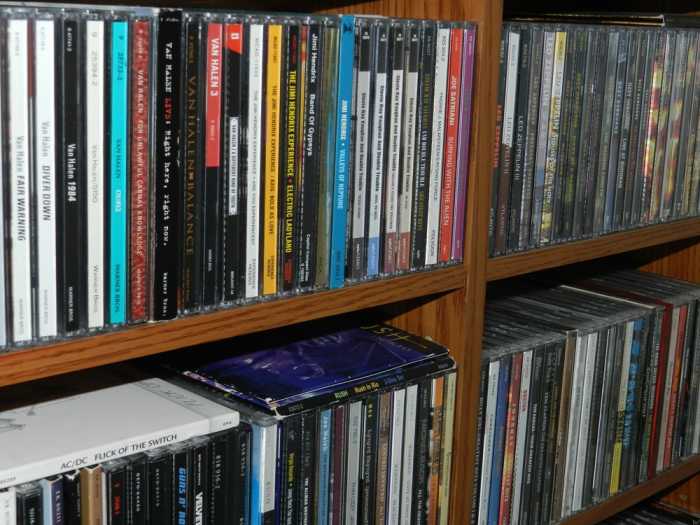
But do you know what it doesn’t have? A compact disc player. It has USB ports and an SD card reader, and it has Bluetooth and an aux-in jack, but not a CD player. While this doesn’t make me love my Jeep any less, and I know it has become the standard on most vehicles, it is a bit frustrating. I don’t know exactly how many CDs I own. Certainly, there are many hundreds, if not over a thousand. They are all now useless in my new vehicle.

Apparently CDs just aren’t cool anymore. This move by car companies is a reflection of a trend in society in general. People don't buy CDs the way they used to, and why should they when there are other, more convenient ways to buy and store music?

But for me, the decline of the compact disc isn’t just annoying. I think it’s an indicator of a much greater problem that won’t be fully realized for a decade or more. And, when it eventually comes down, it will hit music lovers hard.

In this article, I’ll try to explain why I’m not just frustrated by the move away from compact discs, but downright frightened.

Technology Marches On

Before I had a big CD collection, I had a big cassette tape collection. Again, I had hundreds of them. Maybe twenty-five years ago I started trading them in and replacing them with CDs. Before cassettes, people collected vinyl records. I only had a couple of those, but I do remember when most home stereo systems came with a record player. I also remember the 8-track boom when I was a kid, which was but a flash in the pan.

Technology changes and advances, and generally that’s a good thing. As tough as it is to find a compact disc player in a new car these days, it’s a whole lot tougher to find one that has a cassette player. It’s unrealistic to expect CD technology, or any technology, to exist forever.

Today, digital music is the thing. You don’t need to own a physical version of the music. You can download the MP3, store it and play it when you feel like it. You don’t even need to buy the whole album if you’d rather buy just one song, and you can carry many hundreds of songs with you on one small storage device.

In a lot of ways that’s pretty cool. Consumers have more choices and can move more quickly when they want to make a purchase. Bands are able to get their music out there to more people. But in other ways, I think, this model will eventually damage music as we know it.

The problem isn’t that compact discs are going away. It is that they aren’t being replaced by another physical, durable medium. Digital music, stored in the cloud or even on your own personal hard drive or storage device, has an inherently short shelf life. When technology changes again, when you change computers or when you delete a user account, you may make an effort to retain some of the music you like, but much of it will be gone forever. There are no physical copies to stand as a record that it ever existed at all.

If music isn’t important to you, you probably don’t care about this. If you are like the typical consumer you buy music on a whim and have no particular allegiance to any band, artist or genre. Music is just something in the background to distract you when you aren’t thinking about Dancing with the Stars.

But if music means something to you, or if you think art and culture with substance and value should matter, this is really bad news. To me, an album by a band I love is something I want to hold in my hands and cherish. If my hundreds of CDs were stored on my computer instead of sitting on my shelf it wouldn’t be the same.

Music matters, and it should be preserved for the future.

Music matters, and it should be preserved for the future.

Why Physical Music Matters

If you were a Beatles fan back in the ‘60s you probably bought the Sgt. Pepper’s Lonely Hearts Club Band record when it first came out in 1967. I’d bet a lot of Beatles fans still own those same original albums they spent their pennies on way back then. It still exists in physical form, even if it is stored in a box somewhere. And, if you go out and find a turntable, you can still listen to it.

If you are a bit younger and you were a Beatles fan back in 1980 you probably bought Sgt. Pepper on cassette. If you are younger still, in 1990 you likely bought the album on CD.

Heck, there are probably a lot of people who own Sgt. Pepper on vinyl, cassette, and CD, having upgraded each time technology changed. Many copies of each of those still exist, somewhere. They are physical things you can touch and hold.

But the next generation who buys Sgt. Pepper will do so in a digital format. Where will that digital copy be in ten, twenty or thirty years? Chances are it will not exist, and least, not your version that you downloaded.

The Beatles are one thing, but what about a new band who releases their first album today? If most of their music is sold in digital format, where will those albums be in the future? It simply isn’t possible to hold on to a collection of music in digital format for years and decades the way you could with vinyl, cassette, and CDs. If you hope to do so, you are depending on a range of unlikely variables.

So what if I lose my Sgt. Pepper album when my computer explodes or technology changes, you might be thinking. Surely there will be versions of an old album in new formats just like there were in cassette and CD. You can just buy it again.

You’re right. Beatles albums will probably be offered in the most modern formats until the end of time, but that’s not true for all bands. It’s nice to think that record companies would continue to offer a band’s music in new formats for anyone who wants it, but if the money isn’t there surely they won’t bother. There will be songs, albums and entire bands that end up completely lost to time.

That happened with other formats too. But the difference was if a band released a vinyl record album back in 1965 and it was never released on cassette tape or CD, at least copies of the vinyl record are potentially still around. Even though some rare or old albums are no longer printed in any format, if you put your mind to it you could buy an old one on eBay or from a collector if you are lucky.

That won’t be true of digital music. Record companies will decide what music lives and dies based on popularity, which is what they’ve always done. But, without physical copies, the fans of future generations will miss out on a lot of great music that didn’t make the cut. It will simply be gone.

This will hit fans of more obscure genres like metal, jazz and classical especially hard. If you are a casual pop music fan, again, you probably won’t care. However, I like to think maybe you'd care simply because the loss of so much great music will make the world a worse place.

Your Music in 20 Years

If you buy an album in digital form today, do you expect to still own it in twenty years? If so, you are banking on some pretty unlikely events. You need to hope that in twenty years there is still some program or service that plays whatever format your music is stored in. You’re going to have to hope whatever technology you are storing it on remains viable, intact and free of viruses, and that you remember to back everything up correctly and transfer it over each time you change computers or devices.

If you are storing your music online or in the cloud, you need to depend on those services being around in twenty years, and you need to hope they don’t have some kind of problem or disappear overnight. You are going to have to hope that, if something bad does happen, there is still some version of your music out there for you to replace your lost copy.

To be clear, digital music technology is a good thing. It’s good for new bands, it’s good for established bands and it’s good for the consumer. It makes things easier for everybody, and if you are an unsigned band there has never been a time in history when it is more possible to get your music out to more people.

But it lacks a sturdy vessel, and that’s a big problem. We can’t rely on hard drives and the ubiquitous “cloud storage” to protect our music and culture for years or decades to come. Unless this changes, in twenty years there will be a lot of music you remember from years past that you simply will not have access to anymore. It may exist somewhere, in the digital vault of some record company, but as far as the public is concerned it is gone.

Personally, I like the idea that I can remember a band from my high school or college days and still easily find their music. And, for me and I know many others, it’s also about more than just the audio portion of an album. I love the album art, leafing through the liner notes and song lyrics and all the other great stuff that came with a CD or album. With digital music, all of it is gone and that’s really sad.

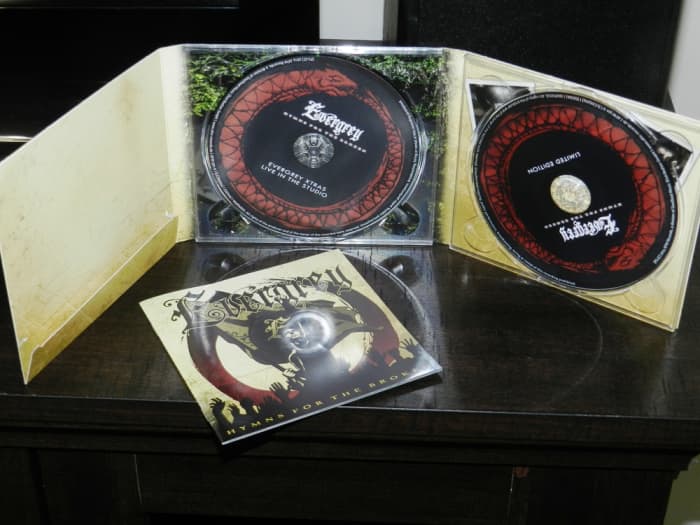
Physical albums have value beyond the audio. Bands like Evergrey give us a product we can cherish for life.

Physical albums have value beyond the audio. Bands like Evergrey give us a product we can cherish for life.

What Can We Do?

I was wandering around a thrift store the other day, checking out their shelves of second-hand CDs. Somebody had once thought it was a good idea to purchase each of those albums but has since decided they didn’t want them anymore. So, they sold them to the thrift shop, where another person can pick them up for a dirt-cheap price. The music lives on, for another generation.

If they were digital albums, the original owner would have simply deleted them when they were sick of them. What a crime. Is there any way to change this way of thinking, and would we even want to?

In my 30+ years as a musician, I have come to the unfortunate conclusion that trying to create any logical change in mainstream culture is like trying to stop a hurricane with a desk fan. The vast majority of people simply don’t care about what will happen in twenty years. As consumers, they want what is cheapest and easiest, and in some ways that’s understandable. They will continue to download songs for a few bucks a pop and the music industry will continue to give them what they want. Expecting people to wake up and figure out the damage this could do is unrealistic.

So, if you do happen to care about music, what can you do? For me, the answer is to continue to buy CDs until another form of physical album comes along. I might not be able to play them in my car, but at least I’ll still own them in 20 years. Like vinyl records today, there will likely still be a way to play them.

If you do choose to buy only digital music, you need to come up with a safe way to store it, controlled completely by you. I’d have a system of dedicated flash drives, and probably backups of those. If the only copy of the music is on your phone, you are asking for trouble.

As for my Jeep, I will probably convert some of my CDs into a digital format so I can listen to them while driving. I’ll have to download them onto my computer and move them over to flash drives or SD cards I guess.

All that seems like a big hassle and something you shouldn’t have to do just to listen to music in your car. There should be an easier way. Like, maybe some kind of disc you could just slide into a player on the dashboard.

Yeah. Somebody ought to work on that idea.

Do You Still Buy Compact Discs?

Comments

KCrusty on July 31, 2020:

I have a lot of CD's as well ...maybe only a few hundred or less. But like you mentioned, Once you move to another format, how many times are you going to pay for the licence to listen to what you already own if you copied all your cd's to a PC hardrive And you move to a new PC your media player will require a licences in order to play it. if you don't have a hard copy then your out of luck. But most people won't care about preserving their old collection

Jon Meltzer on February 10, 2020:

As long as I can keep getting CDs for $1 each at library sales because all the hipsters are dumping them for vinyl, I'm going to keep buying them.

Hell, I remember when vinyl was "worthless". Good thing I saved most of mine then so I can resell it now :-)

Source: https://spinditty.com/industry/How-the-Decline-of-the-Compact-Disc-is-Killing-Music

The Rise and Fall of the Compact Disc


CD sales drop to new low

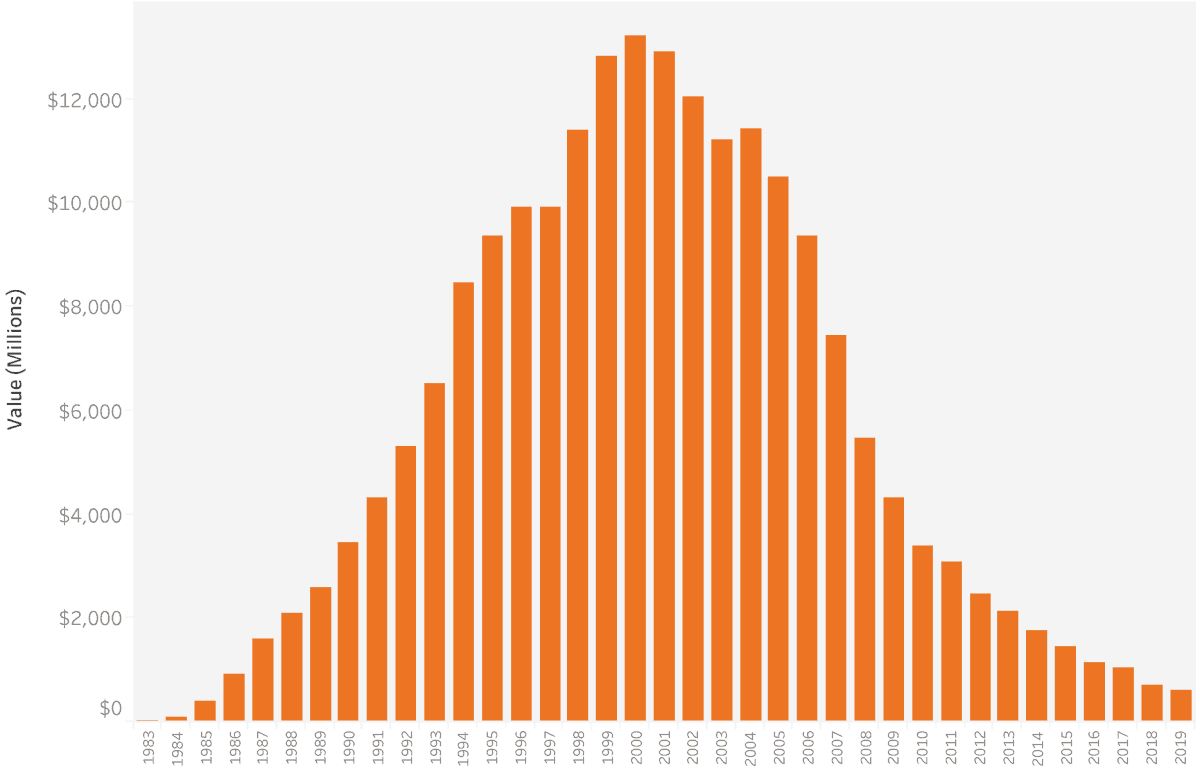
SOURCE: RIAA - The Rise and Fall of CD Sales in US 1983-2019
SOURCE: RIAA – The Rise and Fall of CD Sales in US 1983-2019

Compact Disc (CD)

Updated: 10/04/2020 – The first commercial Compact Disc (CD) was released in 1982 and the CD was planned as the successor to the vinyl record. Developed by Philips and Sony, sales of CDs grew quickly and by 2004 cumulative worldwide sales of audio CDs, CD-ROMs and CD-Rs reached about 30 billion discs and 200 billion by 2007. However, from the beginning of the early 2000s CDs were increasingly being replaced by other forms of digital storage and distribution with the result that by 2010 the number of audio CDs being sold in the US had dropped to about 50% of their peak.

By 2019 sales of music on physical media in the US had fallen to 11% of the total with only 46.5 million CDs (5.5% of the total) sold in the year compared to their peak of 942.5 million copies. CD sales in the UK declined 26.5% during 2019 and were worth £141.7m representing just 13.3% of total revenue.

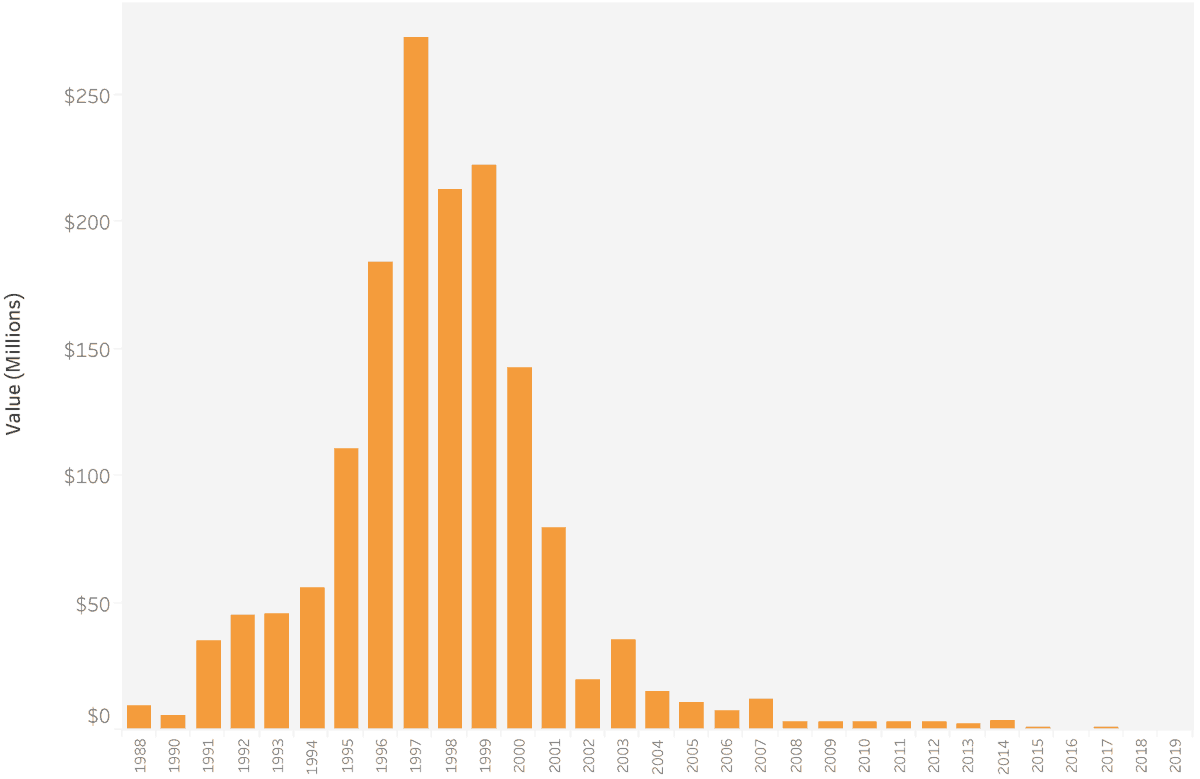
SOURCE: RIAA - CD Singles Sales in US 1988-2019
SOURCE: RIAA – CD Singles Sales in US 1988-2019

CD Singles

Launched in 1986, CD Singles had a relatively short-lived popularity in the mid-1990s but as digital distribution methods started to become available in the early 2000s sales rapidly dropped. At their peak, CD Singles sold 67 million copies annually in the US and now account for sales of less than $200,000 annually.

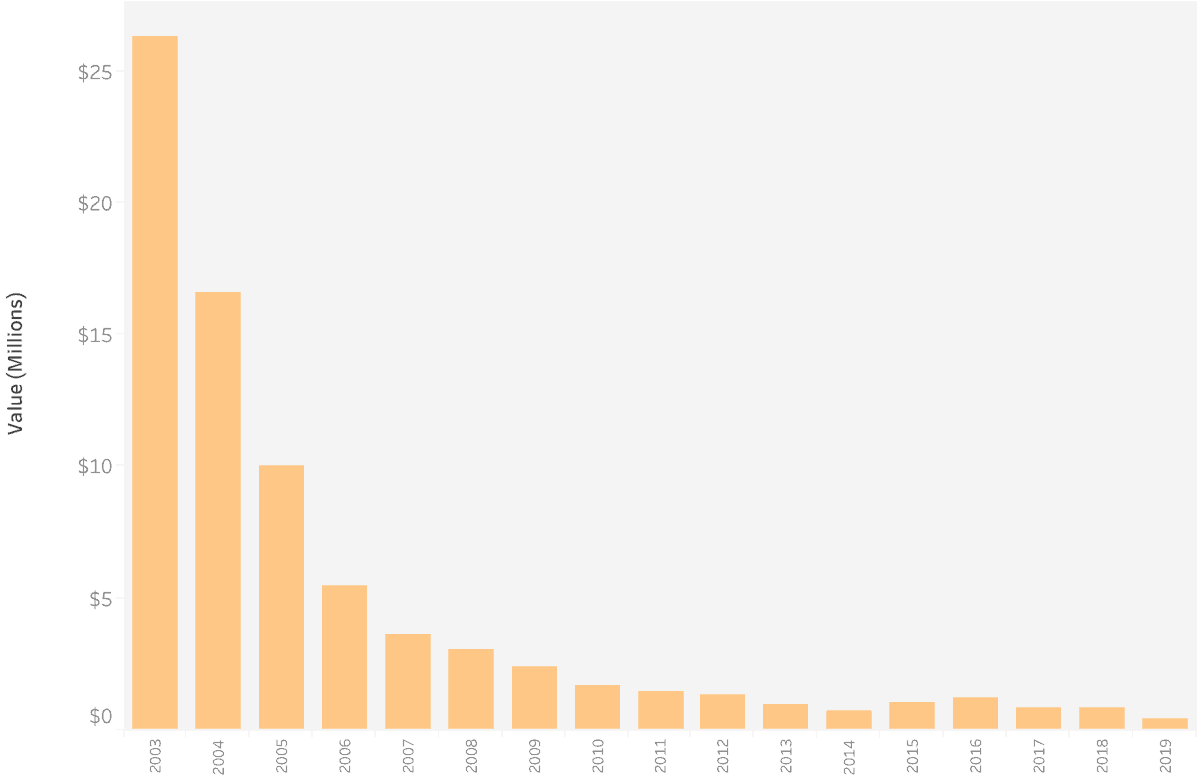
SOURCE: RIAA - SACD Sales US 2003-2019
SOURCE: RIAA – SACD Sales US 2003-2019

SACD

Super Audio CD or SACDs were developed to be the successor to the CD. They allowed additional playing time – 110 minutes compared to the 80 minutes of a normal CD – and the ability to record up to 6 channels of audio instead of the usual stereo pair of a CD. Audio quality was claimed to be improved but research published in 2007 in the Audio Engineering Society journal found no significant difference in audio quality between SACDs and CDs at ordinary volume levels. Controversy continues as whether SACDs sound better than standard CDs but commercially SACDs never caught on and from a high of 1.3 million copies sold in the US in 2003, sales have declined to $400,000 annually and mainly to a fiercely loyal audiophile audience.

Compact Disc Timeline

1982 First commercial Compact Disc (CD) released – The Visitors by Abba on 7th August
1986 First commercial CD Single released – Angeline by John Martyn on 1st February
1988
CD sales in the US overtook vinyl LPs
1992 CD sales in the US overtook pre-recorded music cassette tapes
1997 First portable MP3 player was launched in 1997 by Saehan
Information Systems selling its MPMan players in Asia in spring 1998.
1999 Super Audio CD (SACD) format launched
Napster file sharing service launched – 1st June
2000 US sales peaked at 943 million CDs
2001 Pre-recorded music cassette sales in US dropped to 4% of total
Apple launches iPod on 23rd October
2003 Most major US record companies discontinued manufacturing pre-recorded music cassette tapes
2008 CD Singles start to be dropped by record companies and retailers due to lack of demand
Spotify streaming music service launched launched 7th October
2010 US sales of CDs declined to 50% of their peak
2012 US sales of SACDs dip below 100,000 copies
2014 iPod discontinued by Apple after having sold 390 million units
US revenues from digital music services equalled those from physical format sales
2016 1.5 billion smartphones sold globally
2017 US Sales of CDs had declined to 88 million units – 12.7% of US music revenues
One third of the world’s population own a smartphone
2018 Streaming music services account for 80% of the US recorded music market
US Sales of CDs had declined to 52 million units – 7.1% of US music revenues
2019 Smartphone users are projected to number 2.7 billion users

Future of physical CDs

The Rise and Rise of Streaming

Streaming continues to take an ever larger share of the recorded music market increasing 24% in 2019 to make up 56% of global music industry revenues.

In the US streaming accounted for 80% of the recorded music market in 2019 with physical sales and digital downloads continuing to decline.

Future growth in streaming is likely to come from increased sales of Smart Speakers, ‘connected’ cars with In Car Streaming and the near ubiquitous availability of smartphones.

  Are Smart Speakers the future of Streaming?

US retailers are starting to stop stocking physical CDs

According to Billboard magazine, US retailer Best Buy has told music suppliers it will be ceasing the sales of CDs from its stores from the 1st July 2018. Sources estimate that despite being the most powerful music retailer in the US, the company’s CD business is ‘only generating about $40 million’ every year.

Best Buy will continue to sell vinyl for the next two years, which enables them to keep their commitments it made to vendors.

Another retailer, Target, has already reduced its music presence, having gone from selling around 800 music titles to now ‘less than 100 titles in most stores’

Future of the CD format

The future of the format seems assured with streaming services adopting it as the base level audiophile/HiFi standard adopted by Qobuz, TIDAL, Deezer, Primephonic, Idagio and the Neil Young Archives. These early adopters have now been joined by industry heavyweight Amazon with their Amazon HD service launched in September 2019 offering both CD Quality and HiRes streaming to their Standard Quality (320 kbps MP3) streaming subscriptions.

CD Quality streams are usually 44.1kHz/16bit FLAC and will need a steady internet connection of 1.5 to 2 Mbps. A 3½ minute song downloaded for offline listening will typically need 51 MB of storage.

Most smart speakers, gaming devices and smart TVs support the CD Quality file format and there are now even CD Quality Internet Radio Stations offering a range of programming options with audiophile/HiFi quality sound.

  CD Quality Internet Radio
  How to listen to lossless FLAC Internet Radio with your browser

Link: https://www.hiresaudio.online/the-rise-and-fall-of-the-compact-disc/

Opinion from Disgogs: The Future of CDs


There has been a lot of press and attention given over the last couple years about the ‘return’ of vinyl, with sales numbers for the format reaching highs unprecedented since the compact disc became popular. Yet while we are celebrating the vinyl renaissance (I love it so much I actually wrote a book about it called Why Vinyl Matters), what HAS happened to our former love, the shiny CD? While I extol the virtues of the LP loudly and often, I have to admit I still do own and play CDs (especially in my car). I decided to ask some of my friends, peers and colleagues what they thought the fate and fortunes of the seemingly jilted CD. In no particular order, here are the responses. If my tiny sample group is any indication, the CD is not extinct just yet. –Jennifer Otter Bickerdike

KEVIN MCMANUS-CURATOR, BRITISH MUSIC EXPERIENCE

As part of the British Music Experience, we have a fascinating small display called Playback that highlights the different ways we have listened to music over the years. In amongst the many lovely bits of kit we have on display (the space age looking 8 track player, the boombox, the Dansette, etc.) the poor old CD player looks dull and functional. Two words that probably sum up the largely unloved CD itself.

CDs got a foothold in the mass market when I was doing a load of freelance writing for NME. One of the perks of a job like that was that you get sent loads of free records. Being a slow adapter of new tech and a generous soul to boot, I initially just gave all my freebie CDs away to more savvy mates and persisted with vinyl. Then record company publicists stopped asking which format you wanted their music in and only sent you CDs. I was reluctantly forced to convert. I don’t think I have ever been fully won over by the format. Even though I do still buy the occasional CD, I’ve never felt any real emotional attachment to my collection of CDs in the same way I do with my vinyl. This became clear to me when I recently moved house and was under strict instructions to throw some of my ‘stuff’ out so that we actually had some space in the new place that wasn’t full of my own mini museum/archive. Suffice to say, every single vinyl record I own survived this savage cull while a mountain of CDs was discarded without causing me any great emotional trauma.

Every house and apartment should have records and record players in them. Things would be better.

JULIA RUZICKA-FUTURE OF THE LEFT

Let’s not bury this little fella just yet. Sure, it’s not as cool as its older vinyl sister, and not as vital as its younger digital brothers; but there is still some value left in the CD. The future isn’t bright, but perhaps somewhat stable? Manufacturing time and costs in terms of vinyl production make the CD still a great option for the merch table on tours – the livelihood for many bands. CDs are easier when moving house. They’re still satisfying to whack into the car stereo on a long trip (for us older car owners) and you generally don’t have to worry about them as much – they are the practical, old school, less glamorous sibling of musical formats. The “meh” within the world of recorded music distribution. Nothing wrong with a bit of “meh” in our lives from time to time.

SIMONE ODARANILE-THE GO! TEAM

Growing up and during my teens, my CD Walkman and CD collection were literally my best friends! It’s like comparing E-readers and tablets to books: For me there is not the same personal connection when reading through album artwork and physically placing a CD in to a machine as there is to downloading a track from iTunes. There is something special about having a collection and watching it grow right in front of your eyes! CDs are perfect for bands and artist of all sizes to create and sell; they are an all-arounder for everyone. Let’s not let them go just yet, hey?

CHARLIE ASHCROFT-BT AND AMAZING RADIO

The CD should survive its relative lull. Vinyl costs (to manufacture and buy) are rising, so demand for it may wane again, meaning the CD may re-surface as the physical product, although some distance away from the sales peaks of past decades. Continued mainstream supermarket presence will still count for a lot. Download codes could accompany CD purchases, given the amount of computers without CD drives. Outside the home, CDs still serve the commute, in the same way that FM radio hasn’t disappeared yet. Not everyone has the newest DAB-fitted, data-enabled vehicle — or a streaming subscription.

LUKE GRIFFITHS-FALSE HEADS

The future of CDs seems to be in an extremely bizarre place at the moment. For me, and a lot of people in their twenties and late teens, the CD was like having vinyl (this was really just before the vinyl resurgence occurred). I have a lot of affection for the CD, it was like what vinyl was back in the day AND for what it is now for a lot of people. You had a physical copy of something, with lyrics, liner notes- a proper physical copy in your hand. It’s not like now where record players are everywhere and vinyl is in vogue (which is a good thing, in my opinion; music is more than just streaming) so as a 15-year-old, there wasn’t much chance of getting a record player, and why would I? Vinyl seemed to be dead. Now, vinyl is back and even from our perspective, barely anyone buys our CDs, everyone buys our vinyl. So where do CDs stand? I don’t know. But who expected vinyl to come back like this? Also, remember EVERYONE has a CD player, so I’m not convinced they’re being killed off just yet.

KIM BAYLEY-ENTERTAINMENT RETAILERS ASSOCIATION, RECORD STORE DAY UK

The compact disc remains the most transformational format the music industry has ever seen. Neither the download nor yet streaming have managed to eclipse it. Importantly, 15 years since the launch of iTunes in the UK, the compact disc remains the UK’s biggest album format with around 750,000 discs sold every week. Despite the acres of newsprint devoted to the vinyl revival, the CD stills outsells its vinyl precursor by about ten to one. The relatively poor perception of CD these is in part a factor of just how successful it was: its ubiquity has meant it is too often taken for granted. The fact is its virtues – convenience, sound quality, portability – are the same today as when it was first launched. Sales are certainly down, but CD still has a lot of life left in it.

GRAHAM JONES-AUHTOR, LAST SHOP STANDING

When it was invented in the 1980s the CD was viewed as the future of music. It looked space aged, a gleaming silver disc that the industry told us had a superior sound and no matter how much wear and tear it suffered, would always play perfectly. We were encouraged to change our vinyl collections over to this exciting format, and the industry was happy to sell us our record collections all over again.

The problem with the CD is that it has not improved in more than 30 years. We can send a spacecraft to the edge of the universe but have still not invented a satisfactory CD case. If crushed, the teeth of the plastic tray break so when you open your CD, lots of little pieces of plastic drop out. CDs are wrapped in that irritating plastic that is difficult to tear off. You end up using your teeth or getting a knife. It is as if the format has been sentenced to a long lingering death and nobody is prepared to save it.

People treasure vinyl and take great care not to damage it, yet people don’t value the CD in the same way. My job involves driving all over the UK to visit record shops. On these trips, I take the opportunity to listen to many of our forthcoming releases that I will be selling to the record shops. When I have finished listening to a CD, I throw it on the seat of the car or in to the glove compartment. When I have finished listening to vinyl, I don’t hurl it across the room like a frisbee. The record is carefully replaced in the inner sleeve, before being inserted in the album cover.

Nobody can deny that the CD is undergoing a long and steady decline but talk of “the death of the CD” is premature. It is important to recognize that all formats are integral in ensuring that music prospers. The CD should not be a format we ignore, they are an integral part of the British music industry success story that ought to be celebrated.


RHIAN JONES-MUSIC BUSINESS WORLDWIDE, HITS

For 15 years from the early ‘90s, CDs ruled the music market after rocketing past cassettes to represent the number one format in which people would buy tunes. Before that, cassettes had done the same to vinyl, and now digital is doing it to physical. In 2015, cash generated from the sale of digital downloads and music streaming surpassed CDs (and vinyl), and last year, streaming alone took a 38% marketshare while CD sales counted for less than 30%, according to stats from the IFPI. The global domination of smartphones is only growing and you can’t jam a CD into an iPhone. At their current rate of decline, CDs will count for less than 15% of the music market by 2025 — and it’s surely only downhill from there. If you can afford a bespoke music listening experience at home, would you chose high quality sounding and beautiful looking vinyl, or compressed CDs in plastic casing? In the words of British troubadour Sam Smith, the writing’s on the wall.


JOEL D’EATH-MUSIC FOR NATIONS

Even with my relatively short time in the music industry, I have been surprised multiple times by the changes in people’s listening habits. Fifteen years ago who would have even considered that people would have access to millions of songs on a telephone (that fit in your pocket!!), but equally people are baffled that a vinyl LP is now not just a nostalgic safety blanket, but a format powerhouse in 2018 (24,500 UK sales for Arctic Monkey’s Tranquillity Base Hotel & Casino in one week). So what’s the future of CDs? I’m unsure, but I’m not throwing mine away, I could be sitting on a goldmine!


DEAN HEWINS-BOOGALOO DEE

I don’t think CDs will be obsolete, just look at what happened to cassettes and how that has become a collectors’ thing now after being obsolete for many years. There is always the gifting market to keep it going, albeit in a much smaller capacity.

I find it hard to believe that they will be revered as records are, but for the collectors market, and the possibility of CD only versions of albums (Michaels Jackson‘s Bad included Leave Me Alone on CD only for example) will drive the music fans who feel the need for physical media, but don’t collect vinyl.


BRENT GREISSLE-DISCOGS’ DISCOGRAPHY SPECIALIST

There’s room for a resurgence here, but I have my doubts. Sales of CDs have been increasing over the past few years. They’re still a fraction of the market, which vinyl still holds control over. As a collector, I’m finding that good records are getting harder to find at affordable prices. Vinyl has more competition between collectors. CDs are going to continue to grow over time. People will find new music without extensive efforts to find affordable copies. CDs are also much quicker to produce than vinyl and at a fraction of the cost. This is more attractive to artists looking for physical merchandise. As ’90s/’00s nostalgia continues to grow, people are going to want the music and media of their youth.

There are a few down sides to CDs that I can see continuing to hamper growth. During the heyday of CDs, pretty much every vehicle and computer had a CD player. CD collectors may need to go through more effort to find functioning players. There is also evidence that CDs may have a shorter lifespan than records. Issues such as bronzing or cheap CDR degradation may mean unplayable copies.


Source: https://blog.discogs.com/en/the-future-of-cds/


11/28/2020

3 ways the pandemic has changed our music listening habits — from commuting to country songs

I’m a neurotic music listener, which means I have playlists for everything.

Usually, I can look back on those song collections and remember exactly where I was in life, where I lived, how happy I was or which Playboi Carti I was listening to 20 times a day.

But when I reflect on my playlists from the last six months, I see words like “nostalgia” and “cry.” One playlist has a title that features the facepalm emoji. Another is dedicated solely to songs that, ironically, sound better when played in a crowd.

It’d be an understatement to say my music choices have changed over the past half year, and apparently, I’m not alone.

According to a study released by Nielsen Music/MRC Data earlier this summer, our country’s listening habits have made some drastic left turns since March — when the coronavirus pandemic changed just about every part of our daily lives.

Glenn Peoples, Billboard’s lead analyst, explained our months of quarantining as a “pressure cooker,” which has fast-tracked trends that may have been bubbling below the surface.

“I think it accelerated a lot of consumer behaviors that would’ve happened anyway, but now it’s like a pressure cooker for trends and changes in the market,” he told In The Know.

These changes are widespread, and they’re affecting a lot more than what anal retentive music fans (like me) name our playlists. Since March, Americans have changed not just what they’re listening to but also where they listen and how often they do it.
An ‘on-the-go’ habit

Before the pandemic, the music industry was having a record year. From Jan. 1 to March 12, total audio activity — that is, how much people are listening to music across all formats — was up by 14.6 percent over the same period in 2019, per Nielsen Music/MRC Data’s analysis.

Strangely, audio activity has kept growing since then but by a smaller margin. From March 12 to July 2, listening had fallen to a 6.2 percent rate of growth compared to 2019.

So what caused the drop-off? The report shows a sharp decline for physical album sales during the first months of quarantine, although there’s some evidence that this trend has reversed.

Streaming also saw a decrease. On-demand listening on apps like Spotify and Apple Music was up by more than 20 percent during the first two months of 2020, but that figure fell to around 14 percent from March to July.

It’s a change that, according to Peoples, has some at least some connection to our new normal. For example, music fans are no longer driving hours to and from work each day, or blasting their volume to drown out annoying subway passengers.

“Music streaming is very much an on-the-go kind of product. It’s very much tied to the smartphone,” Peoples told In The Know. “And if people are not out of the home … they’re gonna stream less.”

Music has gotten less personal since March, but in the process, it’s become more communal. For example, Peoples said smart-speaker listening had grown during the first months of the pandemic, as families and roommates holed up at home with their favorite albums.
‘Family friendly’ music

Of course, different music sounds better in different environments. For example, would you rather listen to Beyoncé’s “Lemonade” album on a $5 pair of earbuds or through a surround-sound speaker system?

Our choices in quarantine have been less obvious. Without many of our ritualistic listening spaces (the car, the gym or the wine aisle at Trader Joe’s), we’re not queueing up the same genres as usual.

In fact, Nielsen Music/MRC Data’s research found that all but two genres saw their listening numbers decrease during the first weeks of quarantine when compared with the growth during 2020’s pre-pandemic months.

One exception: country music. The genre saw a 21.4 percent increase during that time, a trend Peoples tied largely to technology.

Country fans, he explained, have traditionally been slower to latch onto new music trends like streaming services and smart speakers. During quarantine, though, they didn’t have a choice but to make the switch.

Then there’s the nature of quarantine itself. Suddenly, families were spending all of their time at home together, and, as Peoples described it, country offered a “family-friendly” option.

“People didn’t have to worry about playing it around their kids,” he said.

It’s impossible to prove exactly why families are queuing up Dierks Bentley over say, Lady Gaga, but kids are certainly playing a role. Nielsen Music/MRC Data also found that, after schools nationwide closed their doors in March, children’s music saw its own bump in popularity.
‘A break from reality’

Nostalgia might not be a genre, exactly, but just like country music, it’s having a moment. Nielsen Music/MRC Data’s analysis found that, during the pandemic, people sought comfort in the familiar.

“Older” songs — defined by Nielsen Music/MRC Data as anything released more than 18 months ago — saw an increase in the first months of quarantine. In fact, as the report states, 87 percent of consumers “turned to music they usually listen to.”

Peoples said that to him, the trend shows people may have been identifying older music as a “soothing” alternative to the current state of affairs.

“They needed a break from reality, and I think older music was probably very soothing to people,” he told In The Know.

Just like in my quarantine playlists — one of which is strictly devoted to songs I loved in the 10th grade — music fans are gazing backward. That’s not to say new music has become invisible though.

There’s been an exciting amount of new music of the past six months, even with A-listers like Lady Gaga and The Chicks pushing back their albums at the start of the pandemic.

Those records, among others from superstar artists like Taylor Swift, got plenty of shine during quarantine, while platforms like TikTok have continued boosting new artists — including Doja Cat, Saint Jhn and Roddy Ricch — to the top of the charts.

Throwbacks might be surging, but it’s clear we’re still on the lookout for new songs.

As Peoples explained, music fans won’t ignore the chance to discover what’s new — especially if it comes easily. He specifically pointed to Spotify’s New Music Friday playlist, which updates with the latest releases each week, as an example.

“They’re gonna listen to that whether or not some country star released a single that day,” Peoples said.

It might be the optimist in me, but it feels like there’s some encouragement in that thought. The pandemic has changed so much about our daily lives, and as a result, how we use music to cope with the world around us.

Our habits might be changing — which isn’t necessarily good or bad — but new music keeps coming out, and we keep listening. In a year where everything feels different, there’s something a little comforting in that.

If you liked this story, check out In The Know’s article on how nationwide protests has shed new light on older songs.

Source: https://www.intheknow.com/2020/09/11/music-listening-pandemic-covid19-nielson-billboard-spotify/

11/27/2020

The Past Year, And Decade, In Music Listening: Video Rules, The Boy's Club Remains

Two competing data firms, BuzzAngle and Nielsen Music, released reports in early Jan. 2020 detailing the many changes in listening over the past decade. Kirsty Lee / EyeEm/Getty Images/EyeEm hide caption

Two competing data firms, BuzzAngle and Nielsen Music, released reports in early Jan. 2020 detailing the many changes in listening over the past decade.

As we ease into the 2020s, data about the music industry's growth is more abundant than ever.

Within the last week, BuzzAngle and Nielsen Music — the two central, competing, public-facing music-data firms in the U.S. — released their annual reports on music listening trends. BuzzAngle powers Rolling Stone's charts and is owned by Penske Media, the parent company of Rolling Stone, Variety and Deadline; Nielsen Music was acquired by Valence Media, the parent company of Billboard and The Hollywood Reporter, in December 2019.

The two reports differ on some details, but are directionally similar. Both put the total number of music streams in the U.S. last year over one trillion for the first time, representing a 15% growth in streams year-over-year. Both note that on-demand streaming accounted for over 80% of total consumption in the U.S., and that audio streaming in particular continued to register solid annual growth (from Nielsen's 24% to BuzzAngle's 32%).

Nielsen's report in particular sheds light on the artists who dominated the past decade. Drake, Eminem and Taylor Swift were the only three artists to rank in the top 10 for the most album sales and streams last decade — country stars like Kenny Chesney, Tim McGraw and Toby Keith lead the radio airplay charts over the same time period. Interestingly, while Adele had the two best-selling albums of the decade — 21 and 25, respectively, both released in 2015 or earlier — she's nowhere to be found on any decade-end streaming charts.

In general, music listening is accelerating: According to BuzzAngle, last year's streams alone accounted for more than 30% of all streaming activity over the past six years. But beneath the "one trillion streams" headlines are some deeper truths about the current state of the music business — some of which reflect the industry's stubborn resistance to change, and others of which provide a sign of the global transformation to come.

Audio streams might rule the U.S., but video streams rule the world

Audio-streaming services like Spotify and Apple Music tend to suck up much of the air when talking about the modern music industry, at least in the U.S. But zoom out to a global level and it's actually video — not audio — that reigns supreme.

Nielsen Music and BuzzAngle both found that audio accounted for around 70% of total on-demand streams in the U.S. in 2019, with video comprising the remaining 30%. But Nielsen's worldwide streaming data flips that ratio on its head: Out of the 5.1 trillion on-demand music streams generated globally in 2019, including U.S. plays, 66% came from video, while the remaining 33% came from audio.

This is because YouTube is the preferred consumption platform and marketing machine for several international music genres, from K-pop in Korea to Bollywood in India (YouTube alone accounts for 40% of Indian labels' revenues). Unlike Spotify Premium or Apple Music, YouTube is free and doesn't require a login, raising its appeal for music markets whose consumers might have lower per-capita incomes or haven't yet warmed up to the concept of a paid streaming subscription.

More songs than ever are in the 500-million-streams club, but power is still concentrated

Comparing the reports also outlines a dual narrative with respect to whether the music industry is really becoming a more-level playing field.

On one hand, more artists and songs are participating in the "top 1%" of the industry. According to BuzzAngle, 31 songs were streamed over 500 million times in 2019, up from 21 such songs in 2018. A tier below, nearly 900 songs were streamed over 100 million times last year, up from 525 in 2018.

But that doesn't mean the distribution of power has gotten any more equitable. BuzzAngle found that the 1,000 most-streamed songs in 2019 accounted for 18% of all streams, while the top 500 album titles were responsible for 30% of all album sales — same as the year before.

Major labels also dominate nearly all of the top artist, album and song charts in both reports. With the exception of YNW Melly's "Murder On My Mind," the top 25 songs, albums and artists of 2019 in BuzzAngle's report were all owned and/or distributed by a major label. Nielsen Music found that Universal Music Group, the largest record label by annual revenue, saw little change to its dominant market share, controlling 38.7% of the market in 2019 versus 38.1% in 2018 .


This isn't necessarily to say that the music business is stale, or hostile to disruption. Consider "Old Town Road." Within just one year, the song that Lil Nas X made with a $30 beat and then strategically seeded onto platforms like Triller and TikTok ended up becoming the most-streamed song of the past 10 years, beating ubiquitous hits like "Despacito," "Rockstar" and "Uptown Funk." But even "Old Town Road" arguably could not have gotten to its historic peak without major-label backing — in this case, a distribution deal with Columbia Records, which helped Lil Nas X land remixes with Billy Ray Cyrus, Young Thug, Mason Ramsey and RM from BTS. Not only did these high-profile celebrities help promote the single, the remixes' streams also counted toward the original song's tallies, helping the track make history as the longest-running No. 1 hit on the Billboard Hot 100.

Vinyl might be having a "revival," but CDs still account for the vast majority of physical albums

Album and song sales continue to wane across the board, seeing a 20% to 25% decline year-over-year in 2019, per BuzzAngle and Nielsen, respectively. Yet vinyl album sales continue to grow, by 11% to 15% annually (BuzzAngle and Nielsen, respectively). According to the Recording Industry Association of America (RIAA), revenues from vinyl records are poised to surpass those from CDs within the next few years.

But there's one important caveat: In terms of units, vinyl is not the top physical music format — far from it, in fact. In 2019, CDs still accounted for 74% to 80% of physical album units sold, according to BuzzAngle and Nielsen, respectively. (Absolute numbers differ between the two reports; BuzzAngle pegs the number of CDs sold last year at 44.9 million, while Nielsen Music reports 54.8 million.)

In contrast, vinyl constituted only around 17% to 19% of physical units sold last year — 10.7 million per BuzzAngle and 18.8 million per Nielsen. While vinyl might be providing the music industry with a growing source of revenue, it doesn't come close to achieving the reach of the CD market. The vinyl market also skews the oldest out of all music formats; six out of the top-10-selling vinyl albums of 2019 were released before 2000, and 67% of vinyl sales overall last year came from catalog (i.e., music older than 18 months), according to Nielsen.

Remember: album sales aren't all created equal

Since streaming now accounts for the vast majority of music listening in the U.S. (again, about 80%), it's natural to assume that those plays are an appropriate proxy for consumer behavior across other formats. But a closer examination of the Nielsen Music and BuzzAngle reports reveals that that could not be further from the truth.

Sales-oriented music charts, like the Billboard 200, calculate artists' rankings using formulas that convert stream counts into approximate "album equivalents." For example, as of summer 2018, the Billboard charts register one "album unit" for every 1,250 paid audio streams, 3,750 ad-supported streams or 3,750 video streams. BuzzAngle, meanwhile, has a simpler, unweighted formula, adding one "album project unit" for every 1,500 on-demand streams, regardless of the streams' source or financial value.

Under these formulas, if only one song on a ten-track album was streamed a million times, with the remaining tracks receiving zero activity, that would count just as much towards an album ranking as every track receiving 100,000 streams each.

As of this month — this week, in fact — the Billboard 200 chart is also now incorporating YouTube data into its formula, which puts even further weight on an album's biggest single(s) rather than on all the project's tracks as a whole. In short, album equivalent units often don't reflect actual album consumption, let alone physical album purchases — a nuance that's difficult to communicate in the context of a surface-level chart.

Radio listening and album sales paint a completely different picture of popularity than streaming

Let's compare the top artists on streaming versus terrestrial radio in both reports.

Unsurprisingly, hip-hop/R&B was the top genre for on-demand streaming in 2019, accounting for nearly a third of total on-demand streams. Moreover, rappers accounted for over half of the top ten most-streamed artists and songs of the year, according to Nielsen. BuzzAngle reported an even stronger skew in favor of hip-hop/R&B, with the genre accounting for 80% of the top 25 artists of the year (by on-demand streams).

In contrast, Nielsen's radio airplay charts are almost completely devoid of hip-hop. Towards the end of Nielsen's report, there are four lists of the top artists and songs by airplay spins and audience reach for the decade ending 2019, encompassing 40 total slots. Only five of those slots went to hip-hop/R&B artists, with country and rock dominating nearly all others.

Isolating album and song sales presents a similar story. Country and rock accounted for 14 of BuzzAngle's top 25 artists by album sales from 2015–2019, while only two rappers make an appearance in Nielsen's top 10 artists of the decade by album sales and song sales — Drake and Eminem.

Once disparate, the demographics of streaming, album sales and terrestrial radio listeners are now starting to blur

Listeners of all ages, including parents and seniors, are adopting smart speakers and other voice-enabled devices at a rapid pace, helping revivify back catalog in the streaming era. And it's not just the old guard who can benefit from selling vinyl: Colorful physical products like vinyl records can potentially help an artist stand out in the crowded streaming landscape — and, when bundled with a digital download, can even help them climb the charts (as long as they stick to the rules). In general, the physical market is also increasingly online, with nearly half of all physical album sales in 2019 happening via online e-commerce stores, according to BuzzAngle.

Perhaps the most surprising case study: While Billie Eilish may be a streaming darling, she also has a much more solid track record in vinyl sales than most of her modern-pop peers. In 2019, 19% (BuzzAngle) to 26% (Nielsen Music) of physical units sold for Eilish's When We All Fall Asleep Where Do We Go were vinyl LPs. In contrast, only 6% of physical sales for Taylor Swift and 9% of those for Harry Styles came from vinyl.

The upper echelon of music is still a boy's club

A disappointing takeaway from both BuzzAngle's and Nielsen's reports is the lack of women among the top-selling artists and songs of both 2019 and the past decade — suggesting that progress towards gender equality in recorded music over the past five to ten years has been incremental at best.

Gender inequities vary somewhat by musical genre. The upper echelons of the pop charts tend to be more inclusive — with the likes of Ariana Grande, Billie Eilish and Taylor Swift reigning in 2019 — but the top of the hip-hop, country and rock charts remain male-dominated. BuzzAngle's report reveals that all of the top-consumed hip-hop songs and albums of 2019 were performed by men. With the exception of Lizzo, Nielsen's hip-hop/R&B year-end charts were also completely male, and not a single woman made it onto Nielsen's top country and rock charts for the year.

While disruptive in a commercial sense, the advent of streaming has not necessarily made this gender split any better. According to BuzzAngle, with the exception of Cardi B's "Bodak Yellow" and Camila Cabello's "Havana," all of the 25 top-streamed songs over the past five years were by male artists.

These findings parallel more longitudinal studies carried out by institutions such as the USC Annenberg Inclusion Initiative, which found that female artists accounted only for 16% of the top 500 charted country songs from 2014 to 2018. Artists like Jennifer Nettles Glamour have been speaking out against these inequities for years, yet they still play out across streaming, physical and radio formats, as well as in the live sector (e.g. the absence of women headliners from this year's Coachella lineup).

It may be a new decade, but the music business is still rife with ingrained biases and gatekeeping practices that prevent women and other minority groups from accessing key exposure, revenue and career opportunities — let alone appearing on year-end industry reports.

Source: https://www.npr.org/2020/01/14/796187782/the-past-year-and-decade-in-music-listening

3/27/2020

Artist: Harry Chapin

Harry Forster Chapin (December 7, 1942 ΓÇô July 16, 1981) was an American singer, songwriter, and humanitarian who fought to end world hunger.

Following an unsuccessful early album made with his brothers, Tom and Steve, Chapin's debut album was Heads and Tales (1972, #60), which was a success thanks to the single "Taxi" (#24). Chapin later gave great credit to WMEX-Boston radio personality Jim Connors for being the DJ who "discovered" this single, and pushed the air play of this song amongst fellow radio programmers in the U.S]

However, Chapin's recording future became somewhat of a controversy between two powerful record companies headed by two very powerful men, Jac Holzman of Elektra Records and Clive Davis of Columbia. According to Chapin's biography Taxi: The Harry Chapin Story by Peter M. Coan, Chapin had agreed in principle to sign with Elektra Records on the grounds that a smaller record label would give greater personal attention to his work. Clive Davis, however, remained undaunted, doubling almost every cash advance offer Chapin received from Holzman. Despite a cordial relationship with Holzman, Davis had a long history of besting Holzman over the years to particular artists, but this was one time that he did not prevail. Chapin ultimately signed with Elektra for a smaller advance, but with provisions that made it worth the move. The biggest stipulation in the nine-album deal was that he receive free studio time, meaning he paid no recording costs. It was a move that would ultimately save Chapin hundreds of thousands of dollars over the term of his contract and set a precedent for other musicians. "This was completely unheard of," said Davis in the Coan book. "There was no such thing as free studio time."

Chapin's follow-up album, Sniper and Other Love Songs (1972, #160), was less successful despite containing the Chapin anthem "Circle" (a big European hit for The New Seekers). His third album, Short Stories (1974, #61), was a major success. Verities & Balderdash (1974, #4), released soon after, was even more successful, bolstered by the chart-topping hit single "Cat's in the Cradle", based upon a poem by his wife. Sandy Chapin had written the poem inspired by her first husband's relationship with his father and a country song she heard on the radio. When Harry's son Josh was born, he got the idea to put music to the words and recorded the result. "Cat's in the Cradle" was Chapin's only number one hit, shooting album sales skyward and making him a millionaire.

He also wrote and performed a Broadway musical The Night That Made America Famous. Additionally, Chapin wrote the music and lyrics for Cotton Patch Gospel, a musical by Tom Key based on Clarence Jordan's book The Cotton Patch Version of Matthew and John. The original cast soundtrack was produced by Tom Chapin, and released in 1982 by Chapin Productions.

Chapin's only UK hit was "WOL*D", which reached #34 in 1974. His popularity in the UK owed much to the championing of BBC disc jockey Noel Edmonds. The song's success in the U.S. was championed by WMEX jock and friend of Chapin's Jim Connors who in part inspired the song.[The national appeal of the song was a result of disc jockeys playing it for themselves, since the song dealt with a much-traveled DJ, problems in his personal life, and his difficulty with ageing in the industry. This song was also a significant inspiration (though not the only one) for Hugh Wilson, who created the popular television series about DJs and radio, WKRP in Cincinnati] Chapin's recording of "The Shortest Story", a song he wrote about a dying child and featured in his 1976 live/studio album Greatest Stories Live, was named by author Tom Reynolds in his book I Hate Myself and Want to Die as the second most depressing song of all time (just behind "The Christmas Shoes").

By the end of the decade, Chapin's contract with Elektra (which had since merged with Asylum Records under the control of David Geffen) had expired, and the company made no offer to renew it. A minor deal with Casablanca fell through, and Chapin settled on a simple one-album deal with Boardwalk Records. The Boardwalk album, though no one knew it at the time, would be his final work. The title track of his last album, Sequel, was a follow up to his earlier song "Taxi", reuniting the same characters ten years later. The songs Chapin was working on at the time of his death were subsequently released as the thematic album The Last Protest Singer.


Discography

In 1972, Chapin switched his career focus to music. After a bidding war broke out over him, he signed a recording contract with Elektra Records. The contract was unprecedented as it granted him free recording time.
His 1972 debut album, Heads & Tales was an international success. It sold 1.1 million units. It was boosted by the Billboard Hot 100 top 20 single, Taxi. The song was also a top 5 hit in Canada. The song is based on Chapin's ex-girlfriend, who wanted to be an actress, selling out her dreams and marrying a rich man. While Chapin originally wanted to be a pilot, and he is now "flying" in his taxi. The story-line, however, is from a dream he had the weekend before he was supposed to start driving a taxi. He got a film job and didn't have to drive the taxi.

The follow-up album, Sniper and Other Love Songs was released the same year. The single, Sunday Morning Sunshine became a top 30 Billboard Adult Contemporary hit. The album's signature song, Sniper, is an almost 10 minute long ballad about the University of Texas tower shooting. The album also contained the Chapin anthem, Circle. The album sold 350,000 units.
His next album, Short Stories was released in 1973. It sold 1 million units. The album produced another worldwide hit, W·O·L·D. The single became a top 40 hit on the Billboard Hot 100, a top 10 in Canada, and top 10 and 20 in various other countries. The song is about an aging disc jockey who has given up his entire life to continue his career. The song is sung in the point of view of the jockey to his ex-wife. The song was inspired by Jim Connors when Chapin listened to him during a phone call to his ex-wife while at the WMEX studio. WOLD is an actual radio station in Marion, Virginia but there is no relation. The name simply comes from getting old, hence the "O*L*D*".

In 1974, he released his most successful album, Verities and Balderdash. It sold 2.5 million units. It was boosted by the #1 hit, Cat's in the Cradle. The single itself sold 1.3 million units. The song is about a dad who didn't have time for his son during his childhood, and then quickly turns into his son not having time for him. The song is from a poem his wife, Sandra Chapin, wrote. A second single from the album, I Wanna Learn a Love Song, was a top 10 hit on the Billboard Adult Contemporary. The song is based on how he met his wife. Another notable song from the album is 30,000 Pounds of Bananas. Although not released as a single, the song was extremely popular. It is based on a real truck crash in Scranton, Pennsylvania that was hauling bananas.
In 1975, he released his fifth studio album, Portrait Gallery. The album was less successful than the last, but contained the top 40 Billboard Adult Contemporary hit, Dreams Go By. The album sold 350,000 units. However, he was working on a Broadway play, The Night That Made America Famous. The play earned a total of 4 award nominations.

In 1976, he released two albums. The first was Greatest Stories Live. The album sold 2.1 million units. It was his first live album featuring a select number of songs from the previous albums. He also released On the Road to Kingdom Come. The album had no single release, but contained two popular songs, Corey's Coming and The Mayor of Candor Lied. The album sold 350,000 units.

In 1977, he released his seventh studio album, Dance Band on the Titanic. The album had no single release, but was named London's album of the year. The album sold 500,000 units.

In 1978, he released his ninth studio album, Living Room Suite. Despite the economic recession, the top 20 Irish hit, Flowers Are Red, was produced. The album sold 350,000 units.

In 1979, he released his second live album, Legends of the Lost and Found. Still in the economic recession, the album sold 250,000 units.

In 1980, his recording contract was up. He signed a new one-album deal with Boardwalk Records. He released the final album of his lifetime, Sequel. The single release, Sequel, was a follow up to his first hit single, Taxi. The song was a top 20 near miss on the Billboard Hot 100, peaking at #23. It is considered to be his fastest breaking album. The album sold 500,000 units.

In 1981, Chapin was killed in a car crash on the Long Island Expressway. He was buried at the Huntington Rural Cemetery. Millions of fans throughout the world mourned him following the news of his death.

On December 7, 1987, on what would have been his 45th birthday, Chapin was posthumously awarded the Congressional Gold Medal for his campaigning on social issues, particularly his highlighting of hunger around the world and in the United States. His work on hunger included being widely recognized as a key player in the creation of the Presidential Commission on World Hunger (under 39th President Jimmy Carter) in 1977. There was also a tribute concert held at the Carnegie Hall to commemorate his 45th birthday if he were alive, and also to award him the Congressional Gold Medal which was presented to his son Joshua Chapin and laid to rest on an empty stool with Harry's guitar leaning against it. Various artists contributed, including Bruce Springsteen, Richie Havens, and Pat Benatar, whom Harry taught to sing rock & roll. It was hosted by Harry Belafonte.

Albums

Studio albums

Live Albums

Compilation and specialty albums

Year Album Chart Positions Certifications Sales
US CA
1972 Heads & Tales
60[2] 57 Gold (US) Platinum (CA) 1,100,000
1972 Sniper and Other Love Songs
160[3] 350,000
1973 Short Stories
61[4] 39 Gold (US) Platinum (CA) 1,100,000
1974 Verities & Balderdash
4[5] 4 2x Platinum (US) 2x Platinum (CA) 2,700,000
1975 Portrait Gallery
53[6] 350,000
1976 On the Road to Kingdom Come
87[7] 66 350,000
1977 Dance Band on the Titanic
58[8] 91 Gold (US) [9] 500,000
1978 Living Room Suite
133[10] 350,000
1980 Sequel
58[11] 72 Gold (US) 500,000
Year Album Charts Certifications Sales
US CA
1976 Greatest Stories Live
48[12] 71 2x Platinum (US) Platinum (CA) 2,100,000
1979 Legends of the Lost and Found
163[13] 72 250,000
Year Album Charts Certifications Sales
US
1985 Anthology of Harry Chapin
  • Released: 1985
  • Label: Elektra/Asylum Records
— 250,000
1987 Remember When the Music
  • Released: 1987
  • Label: Dunhill Compact Classics
— 250,000
1988 The Gold Medal Collection
  • Released: September 13, 1988
  • Label: Elektra/Asylum Records
— Platinum (US) 1,000,000
1988 The Last Protest Singer
  • Released: November 30, 1988
  • Label: DCC Compact Classics
— 250,000
1990 Harry Chapin Tribute
— N/A
1998 The Bottom Line Encore Collection
  • Released: March 10, 1998
  • Label: The Bottom Line Record Company
— N/A
1999 Story of a Life
— N/A
1999 Storyteller
  • Released: 1999
  • Label: BOA Records
— N/A
2000 Onwards and Upwards
  • Released: 2000
  • Label: Harry Chapin Foundation
— N/A
2001 VH1 Behind the Music: The Harry Chapin Collection
— N/A
2002 The Essentials
— N/A
2003 Classics
  • Released: 2003
  • Label: Warner Special Products
— N/A
2006 Introducing... Harry Chapin
  • Released: August 1, 2006
  • Label: Rhino Records
— N/A
2015 Bottom Line Archive Series: Live 1981
  • Released: June 30, 2015
  • Label: The Bottom Line Record Company
— N/A
2019 The Singles A's & B's
  • Released: March 01, 2019
  • Label: Wounded Bird Records
— N/A

Source: https://en.wikipedia.org/wiki/Harry_Chapin_discography