The Sony BDP-S6700 is a moderately priced Blu Ray player that will play Blu Ray discs as well as SACD discs, as well as MP3 and FLAC files from the included USB port. This is a current model and also offers video streaming as a bonus. It will also upscale SD video to HD video. Seems to be a tremendous value for audiophiles.
Sony BDP-S6700 Blu Ray Player , Jeff Miller, by Crutchfield's Jeff Miller
Your home theatre system's jack of all trades
I've built a solid Blu-ray collection, so I'm glad to see Sony is still committed to making great disc players. The Sony BDP-S6700 won't play Ultra-HD 4K Blu-ray discs, but it will upconvert standard Blu-ray and DVD discs to near-4K quality for playback on your Ultra HD TV. And this versatile player also offers popular streaming video services and delivers serious picture detail to a 1080p screen.
If you're connecting to a home theatre audio system, the BDP-S6700 supports high-resolution movie sound formats, like Dolby® TrueHD and DTS® HD. It will play CDs, SACDs, and music files from a thumb drive. Plus, it offers a wide variety of streaming audio options.
Dual-band Wi-Fi means smooth video streaming...
Dual-band Wi-Fi gives you a strong, quick connection for streaming services like Netflix. And Sony's noise reduction technology improves the quality of your streamed videos. On top of that, Miracast™ technology lets you “mirror” what you see on your smartphone or tablet on your TV's big screen.
Sony BDP-S6700
Send sound from the Sony BDP-S6700 to a pair of wireless Bluetooth headphones (not included) for late night viewing.
...and music streaming, too
If you're a Spotify® Premium subscriber, Spotify Connect lets you play your albums and playlists through your connected speakers. Or you can download Sony's free SongPAL™ app for iOS® or Android™. It gives you wireless access to the music stored on your phone, Pandora® Internet radio, and even music stored on a DLNA-connected server.
Beam sound wirelessly to headphones via Bluetooth
The BDP-6700's built-in Bluetooth lets you send the sound of your movies, shows, and other media to a pair of Bluetooth headphones. This helps with late night binge-watching. You can catch all the dialogue and hear all the loud, exciting sound effects without waking everyone up.
Product highlights:
Plays 3D and standard Blu-ray discs, DVDs, SACDs, CDs and rewriteable CDs
4K video upscaling for use with Ultra HD TVs
Dual-band Wi-Fi for smooth wireless streaming
Streaming video and music apps for playing TV shows, movies, and music, including Netflix, Amazon Instant Video, YouTube™, and Pandora (subscriptions required for some services)
Bluetooth transmitter sends audio from player to Bluetooth-compatible headphones or speakers
LDAC Hi-Fidelity wireless music streaming to and from compatible sources
Miracast-compatible — screen-mirroring with Miracast-compatible smartphones and tablets
Quick Start/Load mode swiftly queues up a disc from the "off" position
Free downloadable Sony SongPAL app (available from iTunes Store and Google Play) helps connect the player to your wireless network and controls playback, and volume
Also gives you control over other compatible Sony speakers as part of a multi-room music system
Control the player and stream content from compatible smartphones and tablets with Sony's SideView app for Apple® and Android™ devices (requires both devices to be connected to the same wireless home network)
BD-Live and BonusView support for added bonus features with compatible discs (requires external USB storage device)
Remote control
Pays Region A Blu-ray discs and Region 1 DVDs
Technical Specs:
Selectable video resolution up to 1080p
Built-in audio decoding for Dolby® Digital, Dolby TrueHD, DTS®, and DTS-HD Master Audio
Plays AAC, AIFF, ALAC, FLAC, MP3, WMA, and WAV audio file formats
Sony BDP-S6700 file format support: Media: Bluray Disc (ROM/R/RE) DVD (+/-R/RW/R-DL/8cm) SACD, CD (R/RW) USB (FAT32/NTFS), External HDD (read)
Sound formats: LPCM, Dolby Digital True HD, DTS HD Master Audio, DTS Neo:6, AV Sync, DRC, DSD
Photo: JPEG (jpg, jpeg), gif, png, mpo (not DLNA)
Front-panel USB port to play music, movies, and images from external hard drives and thumb drives
HDMI output
Coaxial digital audio output
Ethernet port for Internet connectivity
10-1/16"W x 1-1/2"H x 8"D
SONY BDP-BX57 Blu Ray Player
Another even lower-cost option is to get the older Sony BDP-BX57 Blu Ray player. It is readily available on eBay for around $50. It also has the traditional older RCA line output jacks. It will play Blu Ray discs at 1080p resolution, CDs, SACDs, and DVDs. It also has built-in Wi-Fi video streaming and offers USB input for MKV, MP4 video files and MP3 music files.
DSD (direct stream digital) is almost like a mythical creature that only certain audiophiles have confronted before.
These are people who come back from their adventures with DSD telling
wild stories about how they heard this extra-terrestrial beast murmur a
sound that nobody has ever noticed before (besides them).
If you’ve heard of DSD, you may be familiar with these stories. In this article, we’ll uncover if they are true or false; and we’ll separate reality from fiction.
But First, Some Primer
It may sound obvious, but most mythical stories are not real. If
someone were to say that DSD sounds better than PCM, they could be
right.
However, the difference between the two is splitting hairs when it comes down to sound quality.
The drawbacks with DSD are high, and the commercial viability of DSD is non-existent compared to PCM.
Before we look at why this is, we need to make sure we understand some of the fundamentals of digital audio first…
What Are Samples?
The common answer to this is usually something like “samples are pieces of music used in other pieces of music.”
While this is correct, in this context a sample is something much smaller than a piece of music.
A sample is the smallest piece of a waveform possible, describing the wave’s exact position at a precise moment in time.
When all these samples are put together, you get a sound wave. You can think of samples as like pixels but for audio.
In some DAWs and wave editors, you can zoom right in and see little dots on the waveform.
These are samples and you may even be able to move them around, though it’s very hard to edit audio this way unless you are removing a few peaks here and there.
What Is Bit Depth?
Audio is stored in computers with bits – 1s and 0s. So if you have some binary code such as 1001010101000110, since it has 16 digits, this means it has 16 bits.
So bit depth is simply a way to store more information per sample in an audio file in x bits.
16-bit means there are 65,536 different possible values per sample
24-bit offers more than 16 million possible values per sample
32-bit has more than 2.1 billion unique values
But it should be noted that 32-bit float is technically 24-bit with an 8-bit mantissa, and there are no major practical benefits to using 32-bit audio over 24.
What Is Sample Rate?
The sample rate is the number of samples in one second of audio. So if you have a 48 kHz sample rate, then 48,000 samples of the audio are measured per second to recreate the sound.
So, if you are digitally recreating a sine wave at 48 kHz, then you are measuring the amplitude of the sine wave at 48,000 different points per second.
The most common sample rates are 44.1 kHz and 48 kHz, which are used in most DAWs.
What Sample Rate Should You Use For Music?
What sample rate you should use will
depend on the audio quality you prefer, but the differences are very
hard to notice. 48 kHz is the safest option but most consumers can not
tell the difference between 48 kHz and 44.1 Khz.
In this case, we look to other reasons to pick between 48 kHz and 44.1 kHz. Simply
put, 44.1 kHz is a leftover from the CD era, and though it sounds
perfectly fine, 48 kHz is more compatible with video formats.
From an engineering perspective, calculations involving 48 samples per millisecond are neater than 44.1 samples per millisecond.
If you want to use Max, Reaktor, or make your own VST plugins, this is worth considering.
What is PCM?
PCM stands for pulse-code modulation and is the standard digital audio format used to encode sound waveforms digitally.
With PCM, the amplitude of an audio signal is sampled at regular intervals, creating a waveform.
He filed a patent in 1938, describing it in theory with its advantages, but there was no practical application that resulted.
PCM technology was mainly used as a better approach to send telephone
calls in the early 1960s, but the quality was not good enough for
high-fidelity music until the 80s.
It was finally brought into the consumer market in 1982 when the Compact Disc (CD) brought PCM to the mainstream market and took off for its convenience and fidelity.
Instead of sampling the amplitude of audio signals at regular intervals, each bit is an interval that changes depending on the amplitude of the signal.
Does DSD Have a Higher Sample Rate Than PCM?
Yes, DSD (direct stream digital) has a much higher sample rate of over 1000kHz. In comparison, PCM is between 44.1kHz-192kHz.
Does DSD Sound Worse Than PCM?
Not necessarily. The problem with DSD is that you cannot edit, mix,
or master it because there’s no proprietary software to do any of these
things.
DSD also uses extremely high levels of noise shaping,
meaning that at lower frequencies (those we can hear) the noise is very
low, but once you get into ultrasonic frequencies the noise level rises
extremely quickly.
What Is A 1-Bit Format?
A 1-bit format is about as simple as it gets.
Whereas, a 16-bit format has 16 different bits that could either be on
or off at the same time, and the combined bits add more complexity.
History of DSD
In the early 1990s, Sony collaborated with Phillips who had begun
developing the DSD technology, and together the two made the SACD
format, which is the same as DSD but in a consumer format (like PCM is
to CD).
However, while the two had finalized the development of the product, the industry had made a giant step forward.
DAC manufacturers switched from 64fs to 128fs, which is twice the sampling rate, as well as a 5-bit format rather than the 1-bit format that they previously created.
So, they were essentially faced with the dilemma of filming a black-and-white film right when color television was invented.
However, DSD didn’t pan out to be commercially viable enough to be used as a mainstream source of digital audio encoding.
PCM became the dominant analog-to-digital encoding format in the early 80s when CDs were invented.
What Are Some Drawbacks of Using DSD?
The problem with DSD is that it is noisier and offers a more limited frequency range than comparable 24-bit PCM of a sampling rate >88.2kHz.
As a 1-bit format, there isn’t enough space in DSD for it to be dithered properly. As a result, you end up with an elevated noise floor.
The same issue applies to the DAC designs that originally inspired the format.
Which Sounds Better? DSD or PCM?
A lot of controversies have been made over which encoding system
sounds better, but one can never really know unless they hear for
themselves.
Not really easy when almost every digital device uses PCM audio-only.
Furthermore, many argue that DSD is not suitable for high-end
applications and high-resolution audio because of its high distortion,
but there are still audiophiles who swear that DSD DEFINITELY sounds better.
How Do I Listen To DSD?
You can listen to DSD by using an external Digital to Analog Converter, or DAC. A DAC can handle the high sample rates that are used in DSD format and can be connected to your computer through USB.
You will also need software to be able to listen to DSD as well.
Programs like HQPlayer and JRiver work for both Mac and Windows, while
Audirvana works for Mac exclusively, and Teac HR Audio Player works for
Windows exclusively.
Can You Do Post-Production With DSD?
There’s been no method to edit, mix, and master DSD files like you could PCM files.
Therefore, most “commercially available” DSD recordings are recorded
directly to DSD with no mixing/mastering, or are simply converted to and
from PCM!
There are a few new software packages that can mix, master, and edit using DSD, but most are from very small niche companies.
Why Does DSD Need To Be Converted To PCM?
PCM does not have noise in the higher frequencies like DSD so it
allows non-linear processing effects such as saturation and distortion.
DSD also cannot be dithered like PCM audio, because dithering applies
randomness, the 0s and 1s become meaningless and the result is simply
noise.
What Is Dithering?
Dither works by adding a bit of
random noise to the signal: the sample values are shifted around a tiny
bit in an unpredictable way.
This gets rid of the nasty distortion that results when decreasing the bit depth from 24 to 16 or lower.
Even though this raises the noise floor, the result is still less harsh than without dithering.
Dithering is somewhat antiquated and
should only be used in the final stage of the production process in
mastering when preparing a 16 bit master. Do not apply dithering to
anything else!
What Is Quantization?
With PCM, the amplitude of the signal is limited to just one of a set
of fixed values, determined by bit depth. This limiting process is
called quantization.
Dither is needed on the signal to avoid quantization distortion. For example, quantization occurs when a 24-bit recording (with 16 million possible values per sample), gets converted to 16-bit CD resolution (which has only 65,536 possible values).
What Are The Different Rates Of DSD?
DSD comes as the standard DSD64, double-rate DSD128, Quad-rate DSD256, and Octuple-rate DSD512.
The number at the end of the acronym signifies that it is 64, 128, 256, or 512 times the sample rate as a CD.
Are DSD Files Smaller than PCM files?
DSD records a 1-bit data stream at 2.88 MHz. This amounts to roughly
22 MB of disk space per minute. So, if you have a typical song around 3
minutes in length, that would only equate to 66 MB.
PCM files such as WAV use less space, however. For
example, a 24-bit 48 kHz WAV file at the same length is about 40 MB
while an MP3 file of that length would be about 4-8 MB.
Playback Options for DSD
What Is DSD Disc Format?
DSD discs are available through the use of specific recorders and appropriate tools.
These discs can be listened to via certain Sony audio hardware
devices such as the PlayStation 3, as well as certain Sony laptops.
Can DSD Be Used With USB?
Yes, USB is an alternative to using discs with files burnt onto them
for playback. In 2012, a lot of companies teamed up to develop a
standard that detects DSD audio in PCM frames they titled DSD over PCM, or DoP.
DSD vs PCM
When comparing DSD vs PCM, it’s important to note that DSD audio has a
higher noise floor than PCM audio, a more limited frequency range, and
was based on an approach to DAC/ADC design that was substantially
improved right after its release.
The other problem is it’s incredibly difficult to work with. In fact, to perform any kind of serious work with DSD, you have to convert it into PCM.
It really seems that in 90% of cases, your average SACD was recorded
as PCM audio, mixed as PCM audio, and then converted to DSD audio.
Contradictory Results
The consistent theme when comparing PCM and DSD is contradictory
beliefs and opinions, and this goes for scientific studies as well as
personal tests.
One double-blind study in Germany found that hardly anybody could distinguish the difference between PCM and DSD audio.
However, in a 2014 study in Tokyo, the results concluded that listeners could distinguish 192 kHz, 24-bit PCM with DSD at 2.8 MHz and 5.6 MHz, but not between 2.8MHz and 5.6Mhz DSD.
Consumer Market
DSD never achieved any level of success in the consumer market
because post-production (which includes editing, mixing engineering, and
mastering engineering) is extremely difficult due to the lack of
necessary software.
DSD is still used, however, as a format for studio equipment in an archival manner as a possible replacement for analog tapes.
Conclusion
The quality of production, mixing, and mastering in most cases is 99%
in the music itself, with that last 1 percent arguably being reliant
upon the encoding format (in this case, DSD vs PCM).
Producing music in DSD format is extremely tiresome and near impossible. So unless you have a point to prove, stick to PCM.
If you’re only interested in listening to music, then DSD is worth investigating if you’re really fussy about audio formats.
If we had to pick a clear winner between the two, it would be PCM, largely thanks to its wide compatibility.
FAQ’s
What is SACD Versus DSD?
SACD (Super Audio CD) uses DSD encoding, except it is compatible with CD as well to make it more commercially viable.
It was intended to replace the Compact Disc (CD) in 1999 when it was introduced, with its multiple audio channel functionality.
The SACD layer uses a 1-bit DSD with a
4.7 GB disc capacity while the optional CD layer uses a 16-bit PCM with
a 700 MB disc capacity (just like a regular CD).
What Is DST?
DST (Digital Stream Transfer) is a lossless data compression method used to reduce space and bandwidth within DSD.
DST compression reduces the file size by twice or three times and carries eighty minutes of sound.
What is ADC and DAC?
ADC is an analog to digital converter while DAC is a digital to analog converter. They are basically what the name implies.
DACs and ADCs are commonly used with music players but are also seen in televisions and phones.
What is Nyquist Theorem?
The Nyquist Theorem
states that a digital sampling system must have a sample rate at least
twice as high as the highest frequency of the audio that is being
sampled.
Simply put, this is because you need at least two samples to generate an oscillation.
So with a 48 kHz sample rate, repeating two samples of opposite values would create a 24 kHz tone.
This is why for high-quality audio we use at least a 44.1 kHz sample rate.
Because the highest frequency we can hear is 20 kHz, this gives us just
enough room to fit the entire audible spectrum of sound.
Direct Stream Digital (DSD) has become a big thing in high-end digital
audio. Simplified encoding and decoding, along with ultra-high sampling
frequencies, promise unparalleled performance. Is this what we’ve all
been waiting for or just mass-marketing hype? This blog separates the
hype from the technical facts. I’ll explain in what ways DSD has the
advantage and in what ways pulse-code modulation (PCM) is better.
If you're not sure if you should believe the statements in this blog
which contradict much of the marketing hype, myth, and legend in the
audiophile industry, feel free to check the references at the end of
this blog.
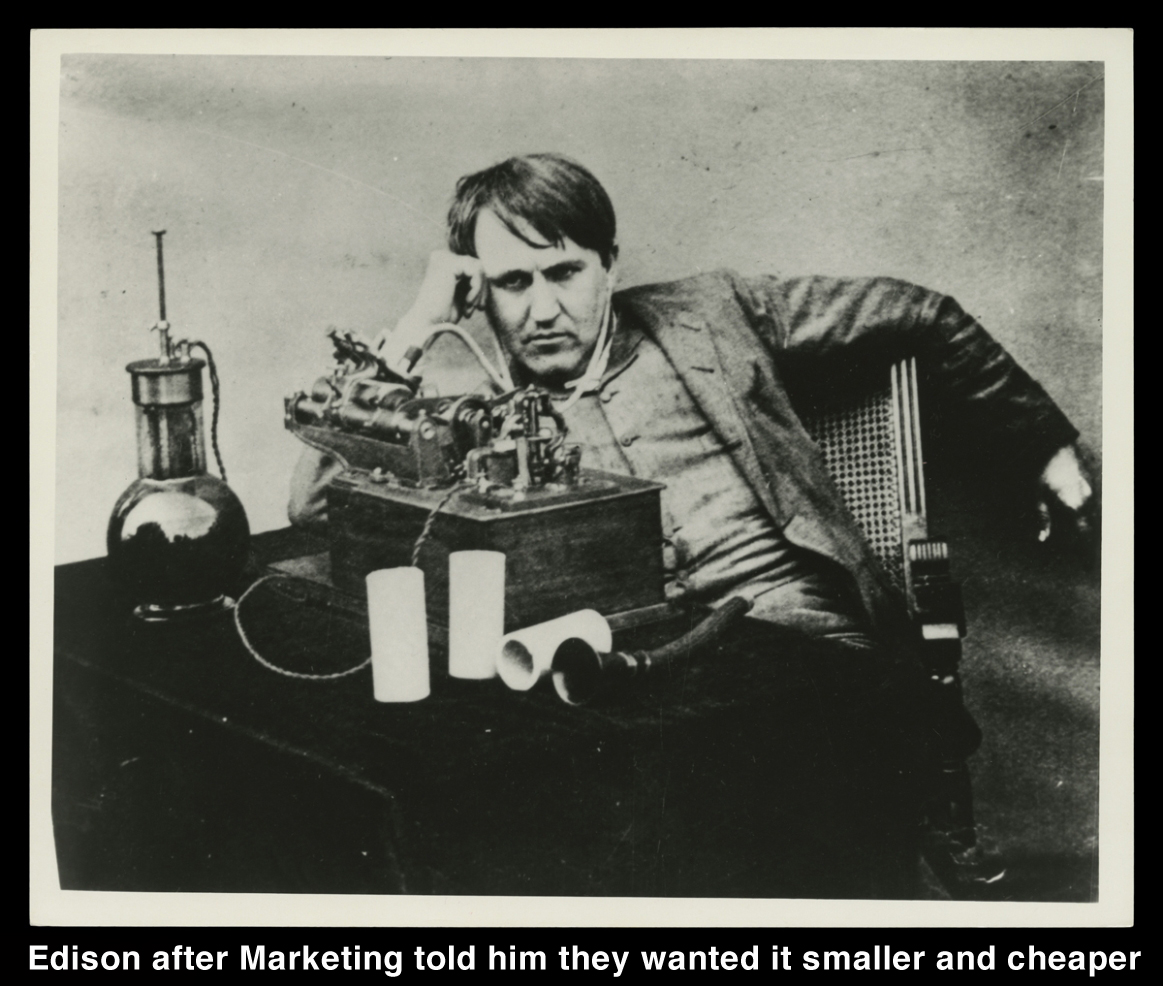
In 1857, Édouard-Léon Scott de Martinville invented the phonautograph,
which could graphically record sound waves. In early 1877, Charles Cros
devised a way to reverse that process on a photoengraving to form a
groove which could be traced by a stylus, causing vibrations that could
be passed on to a diaphragm, recreating sound waves.
In late 1877, Thomas Edison used Cros’ theories to invent the cylinder
phonograph, allowing music lovers to experience recorded music in their
homes for the first time. Can you imagine a modern cylinder phonograph?
Tangential tracking…no arc error…no skating error. The concept was
flawless.
In 1887, Emile Berliner invented the technically inferior disk
phonograph. Disks warp and there was arch error and skating errors
introduced. Certainly no comparison to the tangential tracking Edison
cylinder player.
But since disks are much cheaper to produce than cylinders, and since
disk fit nicely in display bins at stores and can include larger cover
art and notes, they became the standard. And so began the long history
of the recorded music industry being more about consumer convenience and
optimal profits than about optimal fidelity.
The digital revolution was no different. Philips and Sony collaborated
on the new standard for a consumer digital format in 1979. Philips
wanted a 20 cm disk, but Sony insisted on a 12 cm disk which could be
played in a smaller portable device. In 1980 they published the Red Book
CD-DA standard, and mass-market digital music was born. Many in the
recording industry in the early days of digital joked that CD stood for
“compromised disk.”
In the early 1980s, when digital recording became readily available,
studios converted from analog to digital to save money. For studios,
this cost less for the equipment, required less space for both recording
and archiving, and made it easier to mix and edit tracks in
post-production. For consumers, there weren't many advantages. Most of
the early digital recordings were produced with relatively low
resolution and sounded so fatiguing they would make you want to tear
your ears off.
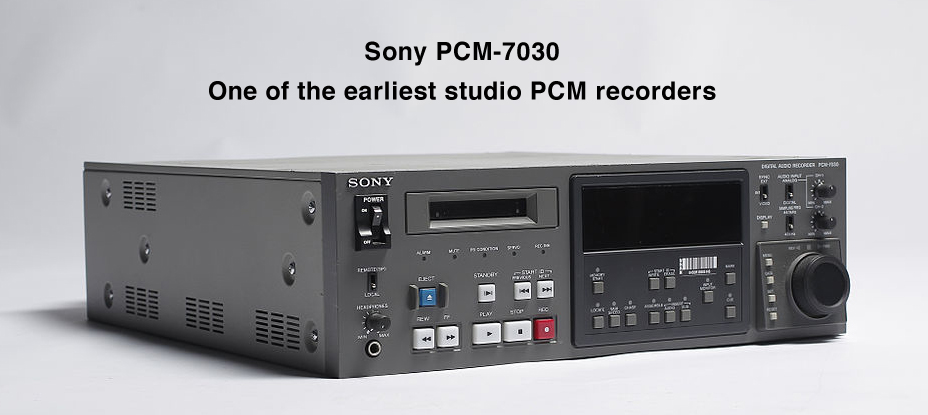
The switch from PCM to DSD was no different. In the early 1990s Sony
wanted a future-proof, less expensive medium to archive their analog
masters. In 1995 they concluded that storing a 1-bit signal directly
from analog-to-digital would allow them to output to any conceivable
consumer digital format (LOL...later I'll explain how Sony screwed the
pooch on this decision). This new 1-bit technology was achieved by
outputting from the monitoring pin on Crystal’s new 1-bit 2.8Mhz Bit
Stream DAC chip.
Later, Sony’s consumer division caught wind of DSD and collaborated with
Philips to create the SACD format. Of course, from the time the SACD
was conceived until the time it came to market, DAC chip manufacturers
had advanced from 64fs to a higher 128fs sampling rate (aka Double-Rate
DSD) and from 1-bit to a higher-resolution 5-bit wide-DSD format. If the
SACD format was DSD128 instead of DSD64 and 5-bits instead of 1-bit it
would have made a huge difference in performance. Oops.
Long before the DVD, SACD, or DSD formats were developed, the Bit Stream
DAC chip was introduced to the consumer market as a lower-cost
alternative to the significantly more expensive R-2R multi-bit DAC chip.
Bit Stream DAC chips have built-in algorithms to convert PCM input to
DSD, which is then converted to analog. Once again, the result was a
huge cost saving at the expense of fidelity.
It was in part Bit Stream DAC technology which allowed the development
of our modern 7.1 channel audio that’s embedded into video formats. This
also allowed electronics manufacturers to market DVD players in small
chassis with cheap power supplies which could retail for under $70. Once
again, the audio purist never stood a chance.
In contrast, not only do multi-bit R-2R DAC chips cost significantly
more to manufacture than single-bit DAC chips, but they also require
much larger and more sophisticated power supplies. If you were to make a
7.1 channel R-2R multi-disk player, it would cost several times the
price of Bit Stream technology and it would be several times the size.
Certainly not what the average consumer is looking for.
To sum things up, the recorded music industry has made decision after
decision to maximize profits and mass consumer appeal at the expense of
the audio purist. History lesson over.
DSD vs. PCM Technology:
PCM recordings are commercially available in 16-bit or 24-bit and in
several sampling rates from 44.1KHz up to 192KHz. The most common format
is the Red Book CD with 16-bits sampled at 44.1KHz. DSD recordings are
commercially available in 1-bit with a sample rate of 2.8224MHz. This
format is used for SACD and is also known as DSD64 or single-rate DSD.
There are more modern, higher-resolution 1-bit DSD formats, such as
DSD128, DSD256, and DSD512 as well as wide-DSD formats with 5-bit to
8-bit Delta-Sigma decoding which I will explain later. These formats
were created for recording studios and comprise only a very small
portion of the recordings which are commercially available.
Though you can’t make a direct comparison between the resolution of DSD
and PCM, various experts have tried. One estimate is that a 1-bit
2.8224MHz DSD64 SACD has similar resolution to a 20-bit 96KHz PCM.
Another estimate is that a 1-bit 2.8224MHz DSD64 SACD is equal to 20-bit
141.12KHz PCM or 24-bit 117.6KHz PCM.
In other words a DSD64 SACD has much higher resolution than a 16-bit
44.1KHz Red Book CD, roughly the same resolution as 24-bit 88.2KHz PCM
recording, and not as much resolution as a 24-bit 176.4KHz PCM
recording.
Both DSD and PCM are “quantized,” meaning numeric values are set to
approximate the analog signal. Both DSD and PCM have quantization
errors. Both DSD and PCM have linearity errors. And both DSD and PCM
have quantization noise that requires filtering at the output stage. In
other words, neither one is perfect.
PCM encodes the amplitude of the analog signal sampled at uniform
intervals (sort of like graph paper), and each sample is quantized to
the nearest value within a range of digital steps. The range of steps is
based on the bit depth of the recording. A 16-bit recording has 65,536
steps, a 20-bit recording has 1,048,576 steps, and a 24-bit recording
has 16,777,216 steps.
The more bits and/or the higher the sampling rate used in quantization,
the higher the theoretical resolution. So a 16-bit 44.1KHz Red Book CD
has 28,901,376 sampling points each second (44,100 x 65,536). And a
24-bit 192KHz recording has 32,212,254,000,000 sampling points each
second (192,000 x 16,777,216). This means 24-bit 192KHz recordings have
over 111,455 times the theoretical resolution of a 16-bit 44.1KHz
recording. No small difference.
So why is it that HD recordings sound only slightly better than a 16-bit
44.1KHz recordings made from identical masters? Later in this blog I’ll
explain the difference between theoretical and actual resolution.
DSD encodes music using pulse-density modulation, a sequence of
single-bit values at a sampling rate of 2.8224MHz. This translates to 64
times the Red Book CD sampling rate of 44.1KHz, but at only one
32,768th of its 16-bit resolution.
In the above graphical representation of PCM as a dual axis
quantization, and DSD as a single axis quantization, you can see why the
accuracy of DSD reproduction is so much more dependent on the accuracy
of the clock than PCM. Of course, the accuracy of the voltage of each
bit is just as important in DSD as PCM, so the regulation of the
reference voltage is equally important in both types of converters.
Of course the accuracy of the clocking during the recording process
which is done at several times the resolution of commercial DSD64 SACD
and 16-bit 44.1KHz PCM recordings is significantly more important than
the accuracy of the clocking of either DSD or PCM during playback.
There are other DSD formats which use higher sampling rates, such as
DSD128 (aka Double-Rate DSD), with a sampling rate of 5.6448MHz; DSD256
(aka Quad-Rate DSD), with a sampling rate of 11.2896MHz; and DSD512 (aka
Octuple-Rate DSD), with a sampling rate of 22.5792MHz. And most modern A
to D and D to A Delta-Sigma converters do multibit wide-DSD with 5-bits
to 8-bits decoding in parallel. All of these higher-resolution DSD
formats were intended for studio use as opposed to consumer use, though
there are some obscure companies selling recordings in these formats.
Note that Double, Quad, and Octuple DSD have both the potential for a
44.1KHz multiple and a 48KHz multiple sample rate for 100% equal
division down to DSD64 SACD and 44.1KHz Red Book (both 44.1KHz
multiples) or 96KHz and 192KHz High-Definition PCM formats (both 48KHz
multiples).
Of course when studios convert a 48KHz multiple format to a 44.1KHz
multiple format or visa versa they introduce quantization errors. Sadly
this is often the case with older recordings when they are released in a
remastered 24-bit 192KHz HD version derived from DSD64 masters, such as
the ones Sony and other companies used to archive their analog masters
in the mid-90's. Note that the optimal HD PCM format which can be
created from a DSD64 master would be 24-bit 88.2KHz. Any sampling rate
over 88.2KHz or that is equally divisible by 48KHz would have to be
interpolated (not good). But consumers demand 24-bit 192KHz versions of
all their old favorites, so companies provide them, despite the known
consequences.
The Problems:
There are three major areas where both PCM and DSD fall short of
perfection: quantization errors, quantization noise, and non-linearity.
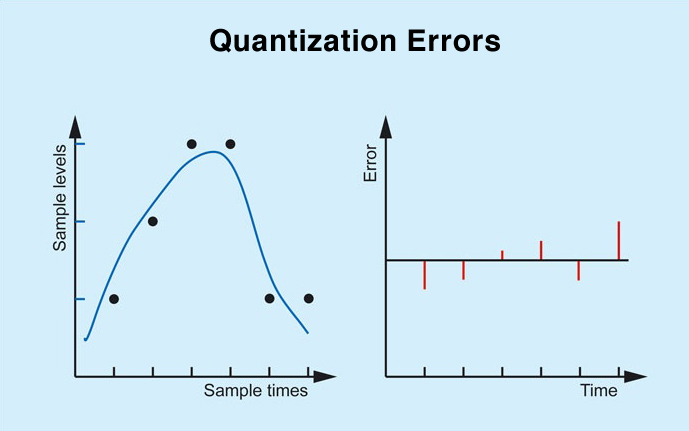
Quantization errors can occur in several ways. One way which was most
common in the early days of digital recording had to do with the
resolution being too low. Think of the intersection points on a piece of
graph paper. You can’t quantize to a fraction of a bit, and you can’t
quantize to a fraction of a sampling rate. You can only quantize to a
value which falls on the intersection points of bit-depth and sampling
rate. When the value of the analog signal falls between two quantization
values, the digital recording ends up recreating the sound lower or
higher in volume and/or slower or faster in frequency, distorting the
time, tune, and amplitude of the original music. Often this creates
unnatural, odd harmonics which result in the hard, fatiguing sound
associated with early digital recordings. Note on the graphic below that
the solid blue line represents the actual music wave and the black dots
represent the closest quantization values.
Though modern sampling rates are high enough to fool the human ear,
quantization errors still occur when translating from one format to
another. For example, when Sony decided to archive their analog master
libraries to DSD64 back in 1995, they were wrong to believe that these
masters would be future-proof and able to reproduce any consumer format.
The fact is, these masters could only properly reproduce a format that
was divisible by 44.1KHz. So any modern 96KHz or 192KHz recording
created from DSD64 master files have quantization errors.
This leads me to one of the many things that enrage me about the
recorded entertainment industry. If 44.1KHz was the standard which was
engineered to put aliasing errors in less critical audio frequencies,
then why did they start using multiples of 48KHz?!?!?!? All they had to
do was go with 88.2KHz and 176.4KHz as the modern HD consumer formats,
and all of this mess could have been avoided. They made DXD, a 24-bit
352.8KHz studio format, equally divisible by 44.1KHz. What blithering
idiot decided to put a wrench in the works with 96KHz and 192KHz HD
audio?!?!?!?
The actual reason for the 48KHz multiple has to do with optimal
synchronizing to video. So it makes sense to have sound tracks from
movies recorded in a 48KHz multiple, such as the 24-bit 96KHz format
embedded into 7.1 channel audio on DVDs and Blu-Rays. But since over 90%
of all music recordings are sold in a 44.1KHz for Red Book CD or DSD64
SACD it is rather ridiculous to offer any HD music in 96KHz or 192KHz as
opposed to the optimal 88.2KHz and 176.4KHz HD formats. But because
naive consumers wrongly believe that the higher the sampling rate the
higher the fidelity they demand 192Khz falsely believing it is better
than 176.4KHz, so that is what record companies market.
Quantization noise is unavoidable. No matter what format you digitize
in, ultrasonic artifacts are created. The more bits you have, the lower
the noise floor. Noise floor is lowered by roughly 6db for each bit. So
as you can imagine, 1-bit DSD has significantly more ultrasonic noise
than even 16-bit PCM. This is part of why wide-DSD formats with 5-bit to
8-bit parallel Delta-Sigma decoding were created. With PCM, you have to
deal with significant noise at the sampling frequency. This is why Sony
and Philips engineered the Red Book CD to sample at 44.1KHz, which is
over twice the human high-frequency hearing limit of 20KHz.
Since quantization noise is present around the sampling frequency of a
PCM recording, a 44.1KHz recording has quantization noise one octave
above the human hearing limit of 20KHz. This quantization noise needs to
be filtered out, so all DACs have a low-pass filter at the output.
Because the quantization noise is only one octave above audibility the
filters used have a very steep slope so as to not filter out desirable
high frequencies. These steeply sloped low-pass digital filters are
commonly known as "brick wall" filters. This is why there can be an
advantage in playing 44.1KHz PCM upsampled to 88.2KHz or 176.4KHz.
Though you hear a lot about "brick wall" filters causing an audible
distortion in the top end of early Red Book CD players , the fact is
that was only a small part of the reason early Red Book CDs and players
had an unnatural sounding top end. Most of the hard, harsh, unnatural
sounding high frequencies in early digital had more to do with flaws in
the power supplies and flaws in the recording process, not "brick wall"
filters.
Sorry to be the one to burst your bubble, but despite what many
audiophiles may believe, less than one person in a thousand can hear
anything above 20KHz as a child and there is almost no one over the age
of 40 who can hear much above 15KHz.
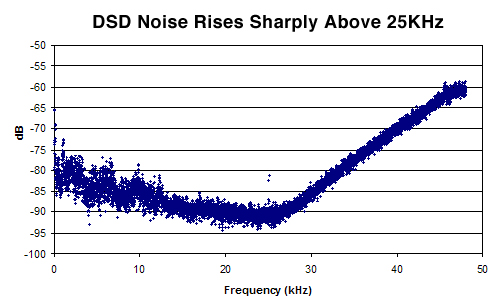
Of course DSD64 is another story: above 25KHz the quantization noise
rises sharply, requiring far more sophisticated filters and/or
noise-shaping algorithms. See graphic below. When you filter the output
of DSD64 with a simple low-pass filter, the result is distorted
phase/time and some rather nasty artifacts in the audible range. The
solution is noise-shaping algorithms which move the noise to less
audible frequencies and/or higher sampling rates. This is why
Double-Rate DSD and Quad-Rate DSD formats came into being. This is also
why advanced player software, such as JRiver,
offers Double-Rate DSD output. Using player software that upsamples
DSD64 to DSD128 or DSD256 significantly improves performance by putting
the digital artifacts octaves above audibility allowing more advanced
noise-shaping algorithms and less severe digital filters. Note these
extremely high sampling frequencies are why ultra accurate clocking is
more important in the playback of DSD than PCM recordings.
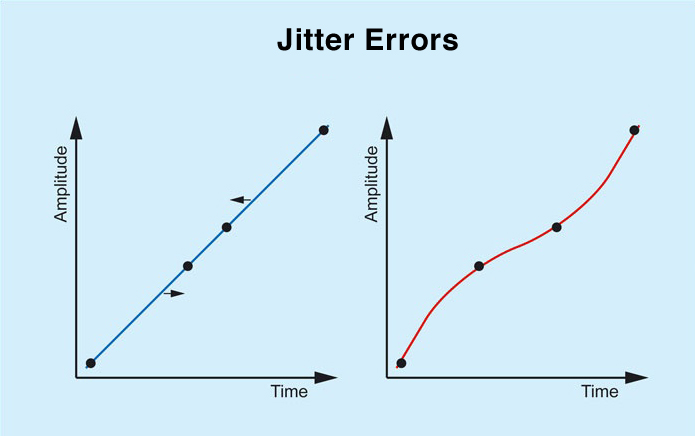
Jitter is defined as inconsistencies in playback frequency caused by
inaccurate clocking. The result is observable as distortion of the time
and tune of the music. Often the pattern of the inconsistency of
frequency can result in an analog wave form that has an unnatural odd
harmonic frequency. This results in the fatiguing character commonly
known as “digititis.” Note in the two graphs below: jitter is an
inconsistency in the horizontal time axis and non-linearity is an
inconsistency in the vertical amplitude axis.
Jitter occurs when the converter’s clock rate is inconsistent and
non-linearity can occur when the converter's reference voltage is
inconsistent. This is why we are hearing so much about “super clocks”
and “femto clocks.” The more accurate the clock, the more accurate the
analog output. This is also why ultrahigh-performance R-2R DACs, such as
Mojo Audio’s Mystique, have a way to adjust the voltage of the most-significant-bit (MSB) at the zero crossing to optimize linearity.
The Myth of Pure DSD:
Despite the marketing hype, there are almost no pure DSD recordings
available to consumers. This is partially because up until quite
recently there was no way to edit, mix, and master DSD files. So most
pure DSD recordings which are commercially available are those recorded
direct to DSD without any post-production. There are some new studio
software packages which can edit, mix, and master in DSD, but these are
quite rare in the industry, and mostly used by small boutique recording
companies. Most DSD recordings are in fact, edited, mixed, and mastered
in PCM and then converted back to DSD. The marketing hype DSD flow chart
you see below rarely exists anywhere but in theory. Yikes…the secret is
out.
There are several generations and levels of quality in purely digital
DSD recordings. The least pure are DSD recordings made from old PCM
masters. Many of these PCM masters had low resolution as well as
significantly higher quantization errors and lower linearity than modern
PCM recordings. Since you can never get better than the original
masters, these DSD recordings sound as bad as or worse than the original
low-resolution PCM masters. The purest common DSD recordings come from
modern DSD masters which are recorded in 5-bit to 8-bit Wide-DSD, which
is in fact a 5-bit to 8-bit parallel Delta-Sigma encoding.
As you can see from the above flow chart, most commercially available
DSD recordings have to be converted back and forth to a PCM format in
order to do post-production editing, mixing, and mastering. In each of
these conversions, more quantization noise and/or quantization errors
are added to the recording. For that reason they created these inaudible
resolution 24-bit and Wide-DSD formats with insanely high sampling
rates. The higher the resolution during editing, mixing, and mastering,
the lower the digital noise in the audible spectrum when these
recordings are downsampled to commercially available formats.
It is quite unlikely that any or many of recording studios that are
currently using Wide-DSD for editing, mixing, and mastering will ever
upgrade to software that can edit, mix, and master in true DSD, since
DSD is in fact an obsolete format. Even Sony no longer supports DSD and
SACD. The modern format which recording studios will likely be upgrading
to would be MQA, which compresses much better than DSD or PCM for
streaming and decodes to PCM formats, such as 24-bit 88.2KHz. That is
why HD music streaming services such as Qobuz and Tidal
are switching over to MQA for their ultra-HD selections. So with the
invention of MQA compression, PCM is quickly becoming the preferred HD
music format.
Another common marketing myth about DSD vs. PCM is that when blind
listening tests were done comparing DSD to PCM, there was a consensus
that PCM had a fatiguing quality and DSD had a more analog-like quality.
This was proved to be total marketing BS. One way that marketing lie
was perpetuated was with hybrid SACDs which have DSD64 and 16-bit
44.1KHz PCM on the same disk. The DSD64 tracks have over 30 times the
resolution of the 16-bit 44.1KHz tracks so that they could make DSD
sound better than PCM in comparisons. The truth is that in recent blind
studies they've proved that high-resolution PCM and DSD are
statistically indistinguishable from one another. Considering that
nearly all DSD recordings were edited, mixed, and mastered in PCM, it is
no wonder.
Then there are the differences in the ways DAC chips work. Most modern
DAC chips are Delta-Sigma which decode native DSD. R-2R DAC chips decode
native PCM. In order for you to play PCM files on a Delta-Sigma DAC or
DSD files on an R-2R DAC the files have to be converted in real time.
Most modern Delta-Sigma DAC chips can decode multiple file formats,
including PCM, DSD, and Wide-DSD. When they are decoding PCM, a
Delta-Sigma DAC chip has to first convert it into DSD, the chip's native
format. Another reason for the common misconception that DSD performs
better than PCM has to do with the poor quality of the real-time PCM to
DSD converters built into native DSD Delta-Sigma DACs. Since R-2R ladder
DAC chips can only decode PCM formats some DAC manufacturers use chips
or FPGAs at the input stages of their DACs which convert DSD to PCM.
But no R-2R DAC chip can decode DSD on its own.
In almost all cases I would recommend playing music files in the native
format which your DAC chip decodes. That would be PCM for an R-2R DAC
chip and DSD for a Delta-Sigma DAC chip. There are several brands of
player software on the market which have real-time PCM to Double-Rate
DSD converters. HQ Player is one of the most sophisticated player software packages on the market today. HQ Player
can be configured for real-time PCM to DSD conversion as well as
real-time DSD upsampling to Double, Quad, Octuple, and even higher rate
DSD formats. Using player software that is capable of converting PCM to
DSD and upsampling it to at least Quad-Rate DSD is highly recommended.
Summary:
Well, all that’s a real ear opener, isn’t it?
When people claim to hear significant differences between PCM and DSD it
is not the difference between the formats that they are hearing, but
most often the difference in the quality of the digital remastering or
the native format their specific DAC decodes. Delta-Sigma DACs decode
native DSD and R-2R DACs decode native PCM.
Keep in mind that most recordings are engineered to sound best on a car
stereo or portable device as opposed to on a high-end audiophile system.
It’s a well-known fact that artists and producers will often listen to
tracks on an MP3 player or car stereo before approving the final mix.
The quality of the recording plays a far more significant role than the
format or resolution it is distributed in. But to increase profits, many
modern recording studio executives insist that errors be edited out in
post-production, significantly compromising the quality of the original
master tapes. So no matter what format these recordings are released in,
the music will always sound mediocre, since you can never have higher
performance than what is on the original masters.
In contrast, some of my favorite digital recordings were digitally
mastered from 1950s analog recordings. Many of these recordings were
done as a group of musicians playing in a room with one take per track
and no post-production editing. Though these recordings have much higher
background noise being limited by old-school pre-Dolby 60dB dynamic
range master tape, they retain an organic character and in-the-room
harmonic cues that can't be duplicated any other way.
Hear It for Yourself:
Are you curious about the potential of digital-to-analog conversion?
No noise-shaping, upsampling, or oversampling algorithms.
MSB zero-crossing voltage adjustment circuitry to optimize linearity.
Perfectly bit-aligned left and right channel hardware-based demultiplexing.
Direct-coupled with no output capacitors or transformers to distort phase and time or narrow bandwidth.
LC choke-input power supplies, which unlike capacitive power supplies, store both current and voltage.
The Mystique
is in a class by itself. Explosive micro-dynamics combined with
harmonically coherent micro-details reveal the true time, tune, tone,
and timbre of the original musical performance.
With Mojo Audio’s 45-day no-risk audition you can hear the Mystique DAC
for yourself, in your own system, with no-risk and no restocking fees.
Experience all the harmonic coherency and emotional content digital
music is capable of delivering.
If you like what you've read in this blog and are interested in getting more free tips and tricks, check out the rest of my blogs on our website. Also, sign up for our e-newsletter to get more useful info as well as discount coupons, special offers, and first looks at new products.
Like a lot of folks today, I have been rediscovering the virtues of CD audio quality sound. Back in the 1990's, CDs were the highest quality source of of music. I have hundreds of CDs, along with several high quality Blu Ray players, but I have to use my TV to play these. The CD player has a place in many hi-fi systems today. Below is a Technics 5 CD Changer Model-SL-PD5. It features a 1-Bit DAC. The Technics MASH process converts the CD red book digital signal to a 1-Bit stream with 256 times over sampling, and then runs that through a filter and DAC. Below are photos and a discussion from Stereophile Magazine on the virtues of this amazing DAC. Later Technics models like the SL-PD5 offered optical outputs, which enable use of an external DAC. Other brands like Phillips and Sony have also introduced Bitstream 1-Bit DACs.
The Technics PD-807 5 Disc CD Changer with expanding tray featured the MASH D/A converter with programmable memory (below). Other Technics models continued the trend with other designs (below):
The Technics PD-5 5-Disc CD Changer below featured programmable memory and external D/A output for DTS audio (below):
PDM, PWM, Delta-Sigma, 1-Bit DACs Peter W. Mitchell Peter W. Mitchell wrote about MASH DACs in January 1990 (Vol.13 No.1):
In October 1989, Technics flew a dozen North American hi-fi writers, including myself, to Japan for a busy week including seminars about MASH 1-bit digital decoding. The "1-bit" digital decoder, is suddenly appearing everywhere. In recent years, competition among makers of CD players has taken the form of "bit wars," the use of ever-higher numbers of bits to decode the CD. Linear 16-bit decoders led to pseudo–18-bit decoding, then to real 18-bit decoders, and now several companies claim to be providing 20-bit decoding. If you don't read brochures carefully you may also come away with confused impressions about 24-, 32-, and even 45-bit processing (in digital filters).
The assumption, of course, is that more must be better. Re-sampling digital filters follow the same rule: if 2x re-sampling is good, 4x is better, and many of this year's best players use 8x. Decoder chips can be multiplied as well: early CD players used a single decoder, switched between channels. Now most players use two decoders, one per channel, while the newest high-performance models often use four D/A chips, a back-to-back pair in each channel.
It is possible to find engineering logic behind each of these design choices. The best reason for using 18- or 20-bit decoding, or back-to-back pairs of DACs, is that it can reduce the effect of decoder nonlinearity, providing more accurate decoding of the 16-bit data on the CD. Furthermore, the interpolations involved in "oversampling" digital filters have the effect of turning the original 16-bit data samples into 18-bit or longer digital words; using an 18- or 20-bit decoder reduces the distortion and noise that would be caused by rounding off the longer words or decoding only the topmost 16 bits.
Such improvements actually are realized in some high-priced players. But in midprice players the bit wars are just a marketing contest, a way to gain a competitive advantage by making specifications look better. In some factories the use of 18-bit or back-to-back DACs has become another excuse for avoiding the costly individual MSB fine-tuning that is required to obtain truly linear low-level decoding. The result, 18 months after this "CD cancer" became widely known, is that midprice CD players continue to vary greatly in linearity from sample to sample, and a 20-bit 4-DAC model of one brand may perform less well than another maker's 16-bit 2-DAC player. In this environment, the "bit" rating is little more than fraud.
"1-bit" processing is a fundamentally different approach from decoding the digital signal—a method that promises both finer performance in the very best CD players and more consistent performance in low-cost models. But at first it is sure to add confusion. If 18 bits is allegedly better than 16, how can a 1-bit decoder be considered hi-fi at all?
Two players with 1-bit decoding, the Technics SLP-555 and SLP-222, have been on the market since last spring, but the inclusion of the new decoder was kept a secret because the company wasn't ready to deal with this question. The brochures for those players incorrectly described them as having normal decoders in back-to-back pairs. This deception was intended not only to avoid causing confusion among consumers but also to prevent a rebellion among retail salespeople, who like to have a simple, persuasive description of each product they're trying to sell. In a "more bits is better" environment, 1-bit decoding would be a hard sell. Technics chose to postpone publicity about 1-bit decoding until the new year, and inviting hi-fi writers to a factory seminar was part of the plan.
The name, "1-bit" D/A conversion, is part of the problem because it engenders confusion without explaining anything. Philips's preferred name, "Bit-stream" decoding, is less confusing but still doesn't tell you very much. Fundamentally, the operation of a bit-stream decoder is not difficult to understand.
To appreciate why it's a better idea, let's begin at the beginning. Digital signal processing is inherently precise because it involves only simple on-off switching. Switches are either on or off; the accuracy of the result is not affected by the precision of the electrical parts involved, nor by the temperature, or other factors. If you have a sufficiently large number of electronic switches, operated rapidly, any desired result can be obtained. This is how computers work. And if you have too few switches for exact computation, the errors are predictable; known errors can be compensated (canceled) or can be averaged out by switching much more rapidly. (The latter is the basis of "dithering" to remove quantizing distortion in low-level signals.)
Analog processing is inherently approximate and variable, because the result depends on the physical properties of the parts used. For example, every digital device (recorder, CD player, et al) requires an output filter to reconstruct a smooth waveform and remove the ultrasonic byproducts of the digital switching process. In the early days of digital audio, those filters were complex analog circuits containing a dozen or more capacitors, inductors, and resistors. An analog filter is basically a frequency-dependent voltage divider: the signal is attenuated at each frequency according to the ratio of impedances in the circuit. Since impedances of electronic parts are specified only approximately and often vary with temperature, the response of an analog filter can be predicted only approximately. Even with selected high-precision parts it is impractical to achieve exact response, and a few years ago every digital product had a slightly different response—a built-in, nonadjustable tone control. Analog filters also exhibited a potentially audible group delay (phase shift) at high frequencies.
Then designers adopted digital filtering. A digital filter operates by combining signals after many brief time-delays (typically a few millionths of a second); in this process, unwanted signals simply cancel out. The response is controlled by the mathematical design of the filter, and by the delay times (which are precisely regulated by a crystal oscillator). Consequently manufacturers can mass-produce digital filters at very low cost, all with exactly the same response, accurate to a few thousandths of a dB. As a bonus, since the internal delays are the same for every frequency, digital filters are phase-linear.
Virtually all new CD players use digital filters, not because they contain more accurate parts, but because accurate response is inherent in their design (regardless of parts quality). Initially digital filters are more costly to design, but in mass-production they are less costly to use because they are all identical; there's no need to measure each one, grade them for accuracy, or match response in pairs.
The same reasoning underlies the development of bit-stream decoders. The problem with a conventional digital/analog converter (DAC) is that its operation involves mainly analog processes and is therefore approximate. A 16-bit DAC contains a precision current source and an array of 16 switches. Each switch is connected to a resistor, and the resistors are supposed to be scaled in exact 2:1 ratios so that each switch, when opened, will contribute exactly twice as much current to the output as the switch below it. The switches are controlled by the 16-bit codes from the CD; thus by opening and closing in various combinations, a total of 65,536 different output values can be generated.
But the topmost switch (the most-significant bit, or MSB) contributes 32,768 times as much current as the least-significant bit (LSB). If the MSB current is in error by as little as one part in 32,768, the effect of the LSB is swamped. In most CD players it is; few 16-bit DACs operate to better than 15-bit accuracy. The practical result is that most CD players are non-linear at very low signal levels, reproducing small signals at the wrong levels and with added distortion. Keep in mind that this problem arises not from the digital code itself but from small errors in an analog quantity—the current produced by the DAC for the several most-significant bits.
For comparison, imagine that you were assigned to fill a bucket with a known amount of water, using measuring cups varying in size from one ounce to 64 ounces. Even if you use care in filling the largest cup, it might contain 63.7 or 64.5 ounces instead of 64; you can't be sure that it contains exactly 64 times as much water as the smallest cup. But there is a way to obtain an exact result: use only the one-ounce cup, and transfer its contents to the bucket 64 times. The capacity of the cup may not be exactly one ounce, but as long as you fill it the same way each time, the total amount transferred will be proportional to the number of refills—an exactly linear relationship. This is the idea behind 1-bit decoding. In place of a method whose result depended on slightly uncertain analog quantities (the currents in the DAC), we have adopted a simple counting scheme—a purely digital process.
Of course with a small cup you'll have to work fast, but in modern digital electronics that's not an obstacle. In the Philips bitstream decoder, the output stage generates around ten million pulses per second, the exact rate being determined by the digital code. (This is called "pulse density modulation," or PDM.) A simple analog filter averages out the pulses to form the final analog output signal.
In all of the Japanese 1-bit decoders announced to date, the output stage is a pulse-width modulation (PWM) circuit of some type. In a PWM system the output signal is an on/off waveform in which the analog voltage is represented by the duration of the pulses, ie, the percentage of time the waveform remains in the "on" state. This is analogous to filling the bucket, not with a cup, but with a hose whose high-precision valve allows the water to flow in precisely timed bursts. When we want a larger amount of water, we use wider pulses (longer bursts).
The Technics MASH (multistage) decoder uses pulses of 11 different durations to form the output signal. The timing circuit that controls the pulses operates at a frequency of 33.9MHz, or 768 times higher than the 44.1kHz sampling rate of the digital codes in the CD. The transformation of the CD's original PCM signal into the final PWM waveform is determined mathematically and is accomplished entirely in the digital domain. In principle this can be done to any desired degree of accuracy, preserving all of the information in the original 16-bit code.
Summing up: to obtain exact frequency and phase response, manufacturers abandoned analog filters whose performance depended on inexact circuit impedances, and adopted digital filters whose response is controlled by mathematical operations and precisely timed delays. Now, to obtain consistently exact decoding of low-level signals, they intend to abandon conventional DACs whose accuracy is affected by uncertain analog quantities (currents flowing through resistors of slightly inexact value), and replace them with bitstream decoders whose accuracy, again, is determined by mathematics and timing (the number and duration of pulses).
The essential point is that the performance of a bitstream decoder, like that of a digital filter, depends on its design and is not expected to vary from sample to sample. Unlike PCM decoders, there is no need to quality-grade the chips for accuracy, nor to fine-tune the performance on the production line. Thus the bitstream decoder brings closer the day when CD players, too, can be assembled by robots with no need for individual adjustment or testing.
Conventional current-summing DACs also require a current/voltage conversion stage, which can be a source of slewing-induced distortion, plus a deglitching circuit to suppress the "glitch" (the high-current spike) that occurs when several bits change in imperfect synchrony. A bitstream decoder needs neither.
Stereophile readers have already seen an example of how good 1-bit decoding can be, in Larry Greenhill's review of Sansui's AU-X911DG integrated amplifier (November 1989, pp.144–150). The amplifier's integral D/A converter, called "LDCS" by Sansui, is actually a third-generation Technics MASH chip. LG loved its sound, while Robert Harley measured its linearity as "exceptionally accurate, among the best I have measured...nearly a perfect straight line."
You might reasonably suppose that, while introducing a significant technological advance, manufacturers would present a united front in communicating the benefits of the new approach to consumers. No such luck. A forthright presentation of the advantages of 1-bit decoding would require admitting how variable the performance of previous and current players has been. Besides, manufacturers like to promote the alleged uniqueness of their designs: they are launching 1-bit technology with a dizzying array of jargon aimed at making each version seem unique.
Philips, the first to go public with the new system, calls its version a Bitstream decoder process and uses a pulse density modulation (PDM) output circuit. Technics, which claims to have been working on 1-bit decoding since 1986 but is only going public with it now, calls its process MASH and uses a pulse-width modulation (PWM) output circuit. Harman/Kardon is using the Technics MASH decoder in two new CD players but confused many observers by calling it a "bitstream" decoder and comparing its performance to the Philips circuit. Sansui, as noted earlier, uses the Technics MASH chip in its Vintage series CD player and integrated amplifier, but calls it "LDCS." Sony appears to be using the Philips PDM circuit in several CD players marketed overseas (but not yet in the US), calling it a "High Density Linear Converter."
All of the new 1-bit decoders contain a "noise-shaping" digital filter that suppresses hiss, enhancing the S/N ratio, hence the resolution. Technics' trade name for its decoder is a quasi-acronym for this filter: MultistAge noise SHaping (MASH). The MASH chip that has been available since last spring is a third-generation design with a claimed S/N ratio of 108dB. Sony recently announced a new decoder using Sony Extended Noise Shaping (SENS) to achieve a claimed S/N ratio of 118dB. Not to be outdone, JVC announced a chip that uses PEM (pulse-edge modulation, a sort of one-sided PWM) and VANS (Victor Advanced Noise Shaping) to achieve 120dB. At its seminar for North American hi-fi writers, Technics capped this game of corporate one-upmanship by announcing that its third-generation chip will be used only in midprice players; the company's best players will contain a new fourth-generation MASH chip rated at 123dB.
Note that these specifications apply only to noise generated in the playback process; since virtually no CD has been recorded with a S/N ratio better than 90dB, these claims won't be realized with real recordings. (The measurement is made using a special test CD recorded with an all-zeroes code, with no dithering.)
But to demonstrate the superb linearity of the fourth-generation MASH decoder, Technics conducted a play-off comparing its newest player with current Denon and Sony models using 18- and 20-bit DACs. It was no contest; in the dithered glide tone from –60 to –120dB on the CBS test disc, the Sony produced audible distortion and the Denon generated obvious noise modulation due to nonlinearities in the DACs. (To be fair, these may have been worse-than-average samples off the production line.) The playback of this track by the Technics was the best I've ever heard, with no audible imperfection.
What appeals most to my Yankee soul is that this performance came from a decoder that is actually less costly to produce than a conventional DAC. MASH chips, or the equivalent from other manufacturers, can be used in CD players at virtually every price level. (A low-power version for portables hasn't been developed yet, but will be.) Within a couple of years, 1-bit decoders could be in every new CD player; then the cancer of nonlinear decoding will have been banished.
I don't want to leave the impression that all 1-bit decoders are alike in their performance or sound. There have been many rumors that the original Philips Bitstream decoder was not designed to leapfrog ahead of the best conventional DAC performance, but is just a way of obtaining consistent linearity in low-cost players. Further rumors suggest that Philips is working on a high-performance Bitstream decoder for introduction next year.
But the picture became confused at the British Penta hi-fi show in September, where an A/B comparison carried out by reviewer Paul Miller apparently persuaded many listeners that the present Philips Bitstream decoder sounds better than the best 18- and 20-bit conventional DACs. A friend of mine who heard the Penta demonstration examined the demonstration setup afterward; evidently the CD players were not accurately matched in level, and the comparison may have been invalid. Martin Colloms, writing in HFN/RR, added that in his own listening tests the present Philips circuit is a good mid-level performer but not equal to the best linear DACs.
Two weeks after my visit to Japan, the potential of 1-bit decoding was confirmed in a paper written by British mathematician Michael Gerzon for the New York convention of the Audio Engineering Society. In Gerzon's absence it was introduced and summarized by Stanley Lipshitz, who called it a very important paper (footnote 11). It is a mathematical analysis of the noise-shaping that is a central part of MASH and other 1-bit decoders, showing that with appropriate selection of the noise-shaping filter function, the effective dynamic range of CD playback can be increased by about 11dB, or nearly two bits' worth.
The actual limitation now lies at the recording end of the signal chain, with the nonlinearities and quantizing distortion in the A/D converters used in professional digital recorders. Gerzon's paper shows, and the Technics demonstration confirms, that if the recorded signal is correctly dithered to eliminate quantizing distortion, it is possible to record—and accurately resolve in playback—signals much smaller than the least-significant bit. (In theory this is also true with a conventional DAC, but only if it is precisely adjusted for good linearity, which real DACs usually aren't.) So while the CD is only a 16-bit storage medium, it is capable of 18-bit effective resolution and dynamic range. At the AES convention a designer of high-performance oversampling A/D converters told me that Sony will soon introduce a successor to its PCM-1630 CD mastering recorder, employing those A/D converters. Then the recent improvements in player design will really pay off.—Peter W. Mitchell
Footnote 11: "Optimal Noise Shaping and Dither of Digital Signals," Michael Gerzon and Peter G. Craven, AES Preprint 2822. Preprints are available from the Audio Engineering Society, 60 East 42nd Street, New York, NY 10165. Web: www.aes.org.
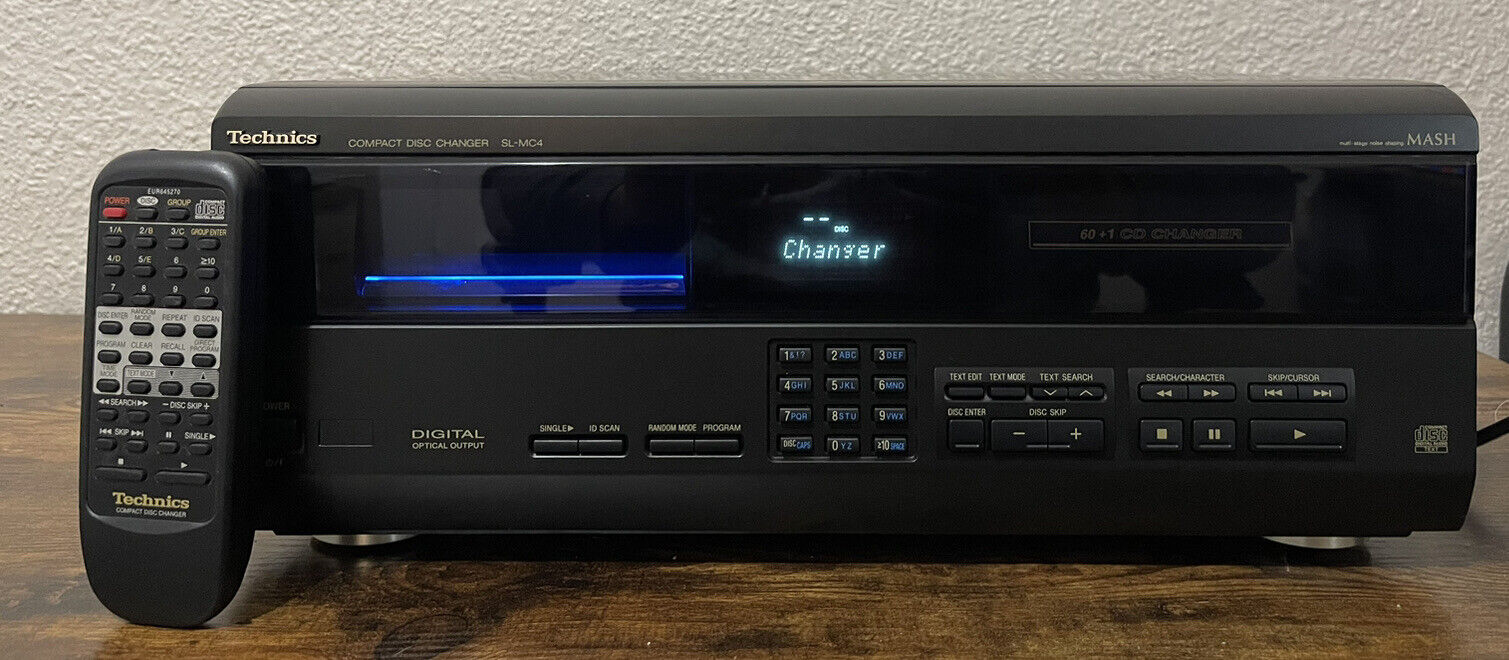
Technics SL-MC4 60 CD Changer (from Amazon.com) 60+1
CD changer, digital optical output, CD text search and scrolling text
display. Text edit function, phone-style 10 key enter pad, Quick disc
change mechanism. Front loading mechanism allows to play one disc while
changing another. Quick single play system, 14 preset grouping files.
Large-capacity
CD changers are among the best bargains in today's audio market, and
Technics is one of a handful of companies responsible for bringing them
to a broad consumer base. The LS-MC4 61-disc changer/player is a
well-crafted component that fits neatly into an entertainment rack while
offering just enough storage capacity to keep most music lovers
content.
This handsome player defies the "jukebox" description of
many changers, measuring as it does less than seven inches high (with a
standard width). The entire front-panel lifts down manually to reveal
all 61 slots, with slot 1 reserved for single-disc play only. We were
impressed with the build quality of the door mechanism, which slides
down gently but firmly and doesn't appear prone to breakage. This
mega-changer includes an optical-digital output for connecting to an
outboard digital-to-analog converter or an surround receiver or
processor with digital inputs.
We connected the LS-MC4 to an
outboard digital-to-analog converter with a Toslink optical cable,
plugged it in, slipped a CD in the single-disc slot, hit play, and
whistled the tune of simplicity.
Since programming features can
be rather complicated with today's computer-reliant changers, operating
instructions are a must-read. Technics deserves credit for providing
well-written, concise instructions on the multitude of programming
options, including how to categorize discs by music genre (choose from
14, from Ballads to Oldies) and how to input customized text to identify
discs (though a growing number of discs offer CD Text, which displays
track and artist information automatically).
It took
approximately 90 minutes to read the instructions and become comfortable
with inputting text using both the remote control and the front-panel
numeric keypads, which include letters just like a phone. It took a few
trial-runs to get the procedure down, which was encumbered by the
computer's 7-second limit to perform text entries. Once we got the hang
of it, however, we had the procedure memorized after about half-a-dozen
discs.
Obviously, programming 60 CDs is cumbersome and requires
an afternoon of leisure time, but it's well-worth the effort, since it
eliminates the task of searching for the right CD in a five-foot display
rack or, worse, shuffling through the changer in search of a specific
title. Once this mega-changer is armed and loaded, it brings added
pleasure to general music listening, not to mention parties.
The
LS-MC4 should top of any host's list of must-have electronics, since it
can play a weekend worth of music with the touch of a button. Although
sound quality doesn't seem to be a priority in mega-CD changers, the
LS-MC4 is more than adequate for most music lovers, particularly when
taking advantage of the fiber-optic audio output. Kudos to Technics for
simplifying today's large-capacity CD changers with the LS-MC4.
The loudness war (or loudness race) is a trend of increasing audio levels in recorded music, which reduces audio fidelity and—according to many critics—listener enjoyment. Increasing loudness was first reported as early as the 1940s, with respect to mastering practices for 7-inch singles.[1] The maximum peak level of analog recordings such as these is limited by varying specifications of electronic equipment along the chain from source to listener, including vinyl and Compact Cassette players. The issue garnered renewed attention starting in the 1990s with the introduction of digital signal processing capable of producing further loudness increases.
With the advent of the compact disc (CD), music is encoded to a digital format with a clearly defined maximum peak amplitude. Once the maximum amplitude of a CD is reached, loudness can be increased still further through signal processing techniques such as dynamic range compression and equalization. Engineers can apply an increasingly high ratio of compression to a recording until it more frequently peaks at the maximum amplitude. In extreme cases, efforts to increase loudness can result in clipping and other audible distortion.[2] Modern recordings that use extreme dynamic range compression and other measures to increase loudness therefore can sacrifice sound quality to loudness. The competitive escalation of loudness has led music fans and members of the musical press to refer to the affected albums as "victims of the loudness war". History[edit]
The practice of focusing on loudness in audio mastering can be traced back to the introduction of the compact disc,[3] but also existed to some extent when the vinyl phonograph record was the primary released recording medium and when 7-inch singles were played on jukebox machines in clubs and bars. The so-called wall of sound (not to be confused with the Phil SpectorWall of Sound) formula preceded the loudness war, but achieved its goal using a variety of techniques, such as instrument doubling and reverberation, as well as compression.[4]
Jukeboxes became popular in the 1940s and were often set to a predetermined level by the owner, so any record that was mastered louder than the others would stand out. Similarly, starting in the 1950s, producers would request louder 7-inch singles so that songs would stand out when auditioned by program directors for radio stations.[1] In particular, many Motown records pushed the limits of how loud records could be made; according to one of their engineers, they were "notorious for cutting some of the hottest 45s in the industry."[5] In the 1960s and 1970s, compilation albums of hits by multiple different artists became popular, and if artists and producers found their song was quieter than others on the compilation, they would insist that their song be remastered to be competitive.
Because of the limitations of the vinyl format, the ability to manipulate loudness was also limited. Attempts to achieve extreme loudness could render the medium unplayable. Digital media such as CDs remove these restrictions and as a result, increasing loudness levels have been a more severe issue in the CD era.[6] Modern computer-based digital audio effects processing allows mastering engineers to have greater direct control over the loudness of a song: for example, a brick-wall limiter can look ahead at an upcoming signal to limit its level.[7]Three different releases of ZZ Top's song "Sharp Dressed Man" show increasing loudness over time: 1983–2000–2008.[8]
The stages of CD loudness increase are often split over the decades of the medium's existence. 1980s[edit]
Since CDs were not the primary medium for popular music until the late 1980s, there was little motivation for competitive loudness practices then. The common practice of mastering music for CD involved matching the highest peak of a recording at, or close to, digital full scale, and referring to digital levels along the lines of more familiar analog VU meters. When using VU meters, a certain point (usually −14 dB below the disc's maximum amplitude) was used in the same way as the saturation point (signified as 0 dB) of analog recording, with several dB of the CD's recording level reserved for amplitude exceeding the saturation point (often referred to as the "red zone", signified by a red bar in the meter display), because digital media cannot exceed 0 decibels relative to full scale (dBFS).[citation needed] The average RMS level of the average rock song during most of the decade was around −16.8 dBFS.[9]: 246 1990s[edit]
By the early 1990s, mastering engineers had learned how to optimize for the CD medium and the loudness war had not yet begun in earnest.[10] However, in the early 1990s, CDs with louder music levels began to surface, and CD levels became more and more likely to bump up to the digital limit,[note 1] resulting in recordings where the peaks on an average rock or beat-heavy pop CD hovered near 0 dBFS,[note 2] but only occasionally reached it.[citation needed]
The concept of making music releases "hotter" began to appeal to people within the industry, in part because of how noticeably louder some releases had become and also in part because the industry believed that customers preferred louder-sounding CDs, even though that may not have been true.[11] Engineers, musicians, and labels each developed their own ideas of how CDs could be made louder.[12] In 1994, the first digital brick-wall limiter with look-ahead (the Waves L1) was mass-produced; this feature, since then, has been commonly incorporated in digital mastering limiters and maximizers.[note 3] While the increase in CD loudness was gradual throughout the 1990s, some opted to push the format to the limit, such as on Oasis's widely popular album (What's the Story) Morning Glory?, whose RMS level averaged −8 dBFS on many of its tracks—a rare occurrence, especially in the year it was released (1995).[10]Red Hot Chili Peppers's Californication (1999) represented another milestone, with prominent clipping occurring throughout the album.[12] 2000s[edit]Waveform envelopes comparison showing how the CD release of Death Magnetic (top) employed heavy compression resulting in higher average levels than the Guitar Hero downloadable version (bottom)
By the early 2000s, the loudness war had become fairly widespread, especially with some remastered re-releases and greatest hits collections of older music. In 2008, loud mastering practices received mainstream media attention with the release of Metallica's Death Magnetic album. The CD version of the album has a high average loudness that pushes peaks beyond the point of digital clipping, causing distortion. This was reported by customers and music industry professionals, and covered in multiple international publications, including Rolling Stone,[13]The Wall Street Journal,[14]BBC Radio,[15]Wired,[16] and The Guardian.[17]Ted Jensen, a mastering engineer involved in the Death Magnetic recordings, criticized the approach employed during the production process.[18] When a version of the album without dynamic range compression was included in the downloadable content for the video game Guitar Hero III, copies of this version were actively sought out by those who had already purchased the official CD release. The Guitar Hero version of the album songs exhibit much higher dynamic range and less clipping than those on the CD release, as can be seen from the illustration.[19]
In late 2008, mastering engineer Bob Ludwig offered three versions of the Guns N' Roses album Chinese Democracy for approval to co-producers Axl Rose and Caram Costanzo. They selected the one with the least compression. Ludwig wrote, "I was floored when I heard they decided to go with my full dynamics version and the loudness-for-loudness-sake versions be damned." Ludwig said the "fan and press backlash against the recent heavily compressed recordings finally set the context for someone to take a stand and return to putting music and dynamics above sheer level."[20] 2010s[edit]
In March 2010, mastering engineer Ian Shepherd organised the first Dynamic Range Day,[21] a day of online activity intended to raise awareness of the issue and promote the idea that "Dynamic music sounds better". The day was a success and its follow-ups in the following years have built on this, gaining industry support from companies like SSL, Bowers & Wilkins, TC Electronic and Shure as well as engineers like Bob Ludwig, Guy Massey and Steve Lillywhite.[22] Shepherd cites research showing there is no connection between sales and loudness, and that people prefer more dynamic music.[4][23] He also argues that file-based loudness normalization will eventually render the war irrelevant.[24]
One of the biggest albums of 2013 was Daft Punk's Random Access Memories, with many reviews commenting on the album's great sound.[25][26] Mixing engineer Mick Guzauski deliberately chose to use less compression on the project, commenting "We never tried to make it loud and I think it sounds better for it."[27] In January 2014, the album won five Grammy Awards, including Best Engineered Album (Non-Classical).[28]
Analysis in the early 2010s suggests that the loudness trend may have peaked around 2005 and subsequently reduced, with a pronounced increase in dynamic range (both overall and minimum) for albums since 2005.[29]
Mastering engineer Bob Katz had argued that "The last battle of the loudness war has been won", claiming that mandatory use of Sound Check by Apple would lead to producers and mastering engineers to turn down the level of their songs to the standard level, or Apple will do it for them. He believed this would eventually result in producers and engineers making more dynamic masters to take account of this factor.[30][31][32]
Earache Records reissued much of its catalog as part of its "Full Dynamic Range" series, intended to counteract the loudness war and ensure that fans hear the music as it was intended.[33] 2020s[edit]
By the late 2010s/early 2020s, most major U.S. streaming services began normalizing audio by default.[34] Target loudness for normalization varies by platform: Audio normalization per streaming serviceServiceLoudness (measured in LUFS) Amazon Music −13 LUFS[35] Apple Music −16 LUFS[35] SoundCloud −14 LUFS[35] Spotify −14 LUFS, −11 and −19 available in premium[36][37] Tidal −14 (default) or −18 LUFS[38][35] YouTube −14 LUFS[39]
Measured LUFS may further vary among streaming services due to differing measurement systems and adjustment algorithms. For example, Amazon, Tidal, and YouTube do not increase the volume of tracks.[35]
Some services do not normalize audio, for example Bandcamp.[35] Radio broadcasting[edit]
When music is broadcast over radio, the station applies its own signal processing, further reducing the dynamic range of the material to closely match levels of absolute amplitude, regardless of the original recording's loudness.[40]
Competition for listeners between radio stations has contributed to a loudness war in radio broadcasting.[41] Loudness jumps between television broadcast channels and between programmes within the same channel, and between programs and intervening adverts are a frequent source of audience complaints.[42] The European Broadcasting Union has addressed this issue in the EBU PLOUD Group with publication of the EBU R 128 recommendation. In the U.S., legislators passed the CALM act, which led to enforcement of the formerly voluntary ATSC A/85 standard for loudness management. Criticism[edit]
In 2007, Suhas Sreedhar published an article about the loudness war in the engineering magazine IEEE Spectrum. Sreedhar said that the greater possible dynamic range of CDs was being set aside in favor of maximizing loudness using digital technology. Sreedhar said that the over-compressed modern music was fatiguing, that it did not allow the music to "breathe".[43]
The production practices associated with the loudness war have been condemned by recording industry professionals including Alan Parsons and Geoff Emerick,[44] along with mastering engineers Doug Sax, Stephen Marcussen, and Bob Katz.[5] Musician Bob Dylan has also condemned the practice, saying, "You listen to these modern records, they're atrocious, they have sound all over them. There's no definition of nothing, no vocal, no nothing, just like—static."[45][46] Music critics have complained about excessive compression. The Rick Rubin–produced albums Californication and Death Magnetic have been criticised for loudness by The Guardian; the latter was also criticised by Audioholics.[47][48]Stylus Magazine said the former suffered from so much digital clipping that "even non-audiophile consumers complained about it".[10]
Opponents have called for immediate changes in the music industry regarding the level of loudness.[46] In August 2006, the vice-president of A&R for One Haven Music, a Sony Music company, in an open letter decrying the loudness war, claimed that mastering engineers are being forced against their will or are preemptively making releases louder to get the attention of industry heads.[6] Some bands are being petitioned by the public to re-release their music with less distortion.[44]
The nonprofit organization Turn Me Up! was created by Charles Dye, John Ralston, and Allen Wagner in 2007 with the aim of certifying albums that contain a suitable level of dynamic range[49] and encourage the sale of quieter records by placing a "Turn Me Up!" sticker on certified albums.[50] As of 2019, the group has not produced an objective method for determining what will be certified.[51]
A hearing researcher at House Ear Institute is concerned that the loudness of new albums could possibly harm listeners' hearing, particularly that of children.[50] The Journal of General Internal Medicine has published a paper suggesting increasing loudness may be a risk factor in hearing loss.[52][53]
A two-minute YouTube video addressing this issue by audio engineer Matt Mayfield[54] has been referenced by The Wall Street Journal[55] and the Chicago Tribune.[56] Pro Sound Web quoted Mayfield, "When there is no quiet, there can be no loud."[57]
The book Perfecting Sound Forever: An Aural History of Recorded Music, by Greg Milner, presents the loudness war in radio and music production as a central theme.[12] The book Mastering Audio: The Art and the Science, by Bob Katz, includes chapters about the origins of the loudness war and another suggesting methods of combating the war.[9]: 241 These chapters are based on Katz's presentation at the 107th Audio Engineering Society Convention (1999) and subsequent Audio Engineering Society Journal publication (2000).[58] Debate[edit]
In September 2011, Emmanuel Deruty wrote in Sound on Sound, a recording industry magazine, that the loudness war has not led to a decrease in dynamic variability in modern music, possibly because the original digitally recorded source material of modern recordings is more dynamic than analogue material. Deruty and Tardieu analyzed the loudness range (LRA) over a 45-year span of recordings and observed that the crest factor of recorded music diminished significantly between 1985 and 2010, but the LRA remained relatively constant.[29] Deruty and Damien Tardieu criticized Sreedhar's methods in an AES paper, saying that Sreedhar had confused crest factor (peak to RMS) with dynamics in the musical sense (pianissimo to fortissimo).[59]
This analysis was also challenged by Ian Shepherd and Bob Katz on the basis that the LRA was designed for assessing loudness variation within a track while the EBU R128 peak to loudness ratio (PLR) is a measure of the peak level of a track relative to a reference loudness level and is a more helpful metric than LRA in assessing overall perceived dynamic range. PLR measurements show a trend of reduced dynamic range throughout the 1990s.[60][61]
Debate continues regarding which measurement methods are most appropriate to evaluating the loudness war.[62][63][64]
Source: https://en.wikipedia.org/wiki/Loudness_war Examples of "loud" albums[edit]